

 English
 Italiano
 Français
 Deutsch
 Español
 Português
 Svenska
 Suomi
Suomi
Wood Wide Web
The Underground Internet of Forests
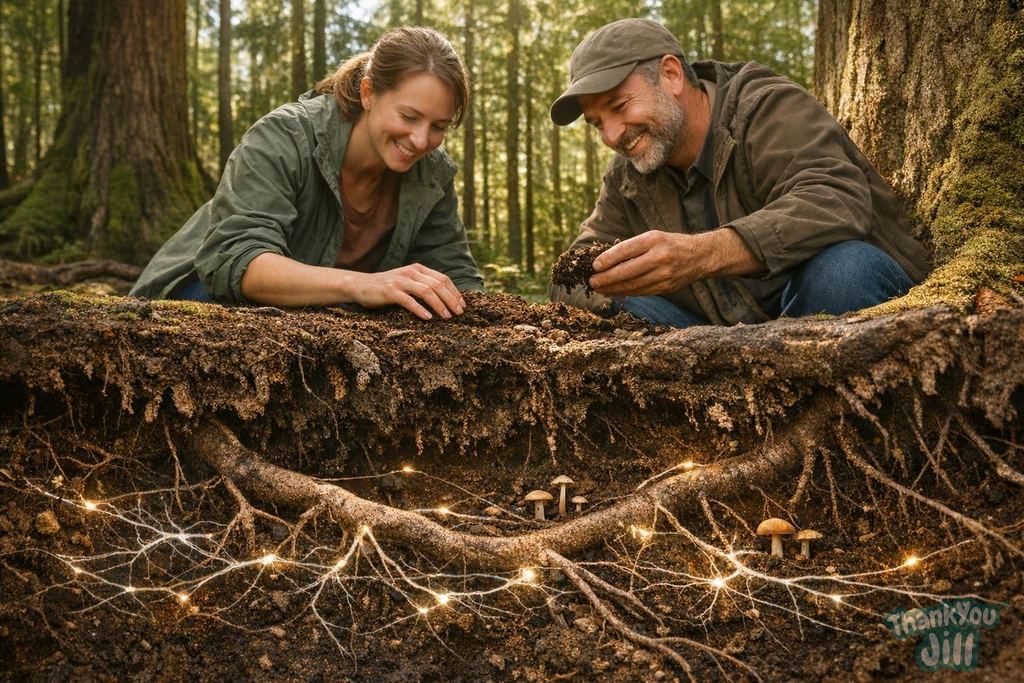
The term "Wood Wide Web" was coined in a 1997 Nature article by Suzanne Simard to describe the network of mycorrhizal connections that runs through forest soil, linking the roots of different trees via fungal filaments (hyphae). The idea that trees communicate and support one another through this network went viral—thanks to Simard's 2021 book "Finding the Mother Tree" and Richard Powers' Pulitzer Prize-winning 2019 novel "The Overstory"—and fundamentally shifted public perception of forests. The scientific reality, however, is more nuanced and far more fascinating than the popular version.
What Are Mycorrhizal Networks: The Basic Biology
Mycorrhizae (from the Greek mykes: fungus, rhiza: root) are symbiotic associations between fungi and plant roots. In a mycorrhizal symbiosis, the fungus colonizes the plant's roots (in different ways depending on the mycorrhizal type) and its hyphae extend into the surrounding soil for hundreds of meters—far beyond what the plant's roots alone could reach. The result: the fungus dramatically expands the plant's absorption surface (hyphae measure 2–20 micrometers in diameter: far thinner than roots, they access soil micropores unreachable by roots) and transfers water, phosphorus, nitrogen, zinc, and other micronutrients to the plant. In return, the plant transfers sugars produced by photosynthesis (carbohydrates: up to 30% of a forest plant's net photosynthetic output) to the fungus. The Common Mycorrhizal Network (CMN): the hyphae of a single mycorrhizal fungus can connect with the roots of many different plants simultaneously, creating a common network (CMN) that links different trees. Within this network, carbohydrates from one plant can theoretically flow to another plant through shared fungal filaments.
Resource Transfer in the Network: What's Proven
Simard's foundational experiment (1997, Nature): Simard used carbon (C13 and C14) and nitrogen isotopes to trace the movement of these molecules between Douglas firs and birches in a Canadian forest. She found that marked carbon moved from fir to birch and vice versa through the mycorrhizal network. In summer (when the birch photosynthesizes more than the shaded fir), carbon flowed from the shaded fir to the sun-exposed birch. In winter (when the birch loses its leaves and photosynthesis stops), the flow reversed. These results suggested bidirectional carbon transfer between species, mediated by the fungal network. Criticism and literature review: a critical review by Karst et al. (Nature Ecology & Evolution, 2023) analyzed 26 years of CMN literature and identified significant methodological weaknesses in many studies: most field experiments used techniques that couldn't distinguish transfer through the CMN from transfer through other mechanisms (nutrient release into soil, uptake from shared resources). The most rigorous studies (with proper controls) show carbon transfer between plants, but at levels far lower than popular narratives suggest, and not always in adaptive directions (from richer to poorer trees). Current consensus: nutrient transfer through the CMN is real but likely far less quantitatively significant and less "intentional" than the Wood Wide Web narrative implies. The CMN is primarily a fungus-plant mutualistic system, not a solidarity system among trees.
Mother Trees and the CMN: A Controversial Concept
Suzanne Simard proposed the concept of "hub trees" or "mother trees": large, old trees that form the central connection point of the mycorrhizal network, with far more connections than young trees, and that would transfer carbon and defense signals to surrounding young trees (particularly their own offspring). The narrative appeal: the idea of "mother trees" nurturing "offspring" became one of the most popular concepts in forest science communication. It appears in novels, documentaries, and TED talks. Scientific criticism: a review by Karst et al. (2023) highlighted that many experiments supporting "mother trees" have methodological problems or unreplicated results. It hasn't been demonstrated that hub trees play a "maternal" role toward their genetic offspring. The concept of "hub tree" (the most connected tree in the network) is biologically plausible, but the narrative of parental nourishment lacks solid evidence. Simard's response: Simard has defended her methodologies and emphasized that science in this field is evolving. The debate is open and productive: it's pushing the scientific community to develop more rigorous methods for studying the CMN.

The Wood Wide Web is real: mycorrhizal networks truly connect the roots of different trees and nutrients do move through these networks. But the forest isn't a cooperative system guided by tree intentions—it's the result of millions of fungal symbioses following chemical gradients. Less romantic than the popular version, but no less extraordinary. Biological reality doesn't need exaggeration to be wonderful.
Mycorrhizal Networks and Forest Management: Practical Implications
Regardless of controversies about "intentional" communication, mycorrhizal networks have very concrete practical implications for forest management and reforestation. Harvesting mother trees and the CMN: removing large trees (especially those most connected in the network) can fragment the CMN, reducing the mycorrhizal colonization capacity of young seedlings nearby. Some selective logging practices account for this by maintaining older trees as "nuclei" of the CMN to facilitate regeneration. Reforestation with mycorrhizal inoculum: seedlings for reforestation grow much better when their roots are inoculated with appropriate mycorrhizal fungi before transplanting. In degraded areas (where the CMN has been destroyed by agriculture or erosion), inoculation is often necessary for reforestation success. Fungal species and specificity: not all mycorrhizal fungi associate with all plants. Arbuscular mycorrhizae (AMF) associate with most herbaceous plants and many trees (80% of terrestrial plants). Ectomycorrhizae (ECM) associate primarily with conifers and some broadleaf trees (oaks, birches, beeches). In reforestation with forest species, using the appropriate fungal species is critical. Mixed forests vs. monocultures: mixed forests (with multiple tree species) tend to have more diverse and resilient CMNs compared to monocultures. The functional diversity of the mycorrhizal network correlates with the resilience of the forest ecosystem.
How to Study the CMN: Research Techniques
Studying the CMN is technically challenging because fungal hyphae are microscopic and soil is opaque. Techniques used in CMN research: stable and radioactive isotopes (C13, C14, N15, P32): the most widely used technique. An isotope is injected into one plant and its transfer to other plants is measured over time. Limitation: it doesn't distinguish transfer through the CMN from transfer through soil (decomposition and soil release). Mesh barrier experiments (mesh partitions): cages with mesh screens of different porosities separate plant roots: the finest mesh allows fungal hyphae to pass but not roots (allowing study of the CMN separately from direct root competition). Soil DNA sequencing (metabarcoding): DNA analysis of soil fungal communities to map the diversity and composition of the CMN. It reveals which fungal species connect which plants. Fluorescence microscopy with tracers: live imaging of fluorescent hyphae in roots. Very powerful but limited to controlled in vivo systems. Network modeling (network analysis): mathematical analysis of mycorrhizal network topology to identify hubs, connection nodes, and network robustness. Uses data from soil DNA sequencing.
The CMN in Italian Forests: Research and Conservation
Italian forests host extraordinary diversity of mycorrhizal fungi. Italian research on the CMN: the CNR (National Research Council) and universities in Turin, Florence, and Milan have research programs on mycorrhizal networks in Alpine and Apennine forests. The LIFE RESILFOR project (European Union) studies reforestation of fire-degraded areas in central Italy using mycorrhizal inoculation techniques. Edible fungi and the CMN: many of Italy's most prized edible fungi (porcini Boletus edulis, white truffle Tuber magnatum, chanterelle Cantharellus cibarius) are ectomycorrhizal fungi: they grow only in symbiosis with specific forest trees (pine, oak, hazel for white truffle). Sustainable truffle harvesting depends on maintaining a healthy mycorrhizal network and associated host plants. Deforestation and the CMN: loss of Italian forests through agricultural abandonment and fires (increasing due to climate change) destroys the CMN that developed over decades or centuries. Reforestation succeeds much more rapidly when fragments of existing forest (with intact CMN) adjacent to reforestation areas are preserved.
Frequently Asked Questions
What is the role of mycorrhizal networks in nutrient transfer between different trees?
Mycorrhizal networks connect the roots of different trees via fungal hyphae, allowing the transfer of water, nutrients, and sugars. This exchange is real but occurs at lower levels and is less "intentional" than often popularized.
How does harvesting mother trees affect the mycorrhizal network and forest regeneration?
Removing large trees that are highly connected in the mycorrhizal network can fragment the CMN, reducing the mycorrhizal colonization capacity of young seedlings and hindering natural forest regeneration.
When is it worthwhile to inoculate seedlings with mycorrhizal fungi during reforestation?
Mycorrhizal inoculation is especially recommended in degraded areas where the CMN has been destroyed, as it promotes seedling growth by increasing nutrient and water uptake, improving reforestation success.
What scientific techniques allow study of nutrient transfer through the Common Mycorrhizal Network?
The main techniques include using stable and radioactive isotopes to trace nutrients, mesh barrier experiments to isolate the CMN, soil DNA sequencing to map fungi, and fluorescence microscopy to visualize fungal hyphae.

Latest News




Comments
No comments yet. Be the first!
Leave a comment