


 Italiano
 Français
 Deutsch
 Español
 Português
 Svenska
 Suomi
Suomi
Mother Trees
How They Protect Their Offspring
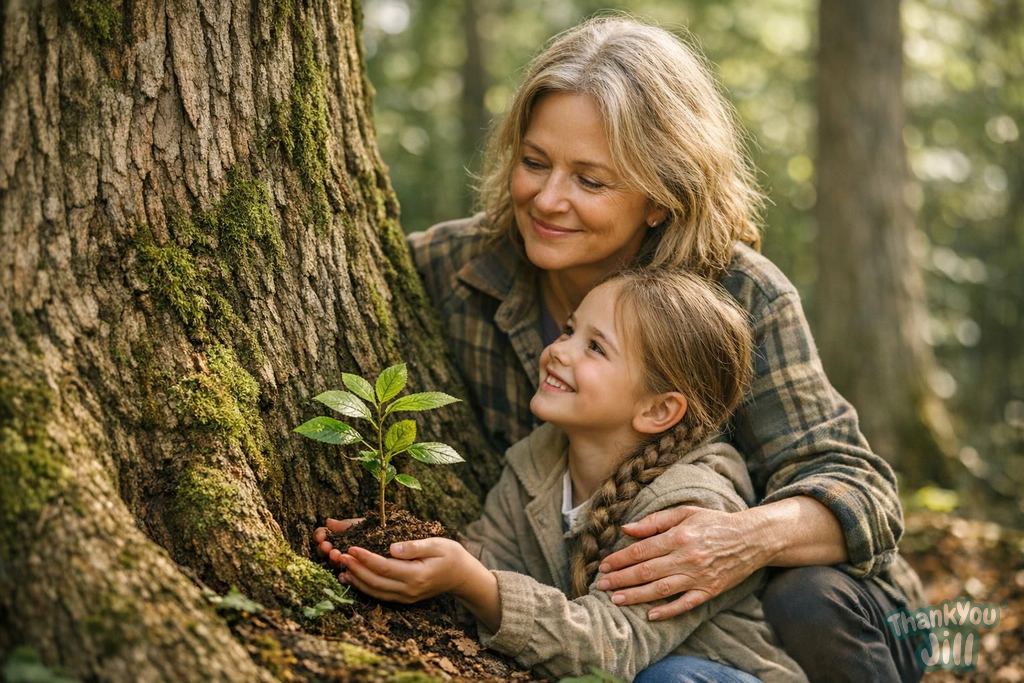
The concept of "mother tree" was popularized by Suzanne Simard in her book "Finding the Mother Tree" (2021) and in her TED Talks. The basic idea is that the oldest and largest trees in a forest (the "hubs" of the mycorrhizal network, with the most connections) play a "guardian" role toward younger trees, transferring carbon, nutrients, and chemical signals through the shared network. Simard claims to have found evidence that mother trees preferentially transfer carbon to seedlings of the same species, and particularly to their genetic descendants (their "offspring"). These claims have generated enormous public interest and vigorous scientific debate.
Scientific Evidence Supporting Mother Trees
Simard's original experiments (1997-2012): Simard conducted a series of experiments in Canadian Douglas-fir forests, using carbon isotopes to trace carbon flow between adult (mother) trees and seedlings through the mycorrhizal network. The results showed: net carbon transfer from adult trees to seedlings in shaded conditions, greater transfer to seedlings of the same species, transfer influenced by light availability (shaded seedlings received more carbon), removal of adult trees reduced seedling survival. The "parent and offspring" experiment (Simard 2015): Simard demonstrated that seedlings growing near their own "parents" (same maternal tree) survived better and grew faster than seedlings of the same species but genetically unrelated, when growing under the same parent forest. She interpreted this as evidence that mother trees recognize their descendants and preferentially transfer resources to them. The hypothesized mechanism: recognition could occur through chemical signals in the mycorrhizal network or through root secretions (exudates) that vary in species-specific and potentially genotype-specific ways.
Scientific Criticisms of the Mother Tree Concept
The critical review by Karst, Jones, and Lutz (Nature Ecology & Evolution, 2023): this systematic review of 26 years of CMN literature raised serious methodological questions: many experiments used to support "mother trees" lack adequate controls that rule out alternative explanations (e.g., carbon could move from soil, not through the fungus; proximity to parents might benefit seedlings for reasons unrelated to the mycorrhizal network). The amount of carbon transferred is generally very small compared to seedling needs (it's unclear whether the transfer is quantitatively significant for survival). The direction of transfer is not always adaptive (from richer to poorer tree): in some studies carbon moves in both directions without consistent patterns. The concept of "offspring recognition" lacks clear mechanistic foundations: it's unexplained how roots (or fungi) distinguish "offspring" from unrelated individuals of the same species. Simard's response to criticism: Simard has defended her data and interpretation, emphasizing that CMN research is complex and methodologies are continuously improving. She has also stressed that the public narrative of "mother trees" may be necessary to motivate forest conservation, even if rigorous scientific evidence is still developing.
What We Can Reasonably Assert
Separating solid evidence from fascinating but unproven hypotheses: Demonstrated with robust evidence: the CMN (Common Mycorrhizal Network) exists and connects tree roots of different species through fungal hyphae. Carbon transfer between plants through the CMN is measurable with isotopic tracers. Larger and older trees (with more roots and more connections) tend to be more connected in the network. Removal of adult trees influences seedling survival in some conditions. Supported but with incomplete evidence: the amount of carbon transferred is ecologically significant for seedling survival. Carbon flow is preferentially directed from the "richer" (adult) to the "poorer" (shaded seedling) tree in an adaptive manner. Not yet demonstrated with robust evidence: "offspring recognition" (that mother trees prefer to transfer resources to their genetic offspring). The "conscious" or adaptive role of the mother tree as a "guardian" of the young. Refuted or greatly downplayed compared to popular narrative: the idea of a solidary forest where trees intentionally cooperate for the common good. The volume and ecological significance of carbon transfer between adult trees of the same species.

The forest is neither a war between individuals nor a human-like family unit: it's an ecosystem where cooperation and competition coexist in dynamic balance. Old and large trees are important to the ecosystem, not because they choose to nourish the young, but because they are nodes in the mycorrhizal network and sources of seeds, soil carbon, and habitat. They're worth protecting for these concrete reasons, without needing to anthropomorphize them.
Forest Management and Protection of Mother Trees
Regardless of the scientific debate over "parental recognition," there is consensus that large adult trees have high ecosystem value that should be preserved. Why protect large adult trees: biodiversity: old trees host far greater invertebrate, bird, lichen, moss, and fungal diversity than young trees. Cavities in old trees provide irreplaceable short-term habitat. Biomass and carbon: large adult trees contain most of the biomass and sequestered carbon in a forest. A single century-old beech can contain more carbon than hundreds of seedlings. Mycorrhizal connectivity: larger trees have roots occupying enormous soil volumes and are likely central nodes of the CMN (hub trees), regardless of "parental recognition." Seeds: adult trees are the primary seed sources for natural forest regeneration. Protection of adult trees in selective cutting: many sustainable forest management guidelines recommend maintaining a minimum number of large adult trees per hectare (seed trees, shelter trees, habitat trees) even in regeneration harvests. The Martelloscopio: a European forest training approach that teaches loggers to identify and protect trees with the greatest ecosystem value (including old trees and large habitat trees) during cutting operations.
Scientific Debate as an Example of Science in Progress
The case of "mother trees" is an excellent example of how science works when it's healthy: pioneering research (Simard 1997) proposing a new and fascinating idea, enthusiastic outreach that creates public interest but sometimes oversimplifies evidence, subsequent research testing claims with more rigorous methodologies (Karst 2023), open debate where both sides present their evidence, revision and refinement of hypotheses (not abandonment of the idea, but increasing precision about what is and isn't proven), improvement of methodologies (new techniques to trace VOCs and nutrients with greater precision). The value of debate: the mother tree debate has driven the scientific community to invest much more in CMN research, developing more rigorous methodologies and better technical tools. Even though some of Simard's original claims are being scaled back, the research has produced genuine discoveries about the mycorrhizal network that wouldn't have been made without the narrative push of the Wood Wide Web. Responsible science communication: the case also illustrates the risk of communicating preliminary scientific results with excessive anthropomorphic enthusiasm. The narrative of solidary forests has value for conservation, but risks creating expectations that subsequent science then contradicts, eroding trust in the scientific method.
How to Experience the Forest with Fresh Eyes: Experiences in Italy
Understanding the CMN and mother trees can transform a forest walk into a completely different experience. Where to have meaningful forest experiences in Italy: Casentino Forests National Park (Tuscany-Emilia-Romagna): one of Europe's best-preserved temperate forests. Hundred-year-old beeches, silver firs, and chestnuts with ancient mycorrhizal networks. Guided trails with naturalist guides. Vallombrosa Forest (Florence): Europe's oldest planned forest (dating to the 12th century). Fir plantations with complex vertical structure and abundant ectomycorrhizal fungi. Gran Sasso and Monti della Laga National Park (Abruzzo): monumental beech forests with century-old trees. Ficuzza Forest (Sicily): one of the Mediterranean's most extensive oak forests. In summer, abundant fruiting of edible ectomycorrhizal fungi. Guided mycological excursions: many Italian Mycological Associations (AMINT: Italian Naturalistic Telematic Mycological Association) organize guided forest excursions with experts explaining relationships between fungi and trees. An excellent way to directly observe the CMN in action (though not with your eyes: through the visible fruiting bodies of ectomycorrhizal fungi).
Frequently Asked Questions
What scientific evidence supports carbon transfer from mother trees to seedlings?
Suzanne Simard's experiments demonstrated that carbon can transfer from adult trees to seedlings through the mycorrhizal network, especially in shaded conditions and preferentially toward seedlings of the same species, affecting their survival and growth.
How does removal of mother trees affect seedling survival?
Removal of the largest adult trees reduces seedling survival in some conditions, since these trees act as central nodes in the mycorrhizal network, providing carbon, nutrients, and essential habitat for forest regeneration.
Is it scientifically confirmed that mother trees recognize and favor their genetic offspring?
There is no robust evidence that mother trees recognize their genetic offspring or preferentially transfer resources to them; this aspect remains an unproven hypothesis using rigorous methods.
Why is it important to protect large adult trees in forests, regardless of the mother tree debate?
Large adult trees are fundamental for biodiversity, carbon sequestration, mycorrhizal connectivity, and seed production—key elements for forest ecosystem health and regeneration, making their protection crucial.

Latest News




Comments
No comments yet. Be the first!
Leave a comment