


 Italiano
 Français
 Deutsch
 Español
 Português
 Svenska
 Suomi
Suomi
Plant Vision
Phototropism and Phytochromes
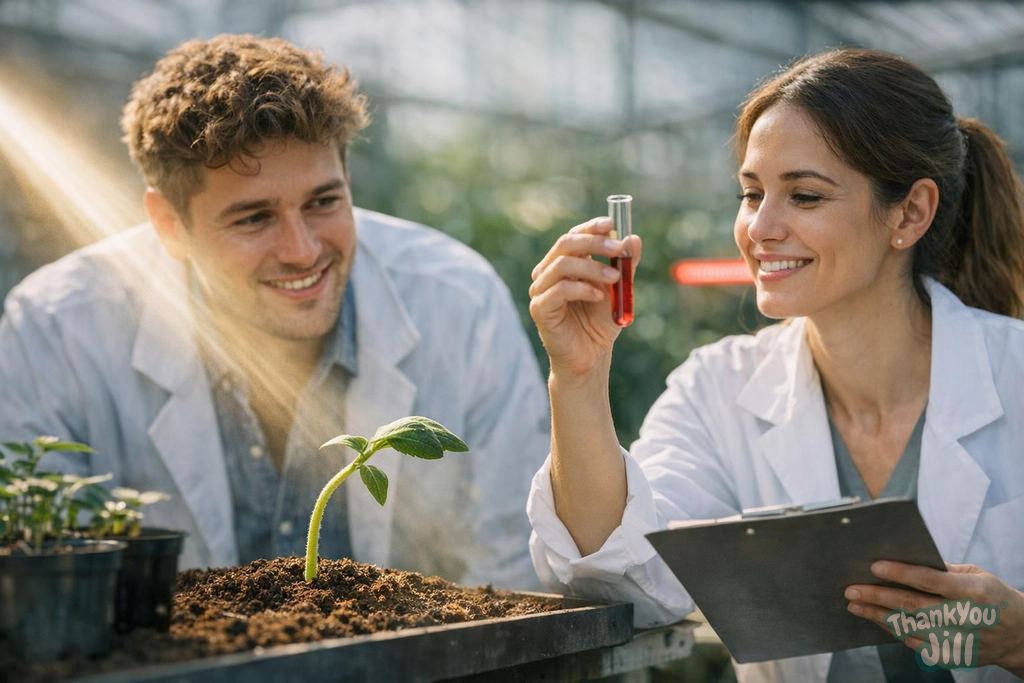
Light perception is the most critical sense for plants: as photosynthetic autotrophs, their survival depends on the ability to optimize sunlight capture. Over the course of evolution, plants have developed at least four completely different light-detection systems—each with distinct molecular mechanisms and each specialized to detect different light characteristics (quality, quantity, direction, duration). Together, these systems give plants an extraordinarily information-rich "vision" of light.
Phytochromes: Seeing Red and Far-Red
Phytochromes are light-receptor proteins that primarily absorb red light (660 nm: R) and far-red light (730 nm: FR). They exist in two interconvertible forms: Pr (absorbs red, converts to Pfr) and Pfr (absorbs far-red, converts to Pr or degrades). Direct sunlight has a high R:FR ratio → converts phytochromes mainly to Pfr → the plant "knows" it's in full light. Light filtered through the green canopy of trees has a low R:FR ratio (chlorophyll absorbs red but not far-red) → converts phytochromes to Pr → the plant "knows" it's in competitive shade → activates shade avoidance response (accelerated longitudinal growth). At night, phytochromes slowly return to the Pr form → the plant measures night length (photoperiodism): a short night (summer) keeps phytochromes in Pfr longer; a long night (winter) leaves them in Pr longer. Phytochromes in Arabidopsis: the PHY gene family (PhyA, PhyB, PhyC, PhyD, PhyE). PhyB is most important for daily light perception and shade avoidance. PhyA is important for far-red light response at low fluence (seedling in darkness) and fine-tuning of photoperiodism. Localization: at night and in darkness, phytochromes are in the cytoplasm. In light (in Pfr form), they enter the cell nucleus where they interact with transcription factors (PIF: Phytochrome-Interacting Factors) to regulate the expression of hundreds of genes.
Cryptochromes: Seeing Blue and Measuring Time
Cryptochromes (CRY1, CRY2 in Arabidopsis) are proteins that absorb blue light (400-490 nm) and UV-A (315-400 nm). They have two main functions: circadian rhythm regulation (they are key components of the plant's biological clock: already discussed in the article on circadian rhythms) and photoperiodic response: CRY2 is particularly involved in photoperiod detection for flowering in long-day plants. The phytochrome-cryptochrome interaction: the photoperiodic response in plants is mediated by the coordinated interaction of phytochromes (which measure the R:FR ratio and night length) and cryptochromes (which detect blue light and regulate the circadian clock). Together, these systems enable precise measurement of both light quality and duration.
Phototropins: Seeing the Direction of Light
Phototropins (phot1, phot2 in Arabidopsis) are proteins that absorb blue light and are the primary mediators of phototropism (directional growth toward light) and stomatal opening in response to light. Phototropism: when light hits one side of the coleoptile (the apical structure of cereal seedlings) more than the other, phototropins activate a redistribution of auxin toward the shaded side → the shaded side grows faster → the seedling bends toward the light. Discovered by Charles Darwin (with his son Francis) in 1880 through experiments on the coleoptile tip: one of the first systematic plant physiology experiments. The molecular mechanism was understood much later (Koch et al., 2000). Stomatal opening: phot1 and phot2 detect blue light and activate proton pumps (H+-ATPase) in guard cells of stomata → pump H+ out of the cell → K+ enters → increase in osmotic pressure → swelling of guard cells → stomatal opening. The exact mechanism by which the guard cell "knows" which direction the light comes from (to open the stoma toward the light) is not completely understood. Chloroplast movement: phot2 regulates chloroplast movement in leaf cells: at low light intensity, chloroplasts arrange perpendicular to the light (to maximize photosynthesis); at high light intensity, they arrange parallel (to avoid damage from excess light).

The sunflower that turns toward the sun (diurnal heliotropism, then fixed toward the East in mature sunflowers) follows the light with its phytochromes and phototropins. It doesn't see the sun the way we do, but it receives the same fundamental information that light gives us: where are you, how intense are you, how long have you been shining. With this information, it regulates every aspect of its growth. It's a different kind of vision—distributed, molecular. No less elegant for that.
UVR8: The UV-B Receptor and Photoprotection
UVR8 is the UV-B light receptor (280-315 nm) in plants, discovered relatively recently (Rizzini et al., 2011, Science). Unlike phytochromes, cryptochromes, and phototropins (which are dimers or protein complexes with organic chromophores), UVR8 is a dimer of proteins that uses tryptophan residues intrinsic to the protein as chromophores (UV-B light dimerizes/monerizes the protein without needing a separate chromophore). Function: UVR8 in monomer form (activated by UV-B light) enters the nucleus and activates transcription of UV-B response genes: synthesis of flavonoids (especially anthocyanins: red-purple pigments that absorb UV-B and protect DNA), cuticle thickening, production of DNA repair enzymes (photolyase, which repair thymine dimers produced by UV-B). Agricultural relevance: plants grown in greenhouses or vertical farms with only LED light (which often doesn't include UV-B) have inactive UVR8 and produce fewer antioxidants (anthocyanins, flavonoids) compared to plants in full sunlight. Adding a small UV-B component to LED light in vertical farms increases the antioxidant content of the produce. A practical application of the biophysics of plant light receptors to food nutritional quality.
Phototropism: Applications in Agriculture and Architecture
Understanding phototropism has applications in several areas. Crop orientation: in greenhouses, arranging plants to optimize phototropism (stems growing toward the optimal light source) is important for product quality and uniform light distribution. Some vertical farming systems use light sources that move slowly to stimulate controlled phototropism that orients growth optimally. The sunflower and heliotropism: the young sunflower (pre-flowering) performs true diurnal heliotropism (follows the sun from East to West during the day, then returns to East at night). The mechanism: asymmetric stem growth controlled by phytochromes and auxins. Mature sunflowers (post-flowering) stop moving and remain oriented toward the East (due to stem lignification). Fun fact: sunflowers oriented toward the East in the morning receive more pollinating insects (which prefer warmer surfaces: the sunflower facing the morning sun is warmer). Sunflowers oriented toward the West receive fewer pollinators and produce fewer seeds. Natural selection for fixed East-facing orientation in cultivated sunflowers (Atamian et al., Science 2016). Bio-inspired architecture: building facades that orient toward the sun (heliotropic buildings) are inspired by plant phototropism. The Bosco Verticale Tower in Milan has terraces with trees and plants specifically oriented to optimize shade in summer and light in winter.
Frequently Asked Questions
What is the role of phytochromes in light perception by plants?
Phytochromes are proteins that detect red and far-red light, allowing plants to distinguish between direct light and shade, regulate growth, and measure night length for photoperiodism.
How do phototropins work in plant phototropism?
Phototropins absorb blue light and activate the redistribution of auxin toward the shaded side, causing asymmetric growth that bends the seedling toward the light, thus optimizing photosynthesis.
Why is it important to include UV-B light in greenhouse or vertical farm cultivation?
UV-B light activates the UVR8 receptor, which stimulates the production of antioxidants such as flavonoids and anthocyanins, improving photoprotection and nutritional quality of plants grown under artificial light.
How do phytochromes and cryptochromes interact in regulating photoperiodism?
Phytochromes measure the ratio between red and far-red light and night length, while cryptochromes detect blue light and regulate the circadian clock; together they coordinate the photoperiodic response for flowering and other processes.
Latest News



Comments
No comments yet. Be the first!
Leave a comment