


 Italiano
 Français
 Deutsch
 Español
 Português
 Svenska
 Suomi
Suomi
Regeneration
How Plants Recover After Fire and Damage
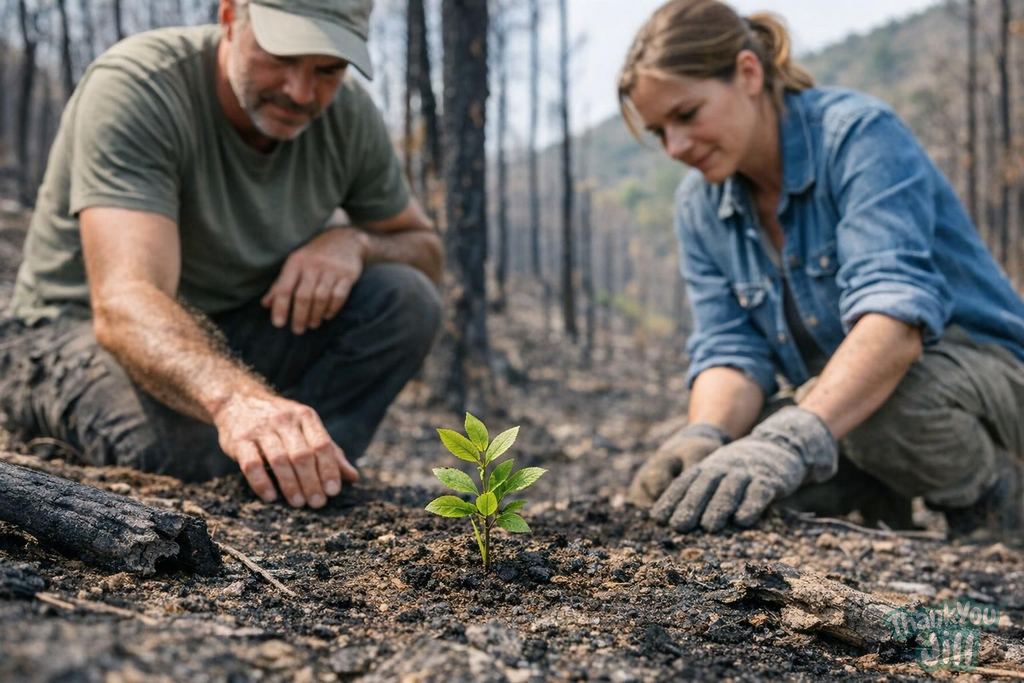
Regeneration after damage is one of the most important survival strategies in the plant world. Every year, billions of plants worldwide suffer damage from fire, hail, drought, pests, herbivores, storms, and human activity. Those that survive do so through a series of regenerative mechanisms ranging from simple regrowth of damaged tissues to complete structural rebuilding from the base. The diversity of these mechanisms reflects the variety of evolutionary pressures plants have faced.
Fire Regeneration: Pyrophytes and Serotinous Cones
Fire is one of the oldest and most frequent disturbances in terrestrial ecosystems. Many plants from Mediterranean, Australian, African, and North American regions have co-evolved with fire, developing specific adaptations. Obligate pyrophytes are plants that not only survive fire but actually require it to complete their life cycle. Banksia (Australia) produces serotinous cones—cones that open only in the heat of fire—releasing seeds immediately after the flames pass, when soil is still warm and enriched with ash (rich in phosphorus, potassium, and nitrogen). Without fire, the cones remain sealed for years. Aleppo pine (Pinus halepensis, Mediterranean region) produces similar serotinous cones, releasing seeds onto fire-cleared soil free from competing vegetation—ideal conditions for germination and growth. Erica rebrouts in Africa's South produce new growth rapidly from their lignotuber (a woody root structure packed with dormant buds) after fire. The lignotuber is a structure typical of plants in fire-prone regions (Mediterranean scrub, South African fynbos, California chaparral). It's an underground or semi-underground organ rich in dormant buds and nutrient reserves. When fire passes through (burning the above-ground parts), the lignotuber immediately produces new shoots from the base. Italian examples include strawberry tree (Arbutus unedo), holm oak (Quercus ilex), myrtle (Myrtus communis), rockrose (Cistus spp.), and mastic tree (Pistacia lentiscus). Mediterranean scrub resilience: Italy's Mediterranean scrub is an ecosystem adapted to fire—most shrub species regrow within 2–5 years after a fire from their lignotuber or seeds. The ecological challenge in Italy is excessive fire frequency (often arson), which doesn't allow enough time for complete recovery before the next fire, leading to progressive ecosystem degradation.
Vegetative Regeneration: Regrowing from Fragments
Many plants can regrow from tiny fragments of themselves: root pieces, leaf fragments, stem sections, or rhizomes. This vegetative regeneration capacity is one of the most direct forms of damage survival. Root regeneration: many plants produce adventitious shoots directly from roots when the stem is destroyed or cut (sycamore, black locust, pussy willow, poplar, wild cherry). This is why many invasive plants (bindweed, horsetail, dock) are so difficult to eliminate—every root fragment left in the soil regrows rapidly. Rhizome regeneration: plants with rhizomes (bamboo, common reed, mint, iris, nettle) regenerate quickly from rhizome fragments. Bamboo can regrow from its root system after complete above-ground removal. Coppicing (sprouting) is the ability to produce numerous shoots from a cut stump. Traditionally exploited in forestry, coppice management (cutting a stem on short rotation and allowing the stump to regrow) harnesses the sprouting regeneration of oak, beech, chestnut, hornbeam, hazel, and linden. Chestnut coppice is the most common forest management form in the Italian Apennines—the chestnut regrows from the stump producing 5–10 new shoots, one or two of which are maintained for the next cycle. Clonal trees like the Pando aspen colony in North America continuously regenerate new stems from a shared root system. When one stem ages and dies, a new stem emerges from the nearby root system. The Pando colony has maintained this cycle of death and regeneration for 80,000 years.
Drought Recovery: Hydraulic Resilience
Extreme drought kills leaf and branch tissues but often leaves roots and the vascular cambium at the stem base intact. Regeneration after severe drought exploits these surviving structures. Dieback and recovery: many plants from arid and semi-arid environments (including Mediterranean scrub) show a "dieback and recovery" pattern—peripheral branches die during summer drought (reducing transpiration and water stress), but the central stem and basal buds survive and regenerate new branches with autumn rains. A sacrifice of peripheral branches to save the central structure. Fruit tree recovery after drought: olives (Olea europaea) show exceptional drought resilience, surviving 2–3 years of drought by drastically reducing foliage and growth. With restored irrigation or rainfall, they resume growth from still-living tissues. This resilience has allowed the monumental olive trees of Puglia and Greece to survive for millennia in climates with severe summer droughts. Compensatory growth: after water conditions improve, many plants show "compensatory growth"—faster-than-normal growth that makes up for losses during drought. This active recovery mechanism is documented in cereals, grapevines, fruit trees, and forest trees.

The forest burned in August turns green again by March. Not identical to before—different, younger, richer in pioneer species. But it returns. Mediterranean scrub doesn't fear fire; it has incorporated fire into its life cycle for millions of years. The problem isn't fire itself—it's the excessive frequency of arson that doesn't give the forest time to fully regenerate before the next blaze. Regeneration takes time.
Forest regeneration after storms: the Vaia case in Italy
Storm Vaia (October 2018) was the most devastating forest storm in modern Alpine Italian history: winds with gusts up to 200 km/h knocked down approximately 14 million trees across Trentino-Alto Adige, Veneto, Friuli-Venezia Giulia, and Lombardia, affecting an area of over 50,000 hectares. The extent of damage: estimated at 3 million tons of felled timber—roughly 10 times the normal annual forest harvest of the Triveneto region. Norway spruce forests (Picea abies) were hit hardest: their single-layered structure with shallow root systems makes them vulnerable to wind. How regeneration progresses: in the immediate phase (0-2 years), downed timber becomes habitat for thousands of saproxylic insect species, decomposer fungi, woodpecker birds, and small mammals. A 'windthrow gap' (void created by the storm) temporarily becomes a biodiversity hotspot. During the recolonization phase (2-10 years): pioneer shrub species (raspberry, bramble, elderberry) colonize open areas. Natural regeneration (from seed) of Norway spruce, larch, beech, and birch in the gaps. In the forest reconstruction phase (10-50 years): natural selection among pioneer plants. Vertical structure slowly re-stratifies. Areas left to natural regeneration are recovering faster than areas artificially planted with Norway spruce monocultures. The lesson from Vaia: mixed forests (with multiple species) and structurally complex forests (with trees of different ages and diameters) are more resistant to storms than uniform monocultures. The storm sparked a major rethinking of Alpine forest management toward more ecological and less production-focused approaches.
Forest restoration techniques after disasters: what works
Research and practice over recent decades have produced guiding principles for post-disaster forest restoration (after fire, storm, or clear-cutting). Assisted natural regeneration vs. artificial reforestation: allowing the forest to regenerate naturally (with possible removal of excess wood material to reduce subsequent fire risk and allow light to reach the soil) generally produces more resilient and diverse forests than artificial monoculture plantations. Artificial reforestation with local species and local provenance is preferable to using exotic species or out-of-region material. The role of standing dead wood (dead standing wood): dead standing trees (snags: tall stems without foliage) are critical habitat for saproxylic species (woodpeckers, nocturnal raptors nesting in cavities, wood-boring insects) and should not be systematically removed after disturbances. Maintain at least 5-10 snags per hectare at post-fire or post-storm sites. Provenance of reforestation material: plant material used for reforestation must come from local populations adapted to local climate and soils. Use seedlings of "certified local provenance" (DM November 20, 2019 in Italy: regulates the production and marketing of forest propagation material). The secondary pest problem: forests with abundant dead wood (after storms or fire) are subject to outbreaks of wood-boring insects (especially the bark beetle Ips typographus in Norway spruce forests). Managing these pests requires a compromise between conserving dead wood (for saproxylic biodiversity) and reducing the risk of insect spread.
Frequently asked questions
What are the main strategies of fire-adapted plants to regenerate after a fire?
Fire-adapted plants regenerate through serotinous cones that release seeds only after fire heat, or through lignotubers—underground structures rich in dormant buds that produce new shoots after fire.
How does vegetative regeneration work in plants after damage like cutting or fire?
Vegetative regeneration occurs through adventitious shoots from roots, rhizomes, or cut stumps, allowing plants to regrow rapidly even from small fragments, as seen in many invasive species or coppiced trees.
Why can excessive fire frequency compromise regeneration in Mediterranean ecosystems?
Excessive fire frequency doesn't allow plants enough time to complete regeneration, causing progressive ecosystem degradation because species cannot fully restore vegetation before the next fire occurs.
What are the advantages of assisted natural regeneration compared to artificial reforestation after forest disasters?
Assisted natural regeneration promotes more resilient and diverse forests, while artificial reforestation often creates less resistant monocultures. Additionally, using local species for reforestation improves adaptation to local climate and soil conditions.


Latest News




Comments
No comments yet. Be the first!
Leave a comment