

 English
 Italiano
 Français
 Deutsch
 Español
 Português
 Svenska
 Suomi
Suomi
The Forest as a Superorganism
Networks of Life That Self-Regulate
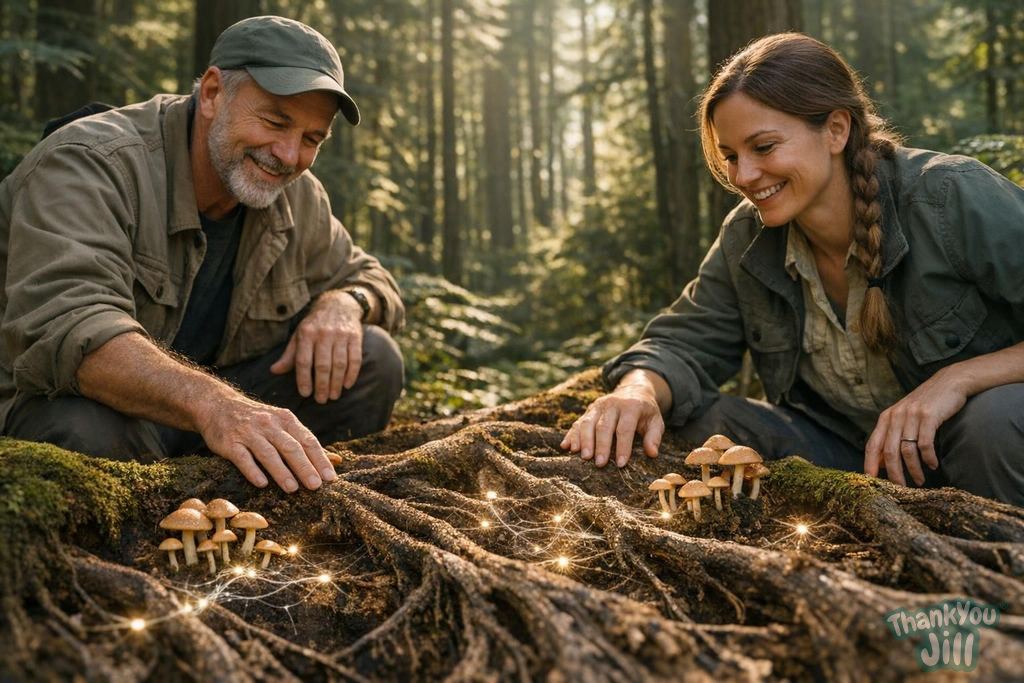
The concept of a "superorganism" applied to the forest is provocative and controversial, yet it captures something biologically real: a mature forest possesses properties that no single tree has—properties that emerge from the network of interactions between trees, fungi, bacteria, animals, water, and soil. The forest regulates temperature, creates its own microclimate, produces its own rain, manages nutrient cycles, and resists disturbances far better than any isolated individual. This emergence of system-level properties lies at the heart of understanding the forest as a superorganism.
The Forest's Emergent Properties: What a Single Tree Cannot Do
Temperature regulation: a single tree does not regulate climate. A mature forest lowers air temperature by 2–8°C compared to surrounding open areas. The mechanism: leaf transpiration (evapotranspiration) cools the air by consuming latent heat for water evaporation. A mature temperate forest transpires 3–5 mm of water daily—an enormous energy expenditure with a cooling effect on the microclimate. The "natural air conditioning" effect of a forest is measurable and significant. Rainfall production: tropical forests generate part of their own precipitation through the transpiration-condensation cycle. Water vapor transpired from leaves cools as it rises, condenses, and falls as rain. It's estimated that 50–75% of precipitation in the Amazon rainforest originates from biotic sources (produced by the forest itself). Deforestation disrupts this cycle, causing drought. Closed nutrient cycling: in a mature forest, nearly all nutrients (nitrogen, phosphorus, potassium) are recycled within the system. Litter decomposition releases nutrients that are immediately absorbed by roots or mycorrhizae. Nutrient loss through leaching (washed deep into the soil by rainwater) is minimal—far less than in agricultural fields. The forest "manages" its nutrients as a highly efficient closed system. Fire, drought, and pest resilience: a mixed forest with structural complexity (many species of different ages) is more resistant to disturbances than a monoculture. Species diversity ensures that at least some survive any single disturbance agent. Structural diversity (tall trees, mid-story trees, shrubs, herbaceous plants) creates varied microhabitats that increase overall resilience.
The Forest Food Web: Who Eats What in a Forest
A mature European forest hosts a food web of extraordinary complexity. Primary producers (plants): trees, shrubs, herbaceous understory plants, mosses, and lichens capture solar energy through photosynthesis. They form the energy base for the entire ecosystem. Decomposers (fungi and bacteria): break down dead organic matter (leaves, branches, carcasses), releasing nutrients and closing the cycle. In a European forest, litter decomposition is managed by an enormous community of basidiomycete fungi, ascomycete fungi, bacteria, and microarthropods (mites, springtails, millipedes). Primary consumers (herbivores): phytophagous insects (the most diverse group: thousands of species per forest), hares, deer, roe deer, wild boar, rodents. Secondary consumers (predators): insectivores (birds, bats, toads, hedgehogs, shrews), small mammal predators (foxes, weasels, martens, raptors), medium herbivore predators (wolves, lynx in Italy: only in Alpine and Apennine areas). Parasites and hyperparasites: each species has its own specific parasites; parasites of herbivores are often parasitoid insects. Top-down regulation: the presence of large predators (wolves, lynx) regulates herbivore populations (deer, roe deer), preventing overgrazing that damages forest regeneration. This concept (trophic cascade) was magnificently documented in Yellowstone National Park (USA) with the wolf's return in 1995: within a few years, reduced deer overgrazing allowed riparian vegetation to recover, which reduced stream erosion and changed river morphology. The forest behaves differently with large predators present.
Forest Soil as an Integral Part of the Superorganism
Forest soil is not merely the substrate on which trees grow: it's an ecosystem unto itself, integrated into the forest's economy. Forest soil profile: L layer (litter: fresh leaf litter on the surface—leaves, branches, fallen fruit from the past year), F layer (fermentation: partially decomposed material), H layer (humus: fully decomposed material into stable humus), A horizon (mineral soil mixed with humus: rich in microbes but with less organic matter), B and C horizons (mineral soil with decreasing biological influence). Soil biocenosis: one gram of forest soil contains 10^8–10^9 bacteria (100–1,000 million), 10^3–10^5 fungal spores, thousands of protozoans (amoebas, flagellates, ciliates that feed on bacteria), hundreds of nematodes, dozens of mites and springtails. Per hectare: the microbial biomass of forest soil equals that of 5–10 cows. Soil fauna (pedofauna): earthworms (each European forest has 50–400 earthworms per square meter: the primary soil structure builders), millipedes, centipedes, isopods (woodlice), saproxylic beetles. The role of earthworms: Darwin devoted his final book to earthworms (1881: "The Formation of Vegetable Mould through the Action of Worms"). Earthworms ingest soil, digest the organic matter, and produce casts (feces) rich in bacteria and nutrients in assimilable form. Through their tunnels, they aerate the soil and improve water permeability. One hectare of temperate forest can have 2–3 million earthworms producing up to 10 tons of casts annually.

The forest is not the sum of the trees that compose it. It is the network of relationships between trees, fungi, bacteria, animals, soil, water, and climate that produces properties no single component possesses alone: resilience, climate regulation, rainfall production, closed nutrient cycling. When we cut down a forest, we don't lose just the trees: we lose the entire system of relationships, which takes centuries to rebuild.
Forest Connectivity: Ecological Corridors and Fragmentation
Italian and European forests are heavily fragmented: reduced to small isolated patches surrounded by agricultural fields, roads, and settlements. This fragmentation reduces the functionality of the forest superorganism in profound ways. Edge effect: forest edges (areas in contact with the external environment) have different conditions from the interior (more light, more wind, higher temperature, lower humidity). The edge effect penetrates 50–200 m into the forest. In a small forest patch of 100 hectares, the entire forest could be under edge effect. Only forests larger than 1,000–10,000 hectares (depending on shape) have a true interior forest core. Interior forest species: some species (the black woodpecker, the wildcat, the badger, many orchids and ferns of the understory) require interior forest conditions and disappear from small forest patches. Their presence indicates the health of the forest superorganism. Ecological corridors: networks of wooded strips connecting isolated forest patches, allowing species movement between fragments. Essential for population genetics (reducing inbreeding), for recolonization after local extinctions, for adaptation to climate change (species can shift toward cooler elevations and latitudes through corridors). In Italy, the "National Ecological Network" project and the National Biodiversity Plan provide for the creation of ecological corridors between major protected areas. "Educational forests" and the ThankYouJill project: every tree planted in an area with low forest cover contributes, with other trees, to recreating connective tissue between existing forest fragments. It's not a single tree: it's a brick in the reconstructed superorganism.
Primary Forest vs. Managed Forest: Ecosystem Differences
A primary forest (never cut or minimally disturbed by humans) is a radically different ecosystem from a managed forest (planted, harvested, periodically rejuvenated). Characteristics of primary forest: trees of all ages and sizes (inverse "J" structure in diameter distribution: many small trees, few large ones), abundance of standing and fallen dead wood (up to 30–40% of total biomass: saproxylic biodiversity hotspots), presence of large predators (where territory permits), complex and diverse mycorrhizal coverage, deep soil rich in ancient humus, stable interior microclimate. Italy's primary forests: estimates range from 1,000 to 4,000 hectares of primary (or near-primary) forest in Italy, mainly in Calabria (ancient beech forests in Aspromonte and Sila), Friuli-Venezia Giulia (Val Rosandra, Bosco Romagno), Sardinia (holm oak forests of Supramontes). A negligible area across a territory of 30 million hectares. Managed forest: productive but less biodiverse, less resilient, with more open nutrient cycles (nutrients leave with harvested wood and must be reintroduced with fertilizers). This is not a value judgment: managed forest produces timber, biomass, mushrooms, hunting, and other important services. But it cannot replace primary forest as a biodiversity reservoir and climate regulation system. The proportion of primary forest in every European country should increase, not decrease.
Frequently Asked Questions
What properties emerge from the forest as a superorganism that a single tree does not possess?
The forest as a superorganism regulates temperature, produces rainfall, closes nutrient cycles, and demonstrates superior resilience to disturbances like fire and drought, thanks to interactions between trees, fungi, bacteria, animals, soil, and water.
How does the presence of large predators influence forest health and regeneration?
Large predators regulate herbivore populations, preventing overgrazing that damages forest regeneration. This balance, known as a trophic cascade, promotes vegetation recovery and ecosystem stability in forests.
Why does forest fragmentation reduce the functionality of the forest superorganism?
Fragmentation creates edge effects that alter microclimate and humidity, reducing the interior habitat needed by sensitive species. Additionally, it isolates forest patches, limiting species movement and genetic diversity, compromising ecosystem resilience.
What are the main differences between primary and managed forests in terms of biodiversity and nutrient cycling?
Primary forest has complex structure with trees of all ages, abundant dead wood, rich soil, and stable microclimate, ensuring high biodiversity and closed nutrient cycling. Managed forest is more productive but less resilient, with nutrient loss and lower biodiversity.

Latest News




Comments
No comments yet. Be the first!
Leave a comment