


 Italiano
 Français
 Deutsch
 Español
 Português
 Svenska
 Suomi
Suomi
Forest Stratification
The Layers of the Forest
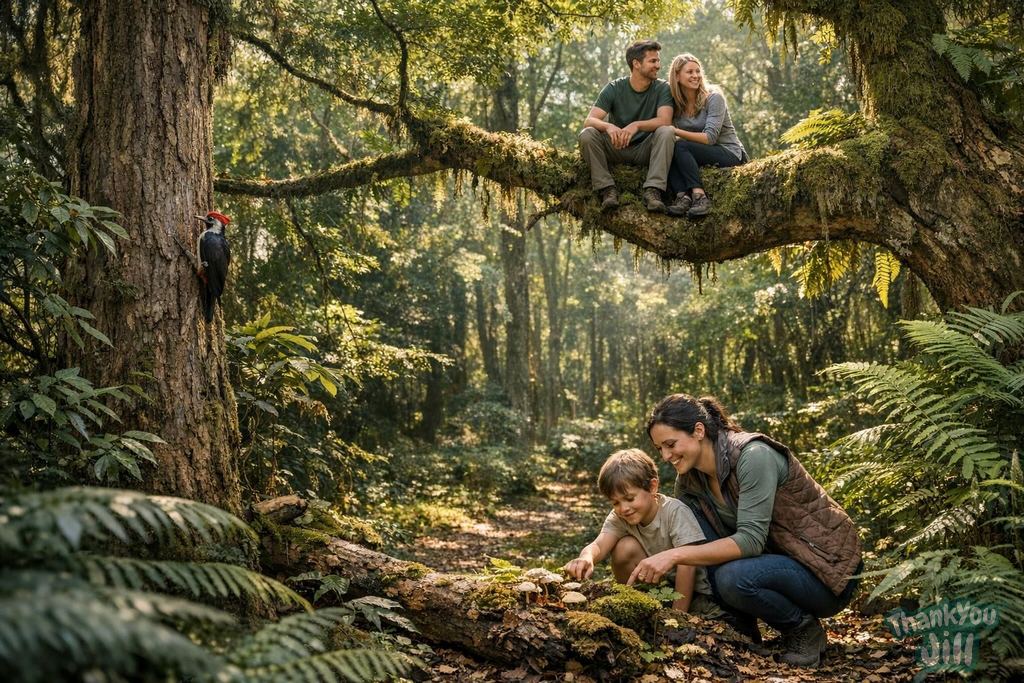
The vertical stratification of a forest is the result of millions of years of co-evolution between species that have found their own ecological niches at different heights from the canopy. Each layer has very different physical conditions from the others: light, temperature, humidity, wind, and nutrient availability vary enormously from the soil to the top of the canopy. This variation creates a series of overlapping microhabitats that support far greater biodiversity than a flat, uniform ecosystem would have.
The Layers of the European Temperate Forest
Emergent layer (height > 30-40 m in lowland forests): in tropical forests, some trees (emergents) exceed the main canopy. In European temperate forests, the highest layer consists of dominant trees: oaks, beeches, firs, and larches depending on climatic conditions. Trees that are historically centuries old. Main canopy layer (height 15-35 m): the forest's "roof." Intercepts 60-80% of available solar radiation. Produces most of the forest's total photosynthesis. Inhabited by nesting birds in high branches (woodpeckers, crows, hawks, buzzards) and arboreal mammals (dormice, squirrels). Sub-canopy layer (5-15 m): younger trees developing while waiting for a canopy opening (gap), or shade-tolerant species that never reach the main canopy (field maple, hornbeam, hazel, hawthorn). Extremely rich in birds (thrushes, blackbirds, finches, shrikes, orioles). Shrub layer (0.5-5 m): typical understory shrubs (elder, viburnum, dogwood, spindle tree, privet in lowlands; rhododendron and raspberry in mountains). Essential habitat for nesting passerine birds (blackcap, blackbird, robin, whitethroat). Herbaceous layer (0-0.5 m): herbaceous plants of the understory. Adapted to filtered light (shade-tolerant) or specialized in completing their life cycle before tree leaves open (spring geophytes: snowdrops, squill, anemones, wood sorrel, celandine). Moss and cryptogamic layer (ground level): mosses, lichens, low ferns, fungi. High humidity conditions, stable temperature, minimal light. Litter layer (soil + leaf litter): fallen leaves, dead branches, decomposing wood. Habitat for hundreds of species of invertebrates, fungi, and soil bacteria.
Light in the Forest: The Fundamental Vertical Gradient
The light gradient from canopy to soil is the primary factor structuring forest stratification. Canopy: full light (1,000-2,000 micromol photons/m2/s in midsummer). Sub-canopy layer: 20-50% of full light. Shrub layer: 5-20% of full light. Herbaceous layer: 1-5% of full light. Soil: <1% of full light. Understory plants (shade-tolerant): species like boxwood (Buxus sempervirens), holly (Ilex aquifolium), butcher's broom (Ruscus aculeatus), lilac, and ivy (Hedera helix) have evolved characteristics to survive with less than 1% of sunlight: very large, flat leaves (maximize surface area for light capture), highly efficient chlorophyll (adapted to the light spectrum filtered by the canopy: rich in green, poor in red), extremely slow growth (consumes little carbon, even if it produces little). Spring ephemerals: a different solution to the same problem. Flowers like snowdrop (Galanthus nivalis), crocus (Crocus vernus), wood anemone (Anemone nemorosa), and squill (Scilla bifolia) complete their entire life cycle (flowering, fertilization, seed dispersal) in 4-6 weeks of spring, before tree leaves open and shade becomes too dense. By June they're already withered and gone. They return the following year from dormant bulbs or rhizomes.
Biodiversity of Different Layers: Who Lives Where
Each vertical layer of the forest has its own specialized species, with defined ecological niches. High canopy and dead trees (snags): black woodpecker (Dryocopus martius), green woodpecker (Picus viridis), great spotted woodpecker (Dendrocopos major): bark and dead wood insectivores. Tawny owl (Strix aluco) and little owl (Athene noctua): nocturnal cavity-dwelling birds. Dormouse (Glis glis) and squirrel (Sciurus vulgaris): arboreal canopy mammals. Mid-canopy and shrubs: song thrush (Turdus philomelos) and fieldfare (Turdus pilaris): berry-eating shrub frugivores. Blackcap (Sylvia atricapilla), pied flycatcher (Ficedula hypoleuca), long-tailed tit (Aegithalos caudatus): mid-layer insectivores. Understory and herbaceous layer: robin (Erithacus rubecula), blackbird (Turdus merula): ground and low understory insectivores. Chaffinch (Fringilla coelebs), yellowhammer (Emberiza citrinella): understory edge seed-eaters. Quail (Coturnix coturnix) and snipe (Gallinago gallinago): strictly ground-dwelling. Reptiles: skink (Chalcides chalcides), green lizard (Lacerta bilineata), slow worm (Anguis fragilis): prefer the herbaceous layer and litter. Soil and litter: spotted salamander (Salamandra salamandra): amphibian of moist understory soil. Badger (Meles meles), hedgehog (Erinaceus europaeus): soil-dwelling insectivorous mammals. Common toad (Bufo bufo): essential controller of soil invertebrates. Saproxylic invertebrates (dead wood beetles: stag beetle Lucanus cervus, longhorn beetles, jewel beetles): strictly dependent on decomposing dead wood.

When you walk through a forest, you're passing through at least six overlapping ecosystems: from litter to mosses, to spring herbs, to shrubs, to sub-canopy, to the high canopy. Every centimeter of height changes the conditions of light, temperature, and humidity, and each level has its specialized species. Forest stratification is the solution evolution found to maximize biodiversity in vertical space: the mature forest is the most biodiversity-productive ecological structure per unit area on Earth.
The Canopy Gap: How a New Vertical Layer Emerges
Forest stratification is not static: it changes continuously with the death of large trees that create openings (gaps) in the canopy, through which light reaches the soil and triggers new cycles of vertical succession. Gap dynamics: when a canopy tree dies or is blown down by wind, it creates a light gap. In the gap: intense competition between already-present understory plants (which grow toward light much faster than normal), seeds of canopy species that germinate on illuminated soil, light-loving pioneer species (birch, aspen, rowan) that colonize rapidly. Competition in the gap: the fastest-growing species initially (the pioneers) quickly occupy the gap. The most competitive long-term species (oak, beech) grow more slowly but eventually dominate. Beech, one of the most shade-tolerant broadleaf species, can survive for decades in the understory in a semi-dormant state, then explode in growth as soon as a gap opens. The gap network: in a mature forest, the natural frequency of gap openings (from natural tree death, wind, lightning) maintains a mosaic structure of patches in different stages of vertical succession. This spatial heterogeneity is fundamental for biodiversity: different species prefer gaps at different stages of closure. Gap management forestry: some sustainable forestry techniques (such as group selection or "plenter forest") mimic the natural dynamism of gaps, opening small circular areas of 0.1-0.3 hectares instead of clear-cutting entire parcels. This technique maintains vertical structure and biodiversity better than clear-cutting.
The Canopy Walk and Canopy Ecology: A Little-Explored World
The forest canopy (the ensemble of tree crowns) is one of the least explored biological environments on Earth, especially in tropical forests. Only since the 1980s (with the development of canopy access techniques: rope climbing, platforms, suspended bridges) have researchers been able to systematically study this aerial ecosystem. Major discoveries in canopy ecology: the diversity of insects in the tropical canopy exceeds previous estimates by an order of magnitude. In 1982, Terry Erwin (Smithsonian) collected the canopy fauna of 19 Luehea seemannii trees in Panama using insecticide misting and described 1,200 beetle species in a single tree species. From this he extrapolated an estimate of 30 million insect species on Earth (enormously higher than previous estimates). Canopy epiphytes: in tropical forests, the canopy surface is covered with epiphytes (orchids, bromeliads, ferns, mosses) that create an additional elevated ecosystem with its own fauna of tree frogs, snakes, lizards, and insects. In Italy, the forest canopy is less rich in epiphytes, but lichens, mosses, and small ferns growing on old tree branches are important indicators of air quality (lichens are bioindicators of SO2 pollution). Canopy walks in Italy: some Italian nature reserves and national parks are developing canopy walk routes (elevated walkways at canopy level) as ecological and educational attractions. The Migliarino-San Rossore Park in Tuscany and some parks in Trentino have such structures. An excellent way to discover the canopy world without disturbing the ecosystem.
Frequently Asked Questions
What is the role of the light gradient in the vertical stratification of the forest?
The light gradient from canopy to soil determines the growing conditions and biodiversity of each forest layer. Full light is present only at the top, while less than 5% reaches the soil, influencing which species can live at each level.
How does a canopy gap form and why is it important for biodiversity?
A gap forms when a canopy tree dies or falls, creating an opening that allows light to reach the understory. This stimulates the growth of new plants and maintains a mosaic structure of vertical succession, essential for species diversity.
What are the main differences between the emergent layer and the sub-canopy layer in a temperate forest?
The emergent layer comprises very tall trees that exceed the main canopy, while the sub-canopy layer is formed by younger trees or shade-tolerant species that don't reach the main canopy. Both host different species adapted to specific light and humidity conditions.
How does gap management forestry contribute to biodiversity conservation?
Gap management mimics natural canopy openings by creating small light spaces that favor the growth of diverse species. This method maintains vertical structure and biodiversity better than clear-cutting, preserving the forest's ecological heterogeneity.

Latest News


Comments
No comments yet. Be the first!
Leave a comment