


 Italiano
 Français
 Deutsch
 Español
 Português
 Svenska
 Suomi
Suomi
Oxygen Production
How much oxygen does a tree produce
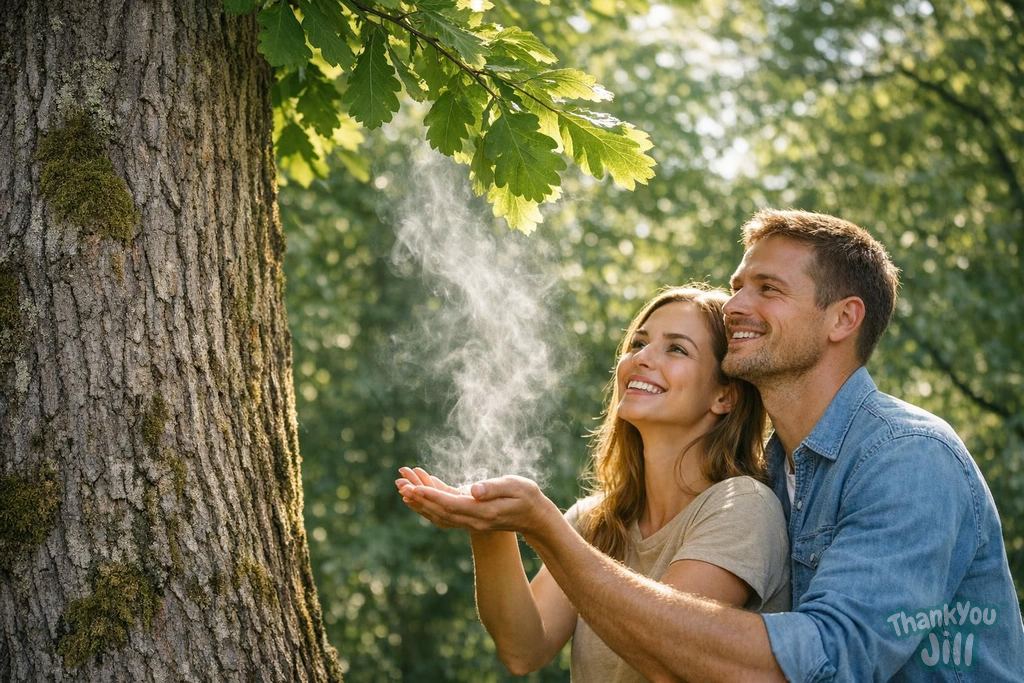
Oxygen production by plants through photosynthesis is one of the foundations of life on Earth: the oxygen in our atmosphere (21% by volume) is almost entirely of biological origin, produced over billions of years by cyanobacteria, algae, and terrestrial plants. But how many people can a single tree actually support with oxygen? The answer requires some calculation and considerable precision.
Photosynthesis and oxygen production: the math
The photosynthesis equation: 6 CO2 + 6 H2O + light energy → C6H12O6 (glucose) + 6 O2. For every molecule of glucose produced, 6 molecules of O2 are released. A tree's net oxygen production: we need to distinguish between gross production (total photosynthesis) and net production (photosynthesis minus respiration). At night and in winter, the tree respires (consumes oxygen) without performing photosynthesis. A tree's annual net oxygen production depends on: species (trees with large leaves and long growing seasons produce more), size (a large tree produces far more than a sapling), and climate conditions (light, temperature, water availability). Estimate for a mature beech tree (height 20m, crown diameter 12m, estimated leaf surface area 200-400 m²): gross oxygen production (photosynthesis only): approximately 100-120 kg O2/year. Net oxygen production (photosynthesis minus tree respiration): approximately 50-80 kg O2/year. Oxygen consumption by a resting person: approximately 500 liters/day = approximately 700 g/day = approximately 250 kg/year. An awake and active person consumes 1-3 times more. Conclusion: a mature beech tree produces oxygen for 0.2-0.3 people per year. Not for 2 people, as is often exaggerated. It takes 3-5 large adult trees to produce the oxygen needed by one person.
The "two people per tree" myth and scientific reality
The claim that "one tree produces oxygen for two people" is widespread (found in educational articles, tree-planting campaigns, eco-friendly product labels) but is significantly overestimated compared to scientific data. How the myth arose: some old and poorly rigorous estimates (probably based on enormous tropical trees or calculations that ignored the tree's nighttime and winter respiration) have been repeated without verification. The problem with estimates: oxygen production varies enormously depending on species (a tropical eucalyptus produces 5-10 times more oxygen than an alpine juniper), size (a 2-year-old sapling produces 100 times less than a 50-year-old mature tree), and climate region (a beech in Tuscany produces more than double that of a Scandinavian beech due to light and temperature conditions). More accurate estimates for different species: mature oak (100 years, large): 80-100 kg O2/year net = oxygen for 0.3-0.4 people. Mature beech (50 years): 50-80 kg O2/year net = oxygen for 0.2-0.3 people. Mature Scots pine (30 years): 30-50 kg O2/year net. Mature plantation poplar (10 years): 40-70 kg O2/year net (rapid growth but less dense trunk). The most important point: total atmospheric oxygen is produced 50-80% by the ocean (phytoplankton and marine algae) and only 20-50% by terrestrial forests. We're not in danger of running out of oxygen (atmospheric reserves are enormous). The importance of forests for air quality is real but relates more to purification (CO2 absorption, dust, pollutants) than to O2 production.
CO2 absorption: the real climate service of trees
The real climate service trees provide isn't so much oxygen production (whose atmospheric reserves are stable) but rather CO2 absorption, the primary greenhouse gas responsible for climate change. Carbon sequestration: every kilogram of dry wood contains approximately 0.5 kg of carbon. For every kilogram of carbon sequestered, 3.67 kg of CO2 is removed from the atmosphere. A large mature beech (dry wood mass approximately 2,000-5,000 kg) has sequestered over its lifetime 1,000-2,500 kg of carbon = 3,700-9,200 kg of CO2. Sequestration rate: a young tree in rapid growth phase (10-40 years) sequesters carbon much faster than an old tree (which has already reached maximum size and whose growth has slowed). This is why fast-growing tree plantations are more efficient short-term for CO2 sequestration, but old forests have much higher and more stable total carbon stocks. Forest soil carbon: forest soil often contains more carbon than the wood of trees! Forest humus (composed of decomposed organic material and glomalin from mycorrhizal fungi) can contain 50-200 tonnes of carbon per hectare: comparable to or exceeding above-ground biomass. Cutting down a forest doesn't just lose the carbon in the trees: it disturbs the soil and also releases some of the soil's carbon. The IPCC estimate (2023): terrestrial forests absorb approximately 3.6 billion tonnes of CO2 annually (about 30% of annual human CO2 emissions). An ecosystem service of immeasurable value for climate stability.

Don't plant a tree for its oxygen: the atmosphere has plenty, and the ocean produces most of it. Plant a tree for the carbon it sequesters, for the microclimate it creates, for the biodiversity it hosts, for the water it regulates, and for the beauty it provides. An adult tree has removed 5-9 tonnes of CO2 from the air over its lifetime. That's the real service it provides to the planet.
Italian forests and carbon: data and perspectives
Italian forests cover approximately 11 million hectares (36% of national territory) and are expanding due to agricultural abandonment in mountain and hill areas (Italian forest area has nearly doubled since 1950). Carbon balance: Italian forests are a net CO2 sink: they absorb more than they emit through respiration and decomposition. ISPRA estimate (2022): Italian forests absorb approximately 40-50 million tonnes of CO2 equivalent annually, equal to about 10-12% of total Italian emissions. Alpine forests: Italian alpine forests (Trentino-Alto Adige, Veneto, Lombardy, Piedmont) contain the highest carbon stock per hectare: spruce and fir forests in the Alps can contain 300-600 tonnes of CO2 per hectare between biomass and soil. The wildfire threat: Italian forest fires (increasing in recent decades due to climate change and summer drought) rapidly release carbon accumulated over years of growth. A single large fire can release in days the carbon sequestered by a forest over decades. The ThankYouJill project in the carbon context: every tree planted by the project contributes to Italian CO2 sequestration. A tree planted today will be an adult tree in 30-50 years: then its carbon stock will be significant. The temporal coherence between the climate crisis horizon (2050-2100) and tree growth time makes today's plantings particularly valuable for future climate.
Air purification: beyond oxygen
Trees' contribution to air quality goes far beyond O2 production. Trees purify air in various ways. Absorption of gaseous pollutants: leaves absorb nitrogen dioxide (NO2), sulfur dioxide (SO2), ozone (O3), and other gaseous pollutants through stomata. The leaf acts as an active chemical filter. Absorption is most efficient during daylight hours when stomata are open. Capture of fine particulates (PM10, PM2.5): leaves (especially those that are wrinkled, hairy, or sticky: linden, plane, elm) trap dust particles, soot, and pollen. An estimate for urban trees in Milan: each year, trees in the Milan municipality capture approximately 100 tonnes of fine particulates. Temperature reduction and thus urban ozone: tropospheric ozone (a pollutant) forms more rapidly at high temperatures. The cooling produced by urban trees reduces ozone formation. Production of beneficial compounds (therapeutic VOCs): terpenes emitted by conifers (pinene, limonene) have positive effects on the immune system and psychological well-being (already discussed in the article on Shinrin-yoku, Cat. 9.6). The downsides of trees in cities: some trees (poplars, planes, birches, ornamental grasses) produce allergenic pollen in large quantities: a cost to spring air quality. Choosing species for urban tree planting must balance air purification benefits with allergenic pollen production, compatibility with compacted soil, drought resistance, and salt tolerance.
Frequently asked questions
How much oxygen does an adult tree actually produce and how many people can it support?
An adult tree like a beech produces approximately 50-80 kg of net oxygen per year, enough for 0.2-0.3 people. To support one person's oxygen needs requires 3-5 adult trees, debunking the myth that one tree produces oxygen for two people.
What is the real contribution of trees to climate compared to oxygen production?
The real climate service trees provide is CO2 absorption, not oxygen production. Trees sequester carbon in wood and soil, helping reduce greenhouse gases and mitigate climate change, while atmospheric oxygen is already abundant.
How do climate conditions and species affect trees' oxygen production efficiency?
Oxygen production varies greatly depending on species, size, and climate conditions. For example, a tropical eucalyptus produces 5-10 times more oxygen than an alpine juniper, and trees in warmer, sunnier climates have more efficient photosynthesis than those in cold climates.
How do trees contribute to air purification beyond oxygen production?
Trees absorb gaseous pollutants like NO2, SO2, and ozone through their leaves and capture fine particulates (PM10, PM2.5). Additionally, they reduce urban temperatures, limiting tropospheric ozone formation, and produce beneficial compounds that improve psychological well-being.


Latest News



Comments
No comments yet. Be the first!
Leave a comment