


 Italiano
 Français
 Deutsch
 Español
 Português
 Svenska
 Suomi
Suomi
Ecological Succession
How a Forest is Born
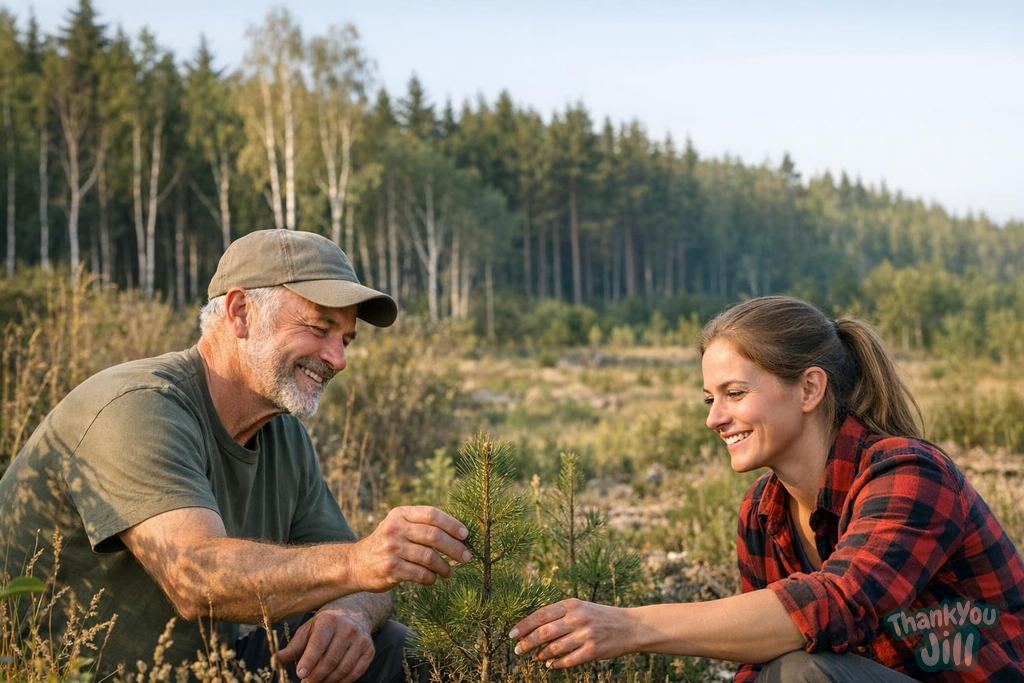
Ecological succession is the process through which biological communities change over time in a directional and relatively predictable way. In terrestrial areas, succession typically leads from bare soil or disturbed environments toward increasingly complex plant communities, eventually reaching a relatively stable state called "climax" (or dynamic equilibrium). Forests are often the final stage of succession in regions where rainfall is sufficient and temperatures are not extreme.
Primary Succession: From Bare Rock to Forest
Primary succession starts from substrates devoid of life and soil: solidified lava from a volcanic eruption, barren soil exposed by melting glaciers, a newly formed island, a sand dune. Stage 1 - Pioneer species: lichens and cyanobacteria colonize bare rock, accumulating organic matter and chemically altering the surface. Mosses follow, creating the first layer of organic soil. This takes decades. Stage 2 - Pioneer grasses: the first vascular plants colonize the developing soil (Saxifraga, Dryas octopetala in alpine environments; pioneer grasses in temperate zones). They produce biomass that accelerates soil formation. This takes additional decades. Stage 3 - Shrub plants: pioneer shrubs (Salix herbacea and Betula nana at higher elevations, brambles and raspberries at lower elevations, dogwood and hawthorn in lowlands) establish themselves, increasing structural complexity and enriching the soil with fallen leaves. This takes 20-50 years. Stage 4 - Pioneer forest: fast-growing trees (birch, aspen, Scots pine, willow) colonize the area. Their gradual shade eliminates light-loving pioneer species. The soil becomes enriched with humus and mycorrhizae. This takes 50-100 years. Stage 5 - Climax forest: the climax vegetation of the region becomes established. In the Italian temperate climate: beech (above 600-800 m), oak (hilly and lowland zones), holm oak (Mediterranean zone). Climax trees are more shade-tolerant than pioneer trees: they can regenerate in the understory of the pioneers themselves. Within 100-300 years, the climax forest replaces the pioneer forest. Total timeframes: from bare rock to climax forest: 200-500 years in favorable temperate environments. In extreme alpine environments: 500-1,000 years. In tropical environments: 100-200 years (high temperature and humidity accelerate soil formation and growth).
Secondary Succession: The Forest Returns
Secondary succession starts from disturbed environments that already had developed soil and partially preserved soil biota: an abandoned agricultural field, a burned area, a deforested area. Why it's faster than primary succession: the soil is already present (with its reserves of nutrients, dormant seeds, mycorrhizal spores, and soil fauna). Colonizing plants grow on fertile soil rather than bare rock. The pace is 5-10 times faster than primary succession. Secondary succession in Italy: the abandonment of marginal agricultural lands (accelerating sharply from the 1950s-80s, especially on Apennine hills) has initiated secondary succession on millions of hectares. Within 50-70 years of abandonment: the field becomes meadow → becomes shrubby (bramble, broom, elderberry, hawthorn) → pioneer forest appears (ash, downy oak, Aleppo pine in the South) → climax species begin to appear. The natural forest expanding in Italy: Italian forest area has increased from 6 million hectares (1950) to 11 million hectares (2023): nearly doubled in 70 years thanks to agricultural abandonment. This "spontaneous renaturalization" is a secondary succession process returning previously cultivated areas to nature. The quality of this successional forest: different from mature climax forest. Simple structure, few cavities, little deadwood, still low biodiversity. It will take centuries to reach the complexity of climax forest. But it's already far better than cultivated fields.
Facilitators and Inhibitors of Succession
Ecological succession is not always linear and predictable: it's influenced by factors that can accelerate, slow, or block it at sub-climax stages. Facilitators of succession: facilitating species are those that, colonizing first, improve conditions for subsequent species. Lichens that produce carbonic acid accelerate rock weathering (facilitating mosses). Pioneer pines create shade and acidic soil that facilitates beech establishment. Alder (Alnus glutinosa) fixes atmospheric nitrogen (in symbiosis with Frankia) enriching soil for subsequent plants. Birch produces easily decomposable leaves that accelerate humus formation. Inhibitors of succession: competitive grasses (Brachypodium rupestre, Molinia caerulea) can form dense stands that resist shrub establishment for decades. Acidic and nutrient-poor soils slow succession. Frequent fire blocks succession at the shrub stage (Mediterranean scrub). Intensive grazing prevents renaturalization. Competition with invasive exotic species: invasive species (black locust Robinia pseudoacacia, tree of heaven Ailanthus altissima, butterfly bush Buddleja davidii) alter succession by forming monospecific invasive forests that are very difficult to replace with native climax species. Black locust (introduced in the 17th century from North America) now covers approximately 500,000 hectares of Italian forest: it's Europe's primary invasive tree species. Managing succession for conservation: some protected areas and historically valuable mountain meadows (for flora and fauna typical of open pastures) are maintained at the herbaceous-shrub stage (before succession toward forest) through controlled grazing or mowing. Succession "toward forest" in these cases is undesirable: the goal is to maintain open habitats.

An abandoned field becomes a meadow, then becomes shrubby, then pioneer pines or ash trees grow, then beech waits patiently in the understory until the light is right. In a few centuries, where there was corn, there's now a forest. Italy has lost half its mountain agriculture in the last seventy years, and nature has responded by slowly covering these abandoned lands. It's a silent, inexorable, beautiful succession.
Succession in Water: How a Peatland Forms
Succession doesn't occur only on dry land: it also happens in aquatic environments, producing the gradual transformation of lakes and ponds into wet meadows, then peatlands, then (eventually) forest. Hydarch succession: starts from open water and proceeds toward land. Stage 1 (deep lake): submerged aquatic species (Potamogeton, Elodea, Ceratophyllum). Gradual sedimentation of debris and organic matter accumulation slowly reduces depth. Stage 2 (shallow lake): rooted species with floating leaves (Nymphaea, Nuphar) and emergent species (Phragmites australis: common reed, Typha: cattail). Stage 3 (marsh): reed growth and slowed decomposition under anoxic conditions produces a peat layer that progressively fills the basin. Stage 4 (fen and raised bog): if conditions are acidic and little influenced by groundwater (ombrotrophic peatland), sphagnum moss (Sphagnum) colonizes the surface. Sphagnum grows and decomposes very slowly under acidic conditions (producing acidic peat). Peatlands form: highly specialized and rare ecosystems with adapted flora (Drosera, Pinguicula, Vaccinium, Eriophorum). Peatlands as carbon reservoirs: peatlands occupy only 3% of Earth's land surface but contain approximately 30% of global soil carbon. Peat is carbon accumulated over thousands of years under anoxic conditions. Peat extraction (for horticultural use: growing substrates) and peatland drainage release enormous amounts of CO2. In Sweden and Finland, peatland protection is a carbon conservation priority. In Italy, peatlands are protected by the EU Habitats Directive (Priority Habitat: asterisk). Some Alpine peatlands in Trentino and Alto Adige are among Europe's most important.
Accelerating Succession: Active Forest Restoration
Ecological restoration is the discipline that seeks to accelerate or guide succession toward target ecosystems (often mature forests) in much shorter timeframes than natural processes. Principles of forest restoration: understand the natural succession process and imitate it, using facilitating species in initial phases and climax species in later phases. Reduce barriers to restoration (invasive species, grazing, fire) before planting. Use plant material from local sources (adapted ecotypes) with high genetic diversity. Create vertical structure from the start (plant together species of different final heights). Innovative techniques: nurse crops (protective crops): fast-growing plants (Alnus, Salix) planted alongside climax species to provide shade and favorable microclimate during early years. The "Miyawaki method" (developed by Japanese botanist Akira Miyawaki): dense planting (2-3 plants/m²) of many native forest species of different stratifications in a single operation. The resulting forest reaches maturity in 20-30 years instead of 200. Excellent results in many urban and peri-urban applications worldwide, including Italy. Rewilding: allowing natural succession to occur without intervention, removing only main barriers (invasive species, fences, artificial drainage). Slower than active restoration, but produces potentially more resilient ecosystems due to greater genetic and structural diversity. Successfully applied in abandoned rural areas of the Apennines and Italian Alps.
Frequently Asked Questions
What is the difference between primary and secondary succession in forest formation?
Primary succession begins on lifeless soils, such as rocks or lava, requiring centuries to develop a forest. Secondary succession starts from already existing, nutrient-rich soils, such as abandoned fields, and is 5-10 times faster at restoring forest vegetation.
How do invasive species affect ecological succession in forests?
Invasive species can block or alter succession by forming monospecific forests difficult to replace with native climax species, reducing biodiversity and ecosystem quality. For example, black locust has invaded vast areas, hindering the return of natural forests.
How does the Miyawaki method accelerate forest restoration compared to natural succession?
The Miyawaki method involves dense planting of many native stratified species, creating a mature forest in 20-30 years instead of 200. It promotes biodiversity and vertical structure from the start, significantly accelerating the formation of resilient forest ecosystems.
What happens if ecological succession is blocked at a sub-climax stage?
If succession becomes blocked at a sub-climax stage, such as herbaceous or shrub stage, the ecosystem remains less complex and less biodiverse. This can occur due to factors like intensive grazing, frequent fires, or poor soils, preventing the formation of mature and stable forests.


Latest News



Comments
No comments yet. Be the first!
Leave a comment