


 Italiano
 Français
 Deutsch
 Español
 Português
 Svenska
 Suomi
Suomi
Growing Sprouts at Home
A complete guide to cultivating them
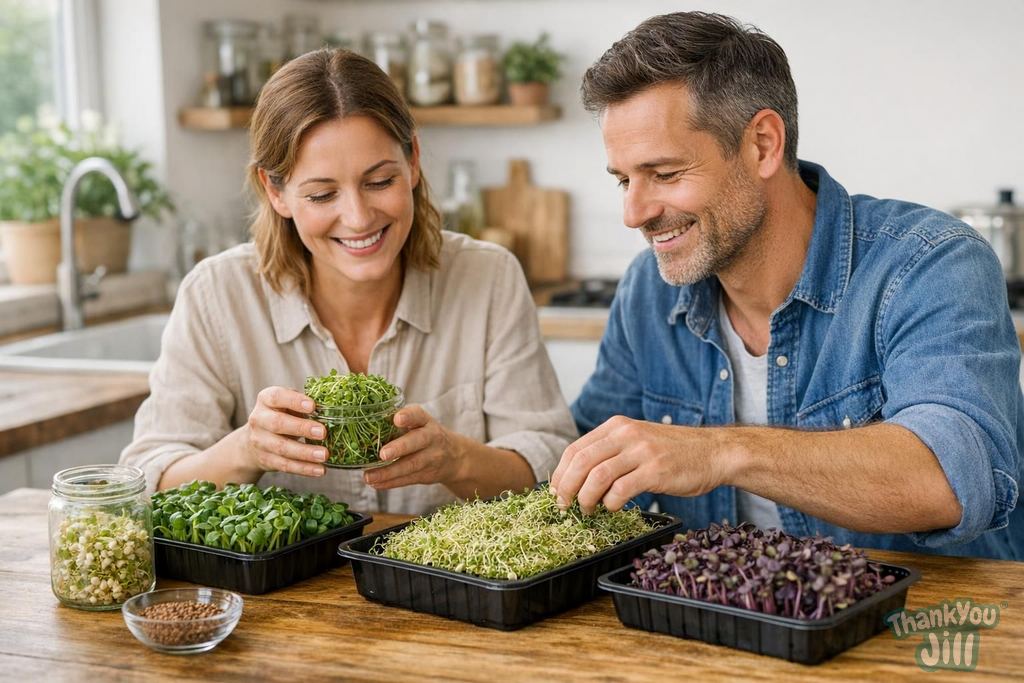
In three or four days, with a glass jar, a small piece of mesh, and a tablespoon of seeds, you can produce one of the most nutritious foods that exists: sprouts. No soil needed, no sunlight, no garden. Just water, room temperature, and the patience to wait a few days. It's the smallest and most efficient garden in the world, and it works in any kitchen.
What are sprouts and why are they so nutritious
Sprouts are seedlings in the early phase of their life, between seed germination and the development of the first true leaves. During this phase, the seed mobilizes all its nutritional reserves to support growth: enzymes, vitamins, and amino acids are synthesized or made available in concentrations far higher than in the dormant seed.
Research has documented significant increases during germination: vitamin C (broccoli sprouts contain up to 35 times more than the seed), B vitamins (B1, B2, B3, B6 increase by 20-300% depending on the species), folates, digestive enzymes, and chlorophyll in species that germinate in light.
Broccoli sprouts deserve special mention: they contain sulforaphane in concentrations 10-100 times higher than mature broccoli. Sulforaphane is among the most studied plant anti-cancer compounds in scientific research: it activates detoxifying enzymes in the liver and has documented anti-inflammatory and neuroprotective effects.
Which seeds can be sprouted
Practically any edible seed can be sprouted. The easiest and most common: lentils (ready in 3-4 days, delicate flavor), chickpeas (5-6 days, eaten raw or lightly sautéed), mung beans (the classic "sprouts" of Asian cuisine, 4-5 days), radish (3-4 days, peppery flavor), alfalfa or lucerne (5-7 days, delicate flavor, classic in salads), broccoli (5-7 days, high sulforaphane content), sunflower (7-10 days, large and flavorful), buckwheat (3-4 days).
Never sprout: tomato, pepper, eggplant, or potato seeds (they contain solanine), whole flax seeds (they form excessive mucilage). Seeds must be untreated: commercial seed varieties are often treated with non-food fungicides.
The basic method: the glass jar
Tools: a 500 ml wide-mouth glass jar, a piece of mesh or cheesecloth secured with a rubber band, a small plate. Procedure: place 2 tablespoons of seeds in the jar, cover with plenty of water, and soak for 8-12 hours (small seeds like alfalfa: 6-8 hours, large ones like chickpeas: 12 hours). Drain the water through the mesh, rinse the seeds with clean water, and drain again. Place the jar upside down at a slight angle on the plate (to allow excess water to drip off). Keep at room temperature (18-22°C), away from direct light. Rinse and drain twice daily. The sprouts are ready when they reach 2-4 cm in length.
How to make sprouts green and maximize nutrients
In the last 12-24 hours before consumption, expose the sprouts to light (not direct sunlight). This activates photosynthesis: the sprouts develop chlorophyll, turn green, and increase their vitamin C and other nutrient content. This applies to all sprouts eaten with green leaves (alfalfa, broccoli, radish). Legume sprouts (lentils, chickpeas, mung beans) are usually consumed before they develop leaves.
Food safety in sprouting
Sprouts grown in warm, humid conditions can harbor bacteria like Salmonella and E. coli if hygiene standards aren't maintained. Precautions: always use clean water for rinsing, thoroughly clean jars before each sprouting cycle, drain well after each rinse (stagnant water promotes pathogens), consume within 5-7 days of maturity, and refrigerate once ready.
For more vulnerable groups (pregnant women, elderly, immunocompromised): it's better to consume legume sprouts cooked (a few minutes in a pan) rather than raw. Alfalfa and broccoli sprouts, consumed fresh and well-rinsed, are generally safe for everyone.

Three days of water and a glass jar give you one of the most nutrient-dense foods on the planet. No soil needed, no sunlight needed, no money needed. All you need is the desire to start.
Your first sprouting cycle: lentils
Start with lentils: they're the simplest, fastest, and most forgiving of mistakes. Take two tablespoons of regular green lentils from the supermarket (not pre-cooked ones in bags). Place them in a jar, cover with water for 8 hours. Drain, rinse, and place the jar at a 45-degree angle. Rinse morning and evening. After three days you have sprouts ready to add to salads, soup, or stir-fry. Success on your first try will motivate you to experiment with other seeds.
Build continuous production
To always have fresh sprouts on hand, start a new jar every two or three days. With three jars in rotation, you'll never run out. Spend five minutes a day rinsing: it's the small time investment that produces the greatest nutritional return possible.
How to use sprouts in the kitchen
Raw: in sandwiches (they replace lettuce with more nutrients), in mixed salads, in sushi and spring rolls, on hard-boiled or scrambled eggs, as a garnish for soups and purées. Briefly cooked: legume sprouts (chickpeas, lentils) can be sautéed in a pan with oil and spices for 2-3 minutes: an excellent addition to rice, pasta, or curry. Don't overcook them: they lose texture and some nutrients.
Introduce sprouting to children
Sprouting is one of the most engaging educational experiences for children: in just a few days they see a tiny seed transform into a plant. Have them participate in the daily rinsing process, show them the daily growth, and involve them in eating the sprouts. Children who have grown their own sprouts eat them much more willingly than store-bought ones.
Frequently asked questions
What is the simplest method for growing sprouts at home without expensive equipment?
The basic method uses a glass jar, a piece of mesh or cheesecloth, seeds, and water. After soaking the seeds for 6-12 hours, rinse them twice daily and let them drain at room temperature until they reach 2-4 cm in length.
How can I make sprouts greener and increase their nutrient content?
In the last 12-24 hours before consumption, expose the sprouts to indirect light to activate photosynthesis. This process increases chlorophyll and vitamin C, making the sprouts more nutritious and green, especially for those with leaves like alfalfa, broccoli, and radish.
Which seeds should I avoid sprouting for food safety reasons?
It's not recommended to sprout tomato, pepper, eggplant, or potato seeds (they contain toxic solanine) and whole flax seeds (they form excessive mucilage). Additionally, it's important to use untreated seeds to avoid fungicide contamination.
How do I ensure food safety while growing sprouts at home?
To prevent bacteria like Salmonella and E. coli, use clean water for rinsing, thoroughly clean jars, drain water carefully after each rinse, and refrigerate the sprouts. Consume them within 5-7 days and, for vulnerable groups, cook legume sprouts.


Latest News




Comments
No comments yet. Be the first!
Leave a comment