


 Italiano
 Français
 Deutsch
 Español
 Português
 Svenska
 Suomi
Suomi
Cereals for Babies
Which ones to introduce and when
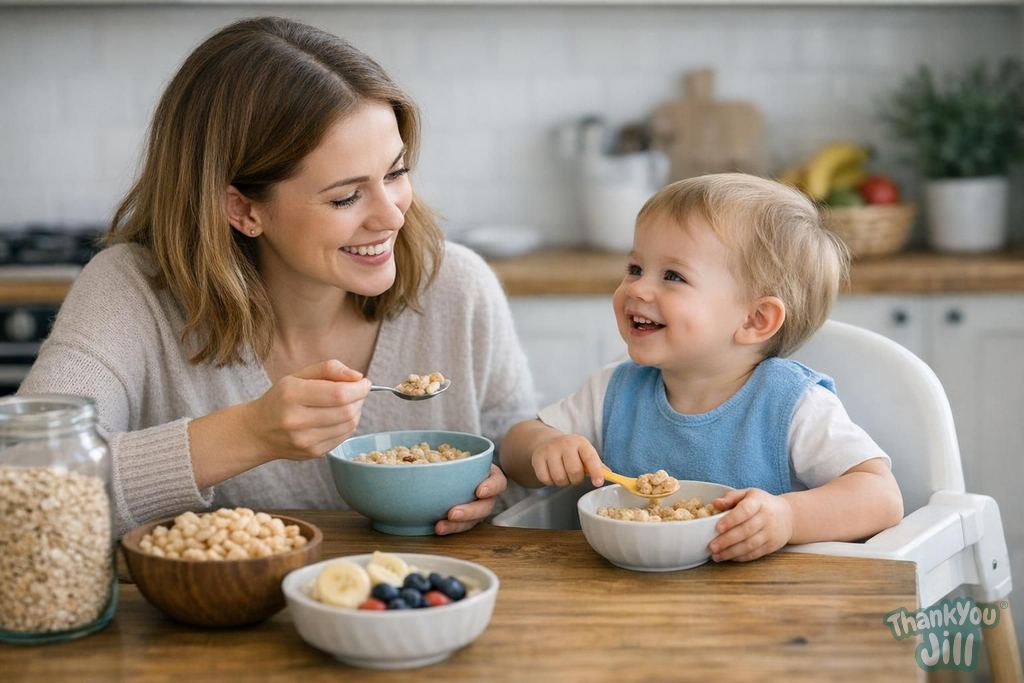
Cereals are the first solid food introduced into infants' diets in almost every culture worldwide. In Italy, baby cereal porridge is a nutritional rite of passage. But recommendations have changed over the years, and parents are understandably confused: when should you introduce gluten? Is gluten-free better, or should you include it? How do you choose commercial baby foods? Are all infant cereals the same? Answering these questions requires knowing the most current guidelines.
When to start cereals: timing for introduction
The ESPGHAN guidelines (European Society of Pediatric Gastroenterology) and Italian Reference Intake Levels agree: cereals (like all solid foods) should not be introduced before 17 completed weeks (4 months) and not after 26 weeks (6 months). The 4-6 month window is recommended, with most pediatricians suggesting 6 months as the optimal timing for breastfed infants.
Your baby is ready for solids when: they hold their head steady, show interest in adult food, can bring objects to their mouth, and can sit upright with support. Not all babies reach these milestones at exactly 6 months—your pediatrician will guide individual assessment.
Gluten: when and how to introduce it
For years, guidelines recommended delaying gluten introduction until after 7 months, outside the breastfeeding window, to reduce celiac disease risk. Later studies reversed this recommendation. Updated ESPGHAN guidelines (2016) indicate there's no evidence that delaying or advancing gluten introduction reduces celiac disease risk. Gluten can be introduced in the 4-12 month window, ideally while your baby is still breastfeeding (which offers immunological protection).
What remains valid: introduce gluten gradually, in small initial amounts, while observing your baby's response. There's no reason to avoid gluten-containing cereals (spelt, barley, wheat) in healthy babies without a family history of celiac disease. A family history of celiac disease isn't a reason to delay gluten—rather, it's a reason to watch for early symptoms and seek diagnosis if they appear.
Commercial baby cereals: what to read on the label
Commercial infant cereal products must comply with EU Regulation 609/2013 on foods for infants. They're subject to much stricter limits on pesticides, heavy metals, and additives compared to regular foods. From this perspective, they're safe.
The main issue is sugar content. Many commercial "cereal" baby foods contain added sugars (sucrose, fructose, glucose syrup) or disguised sweetening ingredients. Read the ingredient list: in an ideal cereal for the first months, the only ingredient should be the grain (rice, corn, oats, multigrain). No sugar, no powdered milk, no vanilla flavoring, no added biscuits.
The best cereals for each stage
First introduction (6 months): rice, corn, buckwheat, tapioca. Naturally gluten-free, neutral flavor, easily digestible. There's no reason to avoid white refined rice at this stage—high glycemic index is less relevant for an infant discovering flavors.
Expansion phase (7-9 months): introduction of gluten through spelt, barley, wheat. Gradual amounts, observing tolerance. Oats: rich in beta-glucans and fiber, delicate flavor, excellent from the second half of the first year.
Older baby (10-12 months and beyond): whole wheat pasta, whole grain bread, grain kernels (spelt in soup, pearl barley). Variety is valuable: exposing your baby to cereals beyond just wheat builds a richer microbiota and more versatile palate.
Arsenic in rice: a point to watch
Rice accumulates inorganic arsenic from soil more than other cereals. Babies eating a lot of rice (rice cereal as the only grain for months) can accumulate suboptimal levels. The European Commission has set specific limits for rice-based infant products, stricter than regular foods. The practical solution: vary your cereals from the start, don't use only rice. Alternate rice, corn, oats, spelt, barley. Variety solves the arsenic issue without eliminating rice.
Quantity and increasing consistency
Start with a few spoonfuls, semi-liquid consistency (cereals well-diluted in breast milk or formula). Gradually increase quantity and thickness over the following months. By 9-10 months, your baby can eat cereals in small lump format (fine pasta, small grain soups). By 12 months, regular pasta cut small. Never force it: your baby regulates intake based on their appetite.

Your baby's first cereals lay the foundation for their microbiota, palate, and relationship with food. Variety, quality, and no added sugars: three simple principles to start right.
How to read baby cereal labels in five seconds
Pick up the cereal box, flip it over, read the ingredient list. It should be short: the grain (rice, corn, oats, spelt...) as the first and nearly only ingredient. If you see sucrose, glucose, honey, vanilla, malt, or malt extract among the first five ingredients: put it back on the shelf. Your baby doesn't need added sugars in cereal. The natural flavor of grains, perhaps mixed with breast milk, is all they need.
Homemade cereal porridge
Cornmeal (fine polenta), blended oat flakes, rice flour: they cook in minutes with water or milk, with no additives or sugars. Spelt or barley semolina porridge is an excellent alternative from the second half of the first year. It's no more complicated than commercial cereals: put 2-3 teaspoons of powdered grain in hot water, stir for 2 minutes, cool. Total control over ingredients and ridiculous cost compared to industrial packages.
Vary, vary, vary
The golden rule of complementary feeding: vary as much as possible. A baby exposed to rice, corn, oats, spelt, barley, rye, quinoa during their first year builds a more diverse microbiota, a more open palate, and more robust food tolerance than a baby fed only rice or only wheat. Variety in infant cereals has documented long-term health benefits.
If your baby refuses whole grain cereals
Many babies readily accept white porridge and refuse whole grain (darker, different flavor). Don't force it: start with white and gradually add increasing percentages of whole grain. Your baby's microbiota adapts and their palate becomes accustomed through repeated exposure. The absolute priority is that they eat peacefully, not that they eat whole grain at all costs.
Frequently asked questions
What's the best time to introduce cereals into your baby's diet?
Cereals should be introduced between 17 and 26 weeks of life (4-6 months), with most pediatricians recommending starting around 6 months, when your baby shows signs of readiness like holding their head up and showing interest in food.
How do you introduce gluten into your baby's diet to reduce celiac disease risk?
Gluten can be introduced gradually between 4 and 12 months, preferably while your baby is still breastfeeding, without specific delays. It's important to observe individual tolerance, but there's no need to avoid it if your baby is healthy and has no family history of celiac disease.
Which cereals are recommended for each weaning stage?
From 6 months, rice, corn, buckwheat, and tapioca are recommended; between 7-9 months, gluten-containing cereals like spelt, barley, and wheat are introduced; after 10 months, whole wheat pasta, whole grain bread, and grain kernels can be added to promote variety and a richer microbiota.
How do you prevent arsenic buildup in babies who consume rice?
To limit inorganic arsenic exposure, it's important to vary cereals from the start, alternating rice with corn, oats, spelt, and barley, avoiding using rice as the only grain for long periods in baby food.


Latest News




Comments
No comments yet. Be the first!
Leave a comment