


 Italiano
 Français
 Deutsch
 Español
 Português
 Svenska
 Suomi
Suomi
White Sugar vs Cane Sugar: The Real Differences
What Actually Sets Them Apart
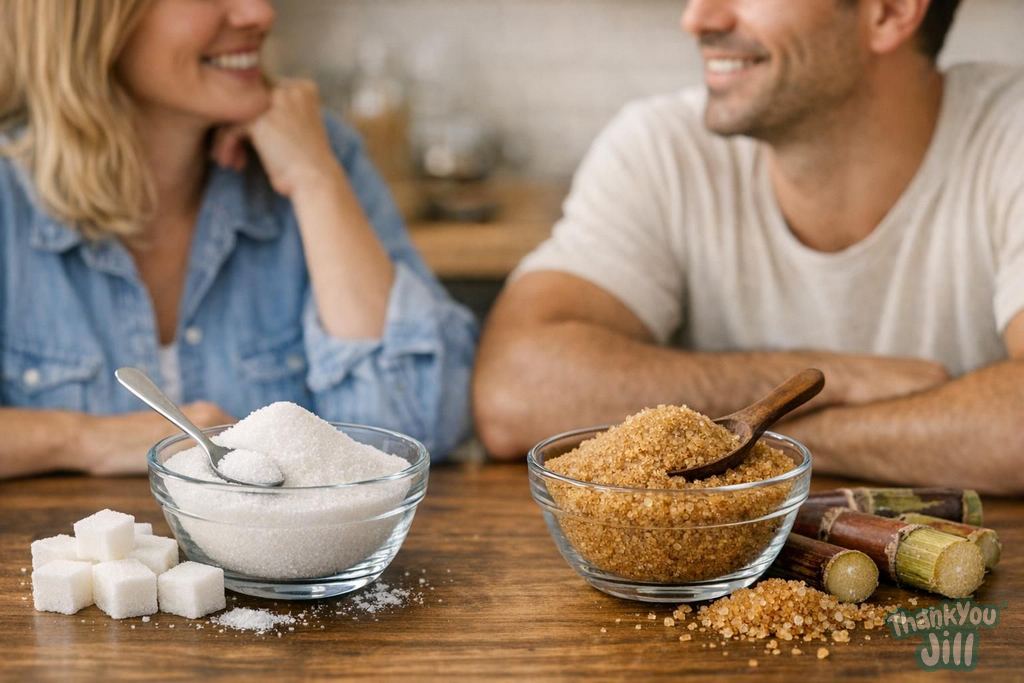
Cane sugar has become the symbol of "healthy" sugar, or at least "less harmful" sugar. It sits next to white sugar at coffee bars, in the kitchens of health-conscious people, on the tables of vegetarian restaurants. But how often have you checked whether what you're using is actually raw unrefined cane sugar or simply white beet sugar dyed brown with molasses?
Where Sugar Comes From: The Raw Materials
Sugar in Italy and Europe comes mainly from two sources: sugarcane (Saccharum officinarum), grown in tropical and subtropical regions, and sugar beet (Beta vulgaris), widely cultivated in Europe (including Italy). Both plants produce sucrose that is practically identical from a chemical standpoint: the sucrose molecule has no structural differences between cane and beet sources.
The distinction "cane vs beet" is therefore not a chemical distinction of sucrose itself, but rather concerns the degree of refinement and the presence or absence of compounds from the original plant juice.
White Sugar: The Product of Complete Refinement
White sugar is sucrose purified to 99.9%. The refinement process removes all molasses (the dark liquid rich in minerals and aromatic compounds), all polyphenols, all minerals, and water. The final product is chemically almost pure: white crystals of sucrose with "empty" calories (energy without micronutrients). The plant source (cane or beet) is irrelevant to the final product: both produce the same pure sucrose.
True Raw Unrefined Cane Sugar: The Real Differences
True raw unrefined cane sugar (Panela, Rapadura, muscovado sugar) has not undergone complete refinement: it is concentrated and dried sugarcane juice, retaining the naturally present molasses. This sugar contains: sucrose (85-92%), molasses (5-10%), water, minerals (calcium, iron, potassium, magnesium, phosphorus, zinc in modest but real amounts), polyphenols (caffeic acid, flavonoids), trace B vitamins.
The glycemic index of true unrefined sugar is slightly lower (45-65) than white sugar (65-70): the molasses and residual fiber minimally slow absorption. The difference is real but small. The mineral content is higher, but considering recommended sugar amounts (<25g per day), the additional mineral contribution is nutritionally negligible.
The Big Deception: "Raw Cane" That Isn't
Most "cane sugar" sold in Italian supermarkets is not truly unrefined: it's refined white sugar (often from European beets) to which molasses has been added to color it brown and give it the appearance of raw sugar. It's called "raw sugar" or "golden sugar" but is technologically almost identical to white sugar, with a coating of added molasses.
How to spot true unrefined sugar: the color should be deep brown, not just golden. The texture should be moist and slightly sticky (from integrated molasses). The taste should have notes of caramel, licorice, and molasses. The price should be significantly higher. Brands like Panela or Rapadura are usually authentic. If the product looks like white sugar tinted brown with perfect, uniform crystals, it probably is.
The Honest Conclusion: Even Raw Sugar Is Still Sugar
Even true raw unrefined cane sugar remains sugar: primarily sucrose, calories, and blood sugar spikes. The benefits compared to white sugar are real but quantitatively modest. Using it instead of white sugar in small amounts is a slightly better choice. Using it in large amounts thinking it "does less harm" is a dangerous illusion. Quantity matters far more than type: two teaspoons of white sugar in your coffee does much less damage than six teaspoons of muscovado in your porridge.

Brown color doesn't work miracles: even authentic cane sugar remains sugar. The real difference isn't between white and raw: it's between using a lot and using a little. Moderation is the only strategy that truly matters.
How to Spot True Unrefined Cane Sugar
At the supermarket, look for the words "panela," "rapadura," "muscovado," or "unrefined whole cane sugar." These terms identify authentic products. "Golden" cane sugar, "raw cane sugar," and "brown sugar" in most cases are refined and tinted with molasses: not true unrefined sugar. The touch test: true muscovado is moist, clumps together, and sticks slightly to your fingers. Refined and tinted sugar is dry with perfect crystals like white sugar.
Where to Use Muscovado for Maximum Aromatic Impact
Muscovado has such a distinctive flavor (molasses, dark caramel, licorice notes) that it transforms recipes where it's used. Excellent for: dark chocolate cookies (amplifies the bitter note), banana cakes, gingerbread, meat marinades (barbecue), dark caramel, brownies. In these preparations, muscovado's intense flavor substitutes quality for quantity: you use less because the flavor is more intense.
For Your Daily Coffee: The Most Honest Choice
If you use one teaspoon of sugar in your coffee, the nutritional difference between white and raw is: 4g of sucrose vs 3.7g of sucrose + 0.3g of molasses. It's an irrelevant difference. If you want to make a better choice for your coffee, reducing the amount (from two teaspoons to one, then to half) has a hundred times greater impact than choosing the type.
Cane Sugar and the Environment
Sugarcane has much greater photosynthetic efficiency than sugar beet: it produces more sugar per hectare with fewer energy inputs. However, cane is grown in tropical countries far from Italy, resulting in transportation impact. Italian sugar beet has a local supply chain. From an overall environmental sustainability perspective, the answer isn't simple: it depends on how you balance production efficiency and transportation impact.
Frequently Asked Questions
What is the real nutritional difference between white sugar and raw unrefined cane sugar?
The nutritional difference is minimal: raw unrefined cane sugar contains small amounts of molasses, minerals, and polyphenols, while white sugar is almost pure sucrose without micronutrients. The health impact is modest and depends mainly on the quantity consumed.
How can you tell true raw unrefined cane sugar apart from refined sugar colored with molasses?
True raw unrefined cane sugar has deep brown color, moist and sticky texture, and tastes of caramel and molasses. Refined and colored sugar appears golden, with dry and uniform crystals. Products like panela, rapadura, and muscovado are authentic.
How much does choosing between white sugar and cane sugar affect blood sugar spikes?
Raw unrefined cane sugar has a slightly lower glycemic index (45-65) compared to white sugar (65-70) thanks to molasses and residual fiber, but the difference is small and not significant if consumed in large quantities.
When is it worth using muscovado cane sugar in recipes?
Muscovado is ideal for recipes where its intense molasses and caramel flavor can enhance the taste, such as dark chocolate cookies, banana cakes, gingerbread, and marinades. You need less of it compared to white sugar to achieve greater aromatic impact.


Latest News




Comments
No comments yet. Be the first!
Leave a comment