


 Italiano
 Français
 Deutsch
 Español
 Português
 Svenska
 Suomi
Suomi
Weaning
When and how to start (updated guidelines)

Weaning is one of the most anticipated and most feared milestones in life with a small child. Questions, anxieties, grandparents with different opinions, pediatricians saying different things than online articles: the information landscape is confusing. But the guidelines from the major pediatric societies worldwide (WHO, ESPGHAN, Italian Society of Pediatrics) are now more aligned and more evidence-based than they were twenty years ago. Understanding them clearly is the first tool for approaching weaning with peace of mind.
When to start: the most important "when"
The official answer from all major pediatric societies is: not before 4 months old, and not after 6 months old. The preferred target according to WHO and SIP is around 6 months. Before 4 months, your baby's gastrointestinal system hasn't matured enough: high intestinal permeability, enzymatically immature digestive system, developing kidney function. After 6 months, breast milk or formula alone no longer covers the need for iron, zinc, and other nutrients critical for growth.
The 4-6 month window doesn't mean "start at four months": it means your baby will show readiness signs during this period. The exact month varies from baby to baby.
Readiness signs: what to look for
It's not the calendar but your baby who tells you when they're ready. Signs of weaning readiness include: head control (your baby holds their head upright and stable without support), interest in food (your baby watches with curiosity what adults eat, tries to grab food), ability to sit with support (not necessarily alone), disappearance of the extrusion reflex (the reflex that pushes everything out of the mouth: present in early months, it decreases at 4-5 months). Loss of the extrusion reflex is the most important sign: if your baby systematically spits everything out, their body is saying "not yet."
How to start: first foods
Current guidelines no longer recommend a fixed rigid order as they did in the past. The principle is early variety. First foods offered can be: cooked vegetables (zucchini, carrot, squash, broccoli) in soft puree, then with progressively coarser textures. Gluten-free cereals in the first months, then with gluten (gluten is introduced between 4 and 7 months). Meat (chicken, turkey, beef): critical source of heme iron and zinc, to be introduced early by 7-8 months. Legumes: red lentils (hulled) among the most digestible for small babies. Ripe fruit: banana, pear, apple, peach.
Salt and sugar: the two absolute rules
No added salt in your baby's food during the first year of life. Your baby's kidneys aren't yet able to handle high sodium loads. No added sugar in the first year: this includes honey (risk of infant botulism under 12 months), fruit juices, and sweeteners. Your baby's palate forms in early experiences: offering artificial sweet flavors early programs a preference for sweetness that will last years.
Texture: from puree to soft food
Current guidelines recommend not unnecessarily prolonging smooth puree textures. The recommended progression: smooth puree (months 4-6), lumpy puree (6-7 months), soft food squashable with the tongue (7-8 months), soft pieces (8-9 months), adapted family food (9-12 months). A baby who stays on smooth purees for too long may develop texture difficulties later.
Quantity: a myth to debunk
In the early months of weaning, quantity matters little: breast milk or formula remains the main food throughout the first year. First offerings of solid food are sensory exploration, not nutrition. Don't force your baby to eat everything on the plate. Your baby has very precise appetite regulation mechanisms: forcing them to eat beyond their fullness teaches them not to listen to these internal signals.

Weaning isn't a race or a test. The baby who at 7 months still eats little puree isn't behind: they're learning. Readiness signs are in your baby, not in the calendar. Follow them and trust them: your baby's body knows exactly what to do, if you give it time and space to do it.
The first meal: how to offer it with peace of mind
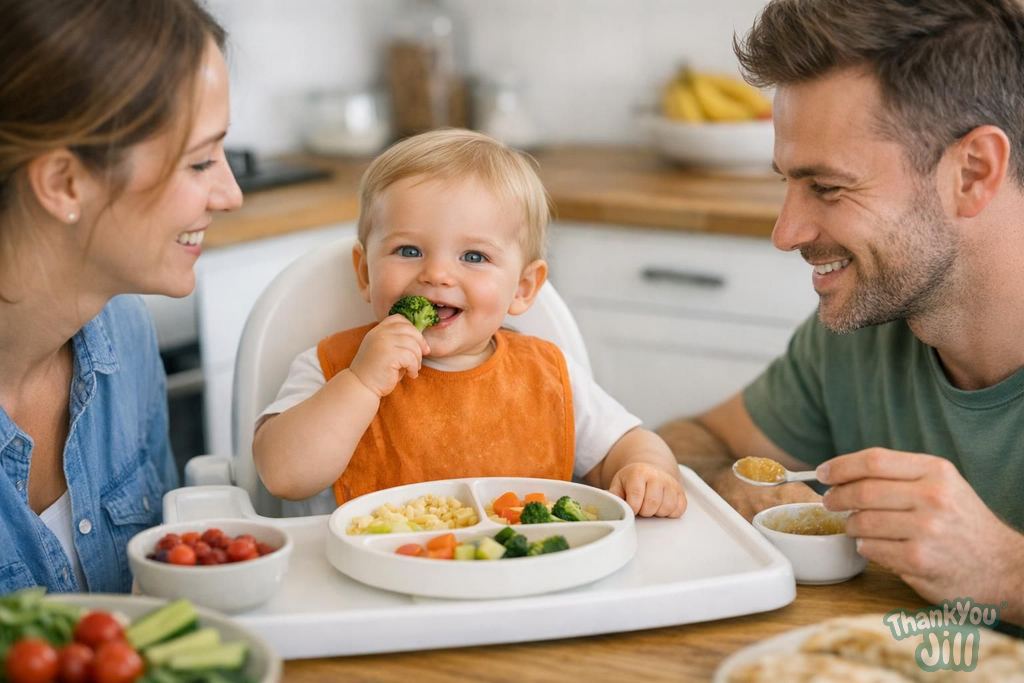
Choose a time when your baby is rested and in a good mood, not starving and not sleepy. Sit them supported in a high chair. Offer a teaspoon of warm puree. Don't force if they turn their head: try again the next day. Expect them to spit, make faces, play with it: it's all normal and part of exploration. Don't show anxiety: your baby immediately perceives stress from adults around food. The first rule of peaceful weaning is that the parent is peaceful.
How to introduce iron in a practical way
Iron is the most critical nutrient to introduce early. Practical strategies: very finely ground meat in vegetable puree, hulled red lentils cooked and blended, chicken liver once a week (exceptional source of heme iron, zinc, vitamin A), iron-fortified cereals for babies. Always pair with a source of vitamin C (lemon juice in the puree, or fruit as dessert) to maximize absorption of non-heme iron.
What to do if your baby refuses everything for weeks
Initial refusal is physiological and very common. If after 2-4 weeks your baby continues to refuse everything, consider: are you offering at the right time? Are you waiting for readiness signs? Is the food temperature appropriate? Does your baby watch you eat with curiosity? Prolonged absolute refusal beyond a month requires pediatric evaluation to rule out organic causes such as early teething pain or gastroesophageal reflux.
Frequently asked questions
What are the main signs that indicate a baby is ready to start weaning?
Readiness signs include stable head control, interest in food, ability to sit with support, and disappearance of the extrusion reflex, which pushes food out of the mouth. The latter is the most important sign to begin.
When should weaning start according to the most updated pediatric guidelines?
Weaning should start no earlier than 4 months old and no later than 6 months. The ideal period is around 6 months, when the gastrointestinal system is more mature and milk alone no longer covers the need for nutrients like iron and zinc.
How to introduce iron during weaning effectively?
Iron should be introduced early with foods like very finely ground meat, hulled red lentils, chicken liver, and fortified cereals. It's important to always pair with a source of vitamin C, such as lemon juice or fruit, to improve absorption of non-heme iron.
What to do if your baby refuses solid food for weeks during weaning?
If refusal lasts more than 2-4 weeks, verify that your baby shows readiness signs, that the food has the right temperature, and that it's offered in calm moments. Prolonged refusal beyond a month requires pediatric evaluation to rule out organic causes.
Latest News




Comments
No comments yet. Be the first!
Leave a comment