


 Italiano
 Français
 Deutsch
 Español
 Português
 Svenska
 Suomi
Suomi
Nutrition Education
Start Right Away
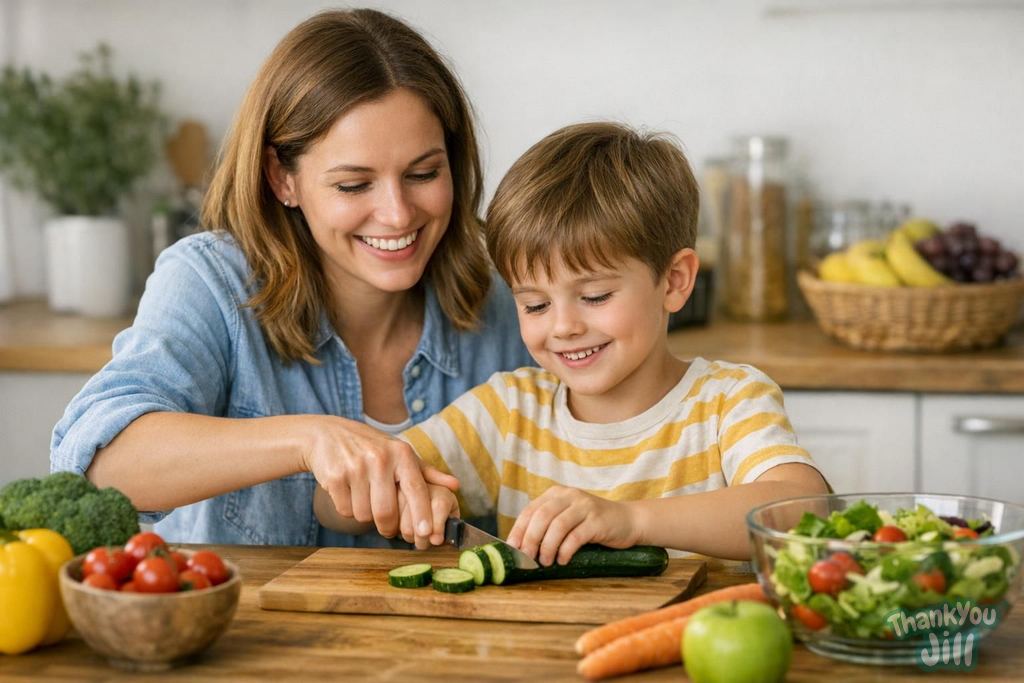
Nutrition education isn't a school course or a set of rules to teach: it's how a child experiences food every day, from the first months of life. Children learn eating preferences mainly through modeling (watching parents eat), exposure (trying many foods), and association (linking food to pleasant moments). Eating habits formed in the first 5 years tend to persist into adolescence and adulthood.
Modeling: You're Your Child's First Cookbook
Children learn to eat by watching. A father who eats vegetables with obvious pleasure is the most powerful nutrition education that exists. A parent who makes faces at fish or says "I don't like lentils" sends the message to the child that this food is problematic. It's not the parent's fault: it's the neurobiology of observational learning (mirror neurons, social modeling). Practical implication: if you want your child to eat vegetables, eat them first with visible enjoyment in front of him. If you don't like something, don't show that while serving it to your child.
Early Exposure and Variety: The First 1000 Days
The first 1000 days (from conception to age 2) are the window of greatest palate plasticity. A breastfed child is already exposed to the flavors of the mother's diet through milk (which varies in taste based on what the mother eats). During weaning, early variety is the most documented factor for reducing later food neophobia. Children exposed to many different flavors in the first 12 months show less rejection of new foods at 2-3 years old.
The Kitchen as an Educational Space
Involving children in food preparation is one of the most effective strategies for improving food acceptance. Studies show that children who participate in meal preparation eat more willingly what they've prepared. How to involve them by age: 12-18 months: washing vegetables, stirring. 2-3 years: mashing bananas, tearing lettuce, decorating pizza. 4-5 years: weighing ingredients, kneading dough, using child-safe knives on soft vegetables. The kitchen should be playful, not perfect.
The Language of Food: How to Talk About It With Children
Avoid: "eat your vegetables because they're good for you" (creates association between vegetables and obligation), "if you eat everything I'll give you a reward" (paradox effect), "you're good when you eat" (links the child's worth to eating behavior), "you don't like this, right?" (negative suggestion). Instead, try: "today we're trying something new: let's see what you think", "what does it taste like?", "have you had enough?" The goal is to build curiosity and autonomy, not mechanical obedience.
Family Meals: The Most Important Context
Family meals at least once a day are associated with better diet quality in children and adolescents, better relationship with food in adulthood, and reduced risk of eating disorders. It doesn't need to be perfect: it needs to happen. Phones away, TV off, pleasant conversation about anything except food. The meal as a moment of connection, not evaluation of your child's eating habits.

Children learn to eat by watching how their parents eat. If you want your child to have a healthy relationship with food, start with your own. You don't need to explain why vegetables are good for you: just let him see you eat them with pleasure every day by your side. This is the most powerful nutrition education that exists.
Container Gardening: Growing Vegetables With Your Child
Even in an apartment without a garden, growing cherry tomatoes, basil, or strawberries in pots with your child is one of the most powerful educational activities for a healthy food relationship. Children who've grown a tomato from start to finish eat it much more willingly than those who find it already on their plate. The care process creates an emotional bond with the food. It doesn't require much space: a pot on a windowsill with basil is enough to start.
Managing Holiday Meals Without Conflict
Holidays bring sweets and special foods. Exceptions don't ruin a child. A slice of birthday cake, Easter chocolates, Christmas panettone: these are part of food culture and social relationships. Problems only arise when exceptions become the norm. Holidays as positive experiences (taste, sharing, family), daily routine as a stable foundation: this combination builds a healthy and flexible relationship with food.
Resources for Parents on Nutrition Education
The Ellyn Satter Method (Division of Responsibility) is the most scientifically validated framework for children's nutrition: available in books and on her website. In Italy, your family pediatrician is the first point of contact for any nutrition concerns. Weaning courses for parents: many hospitals and health centers organize them for free—ask your pediatrician. SINUPE (Italian Society of Pediatric Nutrition) publishes updated recommendations freely available online.
Frequently Asked Questions
How do parents influence children's food preferences in their early years?
Children learn food preferences by observing their parents (modeling), trying different foods (exposure), and associating food with pleasant moments. Eating with pleasure in front of your children promotes acceptance of healthy foods like vegetables.
Why is early exposure and food variety important in the first 1000 days?
In the first 1000 days, a child's palate is very plastic. Exposing your child to many different flavors during weaning reduces food neophobia, making it easier to accept new foods in the following years of life.
How can you involve children in food preparation to improve food acceptance?
Involving children in the kitchen with age-appropriate activities, such as washing vegetables or kneading dough, increases their curiosity and the likelihood they'll eat willingly what they've prepared, making the moment both educational and fun.
What is the role of family meals in promoting a healthy relationship with food?
Family meals, even once a day, promote better diet quality and positive relationships with food. It should be a moment of connection without distractions, with pleasant conversations and without judgment about eating behavior.

Latest News




Comments
No comments yet. Be the first!
Leave a comment