


 Italiano
 Français
 Deutsch
 Español
 Português
 Svenska
 Suomi
Suomi
Virtual Water
How much we really consume through food
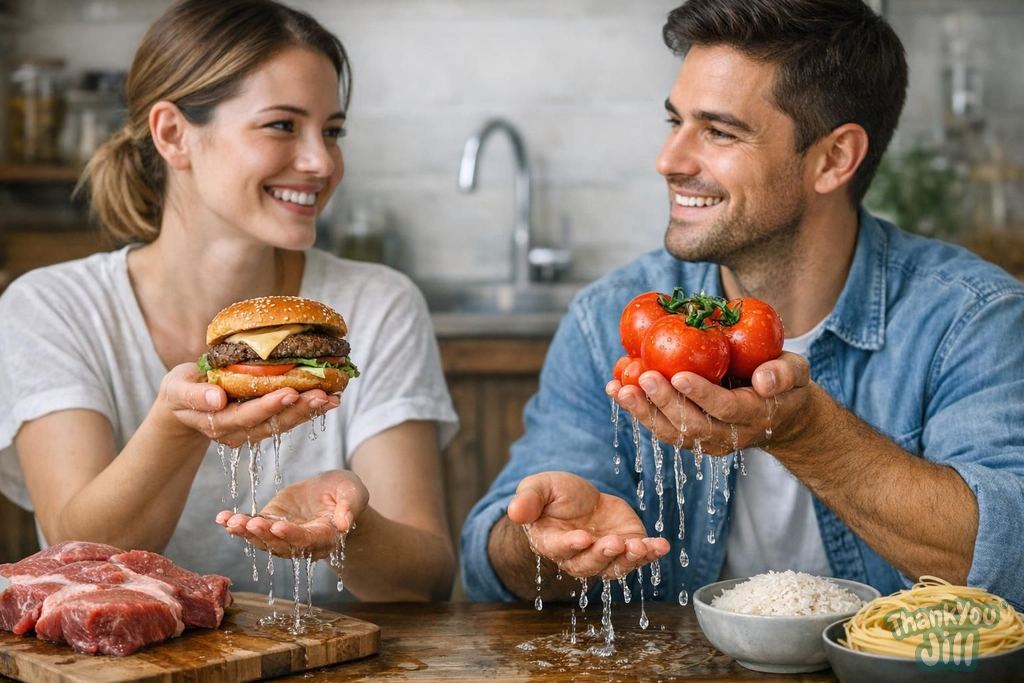
The concept of "virtual water" (or water footprint) was developed by Professor John Allan of the University of London in 1993. It refers to the hidden water in the products we consume: not the water we drink directly, but the water used to produce food, clothing, and industrial products. The global food system consumes 70% of all freshwater withdrawn by humans. The global water crisis (2 billion people without safe access to freshwater, according to the UN) is closely connected to our food choices, especially in parts of the world where intensive livestock farming and monoculture crops for animal feed are depleting aquifers.
The water footprint of main food items
Virtual water values per kg of food product (source: Water Footprint Network, Hoekstra and Chapagain): Beef: 15,400 liters per kg (the highest value among common foods: a 150g hamburger requires about 2,300 liters of water). Pork: 5,990 liters per kg. Chicken: 4,300 liters per kg. Eggs: 3,300 liters per dozen (about 200 liters per egg). Cow's milk: 1,020 liters per liter (it seems counterintuitive, but all the water for the cow to drink, irrigating fields for feed, and cleaning stalls adds up). Chocolate: 17,196 liters per kg (one of the highest overall, due to cocoa cultivation). Coffee beans: 21,000 liters per kg of coffee beans (about 140 liters per espresso cup). Rice: 2,500 liters per kg. Wheat (bread): 1,300 liters per kg. Corn: 900 liters per kg. Lentils: 900 liters per kg. Tomatoes: 180 liters per kg. Potatoes: 290 liters per kg.
The geographic dimension of virtual water
Virtual water is not all the same: it depends on where it's used. Water used for irrigation in a high-rainfall region has a very different impact than water drawn from an aquifer in an arid region already under water stress. This led to the concept of "water scarcity footprint": it considers not only the volume of water used but also where it's used. Cotton cultivation in Uzbekistan (for jeans) consumed the Aral Sea. Avocado cultivation in Chile and Mexico puts local aquifers under stress. Rice cultivation in India and Pakistan competes with drinking water for millions of people. The food we buy often carries with it the virtual water of distant regions that cannot afford to lose it.
How to reduce your diet's water footprint
The same choices that reduce your carbon footprint also reduce your water footprint: a plant-based diet systematically uses less water than a diet based on livestock farming. Reduce beef (15,400 liters per kg) in favor of legumes (900 liters per kg) and vegetables (100-400 liters per kg). Choose chicken over beef if you don't give up meat: 4,300 vs 15,400 liters per kg. Reduce chocolate and coffee to the bare minimum: they're among the most water-intensive products per kg. Consume seasonal and local fruits and vegetables: a tomato in summer grown in open fields uses 70-80% less water than a tomato grown in a heated greenhouse in winter. Reduce food waste: every discarded food item carries with it all the water used to produce it.
International trade in virtual water
International food trade is, in essence, international trade in virtual water. When Italy imports beef from Argentina or chicken meat from Brazil, it also imports the water used to produce them. This has serious geopolitical implications: food-exporting countries deplete their water resources to meet demand from wealthy nations. Spain exporting irrigated vegetables throughout Europe is exporting virtual water from watersheds already under stress. This doesn't mean trade should stop: it means trade policies should account for the hidden water cost in agricultural commodity exchanges.

Every time you eat a steak, you're consuming 3,000 liters of water you don't see but that someone in the world doesn't have. The plate has an invisible water dimension that future generations will feel much more concretely than we do. Eating less meat isn't just good for your health: it's a water policy.
Calculate your food water footprint
The website waterfootprint.org has a personal water footprint calculator (in English) that estimates annual virtual water consumption based on diet, household consumption, and products purchased. An adult with an average omnivorous diet consumes about 3,500-4,000 m³ of virtual water per year from food alone. With a vegetarian diet: about 2,400 m³. With a vegan diet: about 1,700 m³. The main difference is almost entirely determined by the amount of animal products consumed, especially beef and dairy.
Local and seasonal foods: double water benefit
Eating local and seasonal reduces your water footprint in two ways: it eliminates virtual water imported from distant water-stressed regions, and it reduces irrigation water consumption because local rainfall partially replaces artificial irrigation. An Italian tomato grown in Southern Italy in summer has a water footprint of about 100-200 liters per kg. The same tomato grown in a hydroponic greenhouse in Northern Italy in winter has a water footprint of over 1,000 liters per kg. Respecting seasonality is the simplest form of water resource conservation in daily food choices.
How to talk about virtual water with children
The concept of virtual water is incredibly powerful as an educational tool because it's concrete and surprising. "How much water does it take to make a hamburger?" is a question that immediately captures attention. A simple educational project for schools or families: create a "water map" of children's favorite foods, with pitchers that visually represent the liters needed. When a child understands that their favorite steak requires 2,000 times the water of their salad, the connection between food and the environment becomes real and not abstract.
Frequently Asked Questions
What is the difference in virtual water consumption between beef and legumes?
Beef requires about 15,400 liters of water per kg, while legumes consume about 900 liters per kg. Choosing legumes instead of beef significantly reduces your diet's water footprint.
How do seasonality and local sourcing affect the water footprint of food?
Consuming local and seasonal foods reduces water footprint because it avoids virtual water imported from water-stressed regions and takes advantage of natural rainfall, decreasing the need for artificial irrigation.
When is it worth choosing chicken over beef to reduce water consumption?
It's worth choosing chicken over beef because chicken requires about 4,300 liters of water per kg, much less than the 15,400 liters per kg for beef, thus reducing your diet's water impact.
How can you calculate your personal food water footprint and what are the average values for different diets?
You can calculate your personal water footprint using online calculators like waterfootprint.org. On average, an omnivorous diet consumes 3,500-4,000 m³ of virtual water per year, a vegetarian diet about 2,400 m³, and a vegan diet about 1,700 m³.

Latest News




Comments
No comments yet. Be the first!
Leave a comment