


 Italiano
 Français
 Deutsch
 Español
 Português
 Svenska
 Suomi
Suomi
Mulching
Save Water in Your Garden
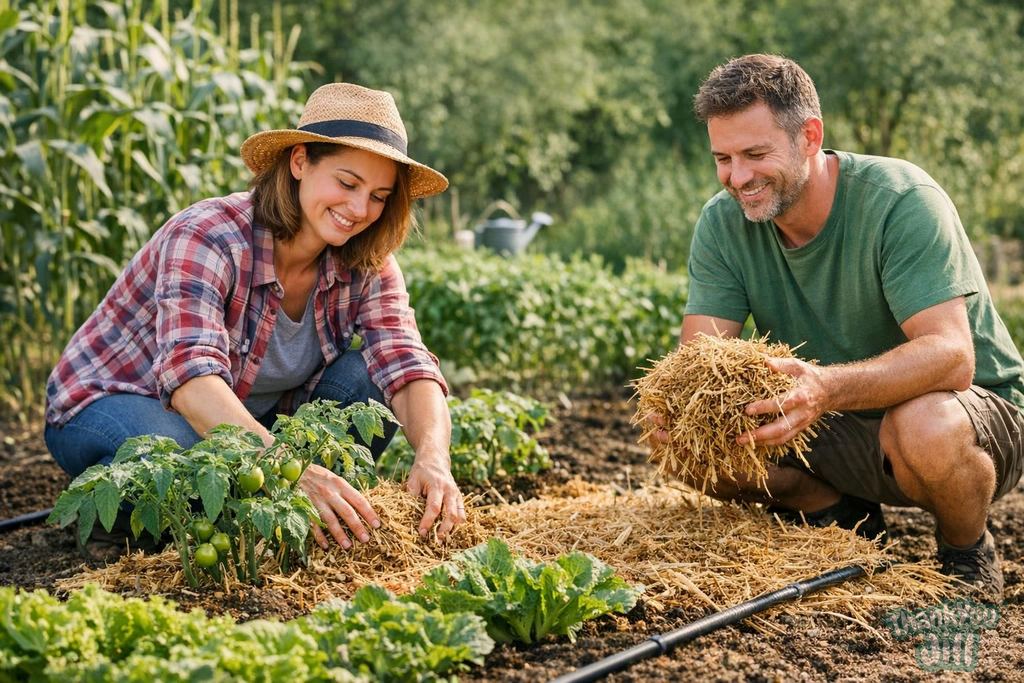
Mulching (or mulch) involves covering the soil surface around plants with a layer of organic or inorganic material. It's one of the gardening practices with the best cost-benefit ratio: it requires minimal work, no expense (the best materials are ones you already have), and produces measurable benefits across nearly every aspect of garden management. Nature itself teaches us about mulching: in any natural forest ecosystem, the soil is always covered by a layer of leaves, branches, and bark. Bare soil is an anomaly of modern agriculture.
The benefits of mulching: five measurable advantages
Reduced evaporation: a layer of 5-8 cm of mulch reduces soil evaporation by 60-70%. In summer, this means watering every 3-4 days instead of daily. For a 20 m² garden, seasonal water savings can reach 1,000-2,000 liters. Weed control: weeds grow from seed germination when exposed to light. By covering the soil with an opaque layer, you prevent light from reaching seeds: 90% of weeds never germinate. The few that do emerge are easy to remove. Soil temperature regulation: mulch acts as a thermal insulator. In summer, it keeps soil cooler (tomato and zucchini roots hate excessive heat). In autumn, it extends the growing season by keeping soil warmer. Soil improvement: organic mulches decompose slowly, adding humus, nutrients, and microorganisms to the soil. A garden mulched with organic materials each year develops progressively more fertile soil. Prevention of leaf diseases: mulch prevents soil-borne pathogens (especially fungal spores) from splashing onto leaves during watering. Tomato late blight often spreads this way: mulch reduces this transmission vector.
Mulching materials: organic (preferred)
Straw (the classic): economical, available at garden centers, easy to apply. Decomposes in 6-12 months. Ideal for larger gardens. Caution: use straw, not hay (hay contains weed seeds). Shredded dry leaves: the most natural and free mulching material. Shredded with a lawn mower, they become excellent mulch. They decompose in 6-12 months while adding humus and nutrients. Grass clippings (thin layer): available free after each lawn mowing. Apply in thin layers (3-4 cm) to prevent compact layers that ferment: it gets moldy if too thick. Pine bark or chipped wood (bark mulch): very attractive, long-lasting (2-3 years before decomposing), excellent for shrubs and fruit trees. Not ideal for annual vegetables because it decomposes slowly and can slightly acidify soil. Semi-mature compost: best for nourishing soil, but more costly in terms of material. Use it around demanding crops (tomatoes, zucchini). Cardboard: excellent as a first layer under organic mulch to suppress aggressive weeds (e.g., when establishing a new raised bed).
Materials to avoid or use with caution
Black plastic film: highly effective against weeds and for warming soil in spring, but it's not water-permeable (except special microporous versions), doesn't improve soil, creates plastic waste, and can overheat soil in summer. Better to use biodegradable corn starch versions (decompose in soil in 12-18 months). Landscape fabric (geotextile): lasts 3-5 years, allows water through but doesn't improve soil. Use it for pathways, not productive garden beds. Unseasoned wood chips: may contain allelopathic substances (growth inhibitors) and deplete nitrogen from soil during decomposition. Use only chips seasoned for at least 6 months. Walnut leaves (Juglans): contain juglone, an allelopathic compound that inhibits many plants. Don't use as mulch in vegetable gardens.
How to apply mulch correctly
Timing: apply mulch after soil has warmed in spring (not on still-cold soil: mulch slows spring warming), after removing existing weeds, after thorough watering. Depth: 5-8 cm is the optimal thickness for most materials. Too thin won't suppress weeds; too thick can create waterlogging and root rot at the plant collar. Distance from plants: always leave 5-10 cm clear around plant stems. Direct contact between wet mulch and stems or collars causes rot. Renewal: top up mulch each spring (it partially decomposes over the year) without removing the old layer (which has become humus in the soil).

Bare soil is a mistake: it loses water, bakes in the sun, compacts, and invites weeds. Cover it with something organic and the problem solves itself. Straw is cheap, dry leaves are free, compost is homemade. Five centimeters of mulch completely transforms summer garden management.
Seasonal mulching: the calendar
April-May: apply your first mulch after summer transplants (tomatoes, zucchini, peppers). Soil has already warmed but summer weeds haven't exploded yet. Use straw or dry grass clippings. July-August: top up or refresh mulch if it's thinned out. This is the critical period for reducing summer irrigation. October-November: apply a thick layer of dry leaves across the entire garden at season's end. This layer protects soil from cold, transforms into humus over winter, and provides a base for the new season in spring. Don't remove winter mulch in spring: just incorporate the undecomposed surface layer into furrows for new plantings.
Mulching and earthworms: the connection
Earthworms (Lumbricus terrestris) love the moist organic mulch layer: it's their ideal habitat. In a garden mulched with organic materials, the earthworm population can be 3-5 times higher than in bare-soil gardens. Each earthworm tunnels through soil, improving drainage and aeration, leaves castings (droppings) rich in bioavailable nutrients, and brings organic material from the surface deeper down. The simplest indicator of soil health is the number of earthworms per shovelful: 10-15 earthworms per 20 cm deep shovelful indicates excellent soil health.
Water savings with mulching: the numbers
A practical comparison: unmulched garden in July at 28°C with moderate wind: soil loses 4-6 mm of water daily to evaporation (4-6 liters per m² daily). A 20 m² garden loses 80-120 liters daily, requiring daily watering. The same garden mulched with 7 cm of straw: evaporation loss reduced to 1-2 mm daily. Watering needed every 3-4 days instead of daily. Savings: 70-80% of summer water consumption. For a 20 m² garden over 4 summer months: approximately 5,000-8,000 liters of water saved. In practical terms: less time, less effort, reduced water bills (if using municipal water), and a garden that holds up better during summer vacations.
Frequently Asked Questions
What are the most effective organic materials for garden mulching?
The most effective organic materials are straw, shredded dry leaves, grass clippings in thin layers, seasoned pine bark, and semi-mature compost. These materials improve soil, reduce weeds, and maintain moisture.
How do I apply mulch correctly to maximize water savings?
Apply mulch after soil has warmed in spring, at a depth of 5-8 cm, leaving 5-10 cm clear around plant stems to prevent rot. Refresh each spring without removing old mulch.
How much does mulching reduce summer irrigation needs in a vegetable garden?
Mulching can reduce irrigation by 70-80%, allowing watering every 3-4 days instead of daily. In a 20 m² garden, this translates to approximately 5,000-8,000 liters of water saved during summer months.
Why is black plastic film not recommended as mulch in vegetable gardens?
Black plastic film isn't water-permeable, doesn't improve soil, can overheat soil in summer, and creates plastic waste. It's better to use biodegradable versions or organic materials to avoid these problems.


Latest News




Comments
No comments yet. Be the first!
Leave a comment