


 Italiano
 Français
 Deutsch
 Español
 Português
 Svenska
 Suomi
Suomi
Forest Bathing
Japanese Forest Therapy
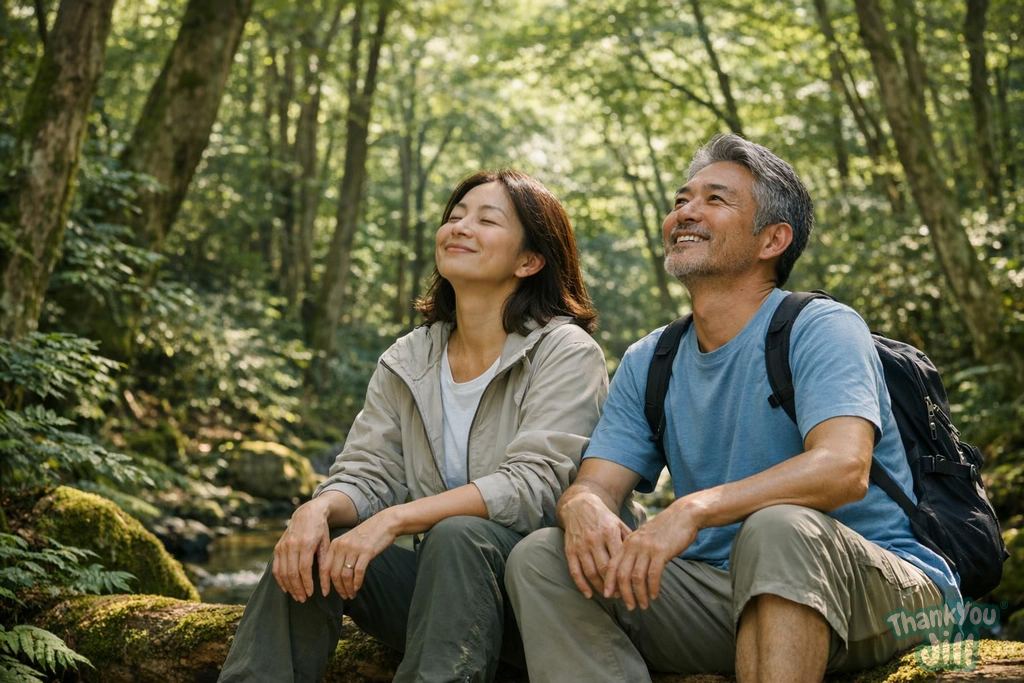
Shinrin-yoku ("forest bathing" in Japanese) is a practice developed in Japan in the 1980s as a response to growing urbanization and work-related stress. It's not simply taking a walk in the woods: it's a slow, mindful sensory immersion in the forest environment, with the goal of opening all your senses to the stimuli of the forest ecosystem. Japanese and international scientific research over the past 30 years has documented measurable physiological and psychological effects of forest bathing, beyond the generic effect of physical exercise in nature.
The biological mechanisms: why the forest is good for your health
Phytoncides: trees release volatile organic compounds (terpenes, sesquiterpenes, phytoncides) as a defense mechanism against pathogens. The main one is alpha-pinene (the characteristic pine scent), but there are hundreds of similar compounds in every tree species. Inhaled during forest bathing, these compounds have documented effects: increased activity of NK (natural killer) cells in the immune system, reduced salivary cortisol (the main stress marker), reduced blood pressure and heart rate, mild antibacterial and antiviral effects. The landmark study by Qing Li (Nippon Medical School, 2009): Japanese businessmen spent 3 days/2 nights in a Japanese cypress forest. Results: 50% increase in NK cell activity (measured in blood), 30% increase in the number of NK cells, increased levels of anti-cancer proteins, effects that persisted for more than 30 days after forest bathing. These effects did NOT replicate in urban walks of the same duration.
The psychological and neurological effects: modern research
Beyond immune effects, forest bathing produces measurable changes in the autonomic nervous system: reduced activation of the sympathetic system (fight-or-flight), increased parasympathetic system (rest-and-digest). This translates to: reduced anxiety and negative rumination (obsessive thoughts), improved mood and subjective vitality, improved cognitive functions (attention, creativity, problem-solving). A Stanford University study (Bratman et al., 2015) measured the activity of the subgenual prefrontal cortex (the brain area active in rumination) in subjects walking 90 minutes in a forest vs 90 minutes in an urban environment. The forest significantly reduced activity in this area and self-reported negative thoughts. Kaplan's "Attention Restoration Theory": nature offers "soft fascination" (stimuli that capture attention without requiring cognitive effort: a stream, moving leaves, a bird) that allows "directed attention" (what we use for work, screens, decisions) to recover. This theory explains why even just looking at nature from a window produces positive effects.
How to practice forest bathing correctly: the protocol
Forest bathing is not a run or a fast hike: it's a slow practice. Guidelines from the Association of Nature and Forest Therapy (ANFT): minimum duration of 2-4 hours (not 30 minutes: physiological benefits require immersion time), very slow pace (1-2 km in 2-3 hours: much less than a normal walk), smartphone off or in airplane mode (eliminates the main cognitive distraction), all five senses open: what you see (look for micro details: a mushroom, a spider, the veins of a leaf), what you hear (the layered sounds of the forest: wind, birds, branches), what you smell (the phytoncides), what you touch (tree bark, leaves, damp soil), what you taste (a small taste of fresh air if you like), frequent stops (sit down, lean against a tree, observe the sky through the canopy), optional journaling (write in 5 minutes what you've observed to anchor the senses). You don't need a "wild" space: a city park with mature trees produces similar effects if the immersion is authentic.
Therapeutic forests in Italy: where to go
Italy is among the countries with the highest percentages of forests certified for wellness in Europe. The Foreste Benessere project by PEFC Italy has certified over 80 "therapeutic forests" throughout Italy, managed according to criteria that guarantee their safe use and therapeutic value. Among the most well-known certified therapeutic forests: Vallombrosa Forest (Tuscany), Sant'Antonio Woods (Abruzzo), Foresta Umbra (Puglia, in the Gargano), Apennine forests in Emilia, forests of Friuli-Venezia Giulia. The national Italia Forestale program (italiaforestale.org) maps guided forest bathing experiences throughout Italy. ANFT-certified guides are available for guided experiences that follow the scientifically validated protocol.

Two hours in the forest aren't a luxury: they're medicine. Measurable, documented, with no side effects. The immune system that activates, cortisol that drops, obsessive thoughts that quiet: all of this happens while you're simply present, in silence, beneath the tree canopy. You don't need to go far. You just need to go slowly.
How to build a regular forest bathing practice into your daily life
Don't wait for vacation to practice forest bathing. Integrate it into your weekly routine: identify your "nearby forest" (a tree-filled park, a tree-lined avenue, the closest community forest to your home), plan 2 outings weekly of at least 45-60 minutes (even if less than optimal, regularity produces cumulative effects), gradually invite sensory awareness even into your short daily walks (2 minutes of intentional observation of a tree near your home during a coffee break), use pre-work mornings in parks instead of scrolling on your phone in bed. The key is frequency more than duration: 3 walks of 30 minutes in an urban forest every week have more effects than a single long outing once a month.
Children and forest bathing: unstructured time in nature
Children who spend unstructured free time in nature (what Richard Louv calls "nature deficit disorder" when it's missing) show better attention span, creativity, and emotional resilience compared to children who spend time mainly in closed, structured environments. Forest bathing "for children" doesn't require protocols: it requires time, space, and freedom to explore. Taking children into the forest without structuring the activity (without using your smartphone, without giving them tasks or instructions) is already forest bathing in its purest sense. Programs like Forest School (widespread in Northern Europe and growing in Italy) take children into the forest for hours every week with an educational approach based on direct experience in nature.
Starting a local forest bathing group: how to do it
Forest bathing is best practiced in a group (sharing the experience, mutual guidance) but can be started on your own. To form a local group: post an announcement on Meetup.com or in wellness/nature Facebook groups in your area, propose a monthly outing of 2-3 hours in a local park or forest without expecting professional guidance (sharing itself is valuable), if the group grows, consider inviting an ANFT-certified guide for some sessions. Italian ANFT guides are certified after specific training on scientific research and forest bathing facilitation techniques: anftl.org has the directory of certified professionals. True therapeutic forest bathing (for clinical settings: oncology, burnout, anxiety disorders) requires certified professional figures.
Frequently Asked Questions
What are the measurable physiological effects of forest bathing on the immune system?
Forest bathing increases the activity and number of NK (natural killer) cells, reduces salivary cortisol, lowers blood pressure and heart rate, thanks to the inhalation of phytoncides produced by trees, with effects that can last over 30 days.
How do you practice forest bathing correctly according to the scientific protocol?
Forest bathing is practiced slowly for 2-4 hours, walking at a very slow pace (1-2 km in 2-3 hours), with smartphone off, opening all your senses to the forest environment and making frequent stops to observe, listen, smell, and touch the surrounding nature.
What psychological and neurological benefits does forest bathing produce compared to an urban walk?
Forest bathing reduces activation of the sympathetic nervous system, lowers anxiety and obsessive thoughts, improves mood, vitality, and cognitive functions such as attention and creativity, effects not replicated by walks in urban environments.
How do you integrate forest bathing into your daily routine to maximize benefits?
It's recommended to identify a nearby forest or park, plan at least two weekly outings of 45-60 minutes, practice sensory awareness even in brief daily walks, and prefer morning nature walks instead of smartphone use.
Latest News




Comments
No comments yet. Be the first!
Leave a comment