


 Italiano
 Français
 Deutsch
 Español
 Português
 Svenska
 Suomi
Suomi
The Holm Oak
The evergreen guardian of the Mediterranean landscape
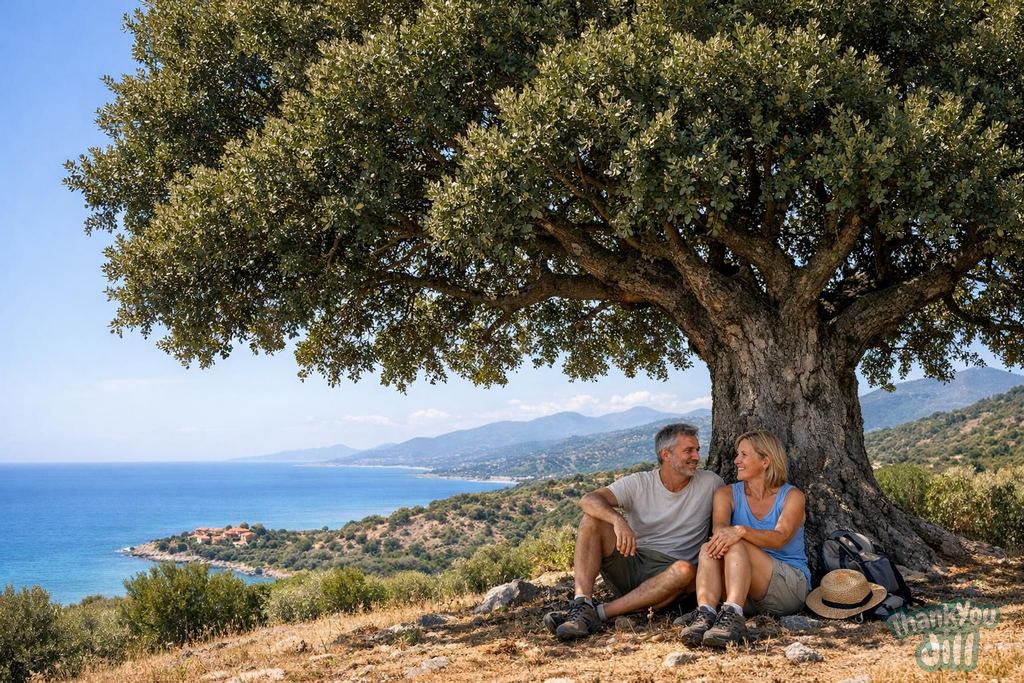
While other trees surrender, shed their leaves, and rest — the holm oak stands firm. Green all year round, with those leathery, glossy leaves that yield neither to August's scorching sun nor to January's cold north wind. The holm oak is the tree that refuses to give up, and this has made it the undisputed master of the Italian Mediterranean landscape.
What is the holm oak
The holm oak (Quercus ilex) is an evergreen oak — a close relative of the pedunculate oak and sessile oak, but with completely different morphology. Its leaves are small, leathery, glossy on top and whitish underneath, with margins ranging from entire to weakly toothed. This leaf variability is normal and shouldn't be confusing: young holm oak plants have more toothed and spiny leaves (a defense system against herbivores), while mature plants have simpler, lanceolate leaves. The holm oak grows naturally throughout peninsular Italy and the islands, from the coast up to about 1,000 meters elevation, preferring sunny slopes and areas with Mediterranean climate. In some parts of Italy (Gargano, Cilento, Maremma, and the Sardinian and Sicilian coasts) it forms pure forests — the holm oak woodlands — which are among the most characteristic and stable forests in the entire Mediterranean.
The strategy of the Mediterranean evergreen
Being evergreen in a Mediterranean climate — with hot, dry summers and mild winters — is a highly effective evolutionary strategy. The holm oak keeps its leaves year-round, but gradually renews its foliage in spring and summer: old leaves fall as new ones grow, so the tree never becomes completely bare. Its leathery leaves, rich in cuticular waxes, reduce water loss through transpiration far more efficiently than deciduous leaves. In summer, when water is scarce, the holm oak partially closes its stomata and slows its metabolism — a form of summer dormancy called estivation — then resumes full activity in autumn and winter, when rains return and temperatures drop. This reversal of the cycle compared to northern temperate trees is one of the most fascinating characteristics of Mediterranean biology.
The holm oak acorn: a precious food
Like all oaks, the holm oak produces acorns — smaller and more elongated than those of the pedunculate or sessile oak. Holm oak acorns are less bitter than other oak species and were consumed by humans in historical times, especially by the pre-Roman peoples of Sardinia and Sicily. By grinding holm oak acorns, a starch-rich flour was obtained and used for bread and polenta. Today, holm oak acorns are mainly food for wildlife: wild boar, deer, jays, wood pigeons, pigeons, quail, and starlings are extremely fond of them, and the abundant acorn production in autumn (called mast) profoundly regulates wild boar population dynamics in many Mediterranean areas.
The holm oak woodland as an ecosystem
A mature holm oak woodland is one of the most stable forest ecosystems in Italy. The dense evergreen canopy creates a cool, humid microclimate even during the hottest summers. The soil is covered by a thick layer of slowly decomposing leaves, broken down by specialized fungi. Beneath holm oak woodlands grow plants adapted to shade and drought: wild asparagus, phillyrea, myrtle, heather, butcher's broom, and Italian buckthorn. Together they form what ecologists call tall scrubland — Mediterranean vegetation in its most evolved and stable stage. The holm oak woodlands of Gargano (Puglia), Cilento (Campania), and Maremma (Tuscany) are among the finest in Italy and are protected within their respective national parks and nature reserves.
The holm oak and fire
One of the most fascinating survival mechanisms of the holm oak is its ability to regenerate after fire. After a fire, the holm oak doesn't die: it vigorously regrows from shoots at the base of the trunk, from stump sprouts, and from roots. Within a few years it can reach significant heights again. This fire resilience is why the holm oak tends to rapidly recolonize fire-affected areas in the Mediterranean, rebuilding vegetation cover and protecting soil from erosion.

The holm oak remains green when everything around it yellows and falls. It's not stubbornness: it's wisdom. It knows that drought will pass, that rains will return, that endurance is often the best choice.
How to recognize and experience the holm oak in the Mediterranean landscape
- Recognize the leaves: small (3-7 cm), leathery, glossy dark green on top, whitish and slightly hairy underneath. The edge varies: entire on mature plants, with small spines on young plants or lower branches. If you rub the leaf between your fingers, you'll feel its almost plastic-like texture.
- Look at the bark: dark, almost black on mature plants, with deep cracks and an almost cardboard-like appearance. The bark of young branches is grayish-brown, smoother.
- Visit a holm oak woodland in August: while the surrounding landscape is yellow and parched, the woodland remains cool and green. Walk into it: you'll immediately feel the difference in temperature, the humidity of the understory, the scent of soil and tannins. It's an oasis in the summer heat.
- Look for acorns in September-October: they're elongated, green in color before ripening and brown at maturity, with a cup covering about half the fruit. Holm oak acorns are less bitter than those of the pedunculate oak — you can taste one (in moderation) to understand why they were a food source.
- Observe the wild boar: in autumn, beneath holm oak woodlands, the tracks of wild boar coming to eat acorns are easy to spot: plowed soil, droppings, hoofprints. You don't need to see it in person to know it's been there.
- If you're on the coast: the coastal holm oak woodlands of Gargano, Argentario, Cilento, and the islands are accessible via CAI and Park trails. A walk through these forests is one of the finest naturalistic experiences in southern Italy.
The holm oak is the tree that doesn't surprise you with dramatic seasonal spectacles — no explosive flowering, no fiery autumn. But it's always there, green and solid, keeping the forest alive when everything else stops. There's something profoundly reassuring about that.
Frequently Asked Questions
What characteristics make the holm oak particularly resistant to drought and Mediterranean climate?
The holm oak has leathery, glossy leaves with cuticular waxes that reduce water loss. Additionally, it partially closes its stomata in summer and slows its metabolism, entering estivation to survive the drought conditions typical of the Mediterranean climate.
How do you recognize holm oak leaves compared to other oaks?
Holm oak leaves are small (3-7 cm), leathery, glossy dark green on top and whitish underneath, with entire margins on mature plants and slightly toothed or spiny margins on young ones. Their texture is almost plastic-like when rubbed between the fingers.
How does the holm oak regenerate after a fire?
After a fire, the holm oak doesn't die but vigorously regrows from shoots at the base of the trunk, from stump sprouts, and from roots. This rapid regeneration capacity makes it a key tree for recolonizing burned areas in the Mediterranean.
What is the ecological role of holm oak woodlands in the Mediterranean landscape?
Holm oak woodlands form stable forest ecosystems with cool, humid microclimates, promoting the growth of plants adapted to shade and drought. They provide habitat for numerous species and contribute to maintaining biodiversity and landscape stability in the Mediterranean.

Latest News



Comments
No comments yet. Be the first!
Leave a comment