


 Italiano
 Français
 Deutsch
 Español
 Português
 Svenska
 Suomi
Suomi
Linden: The Tree of Fragrance, Bees, and European Legends
The aromatic tree that has shaped European culture, medicine, and craftsmanship for centuries
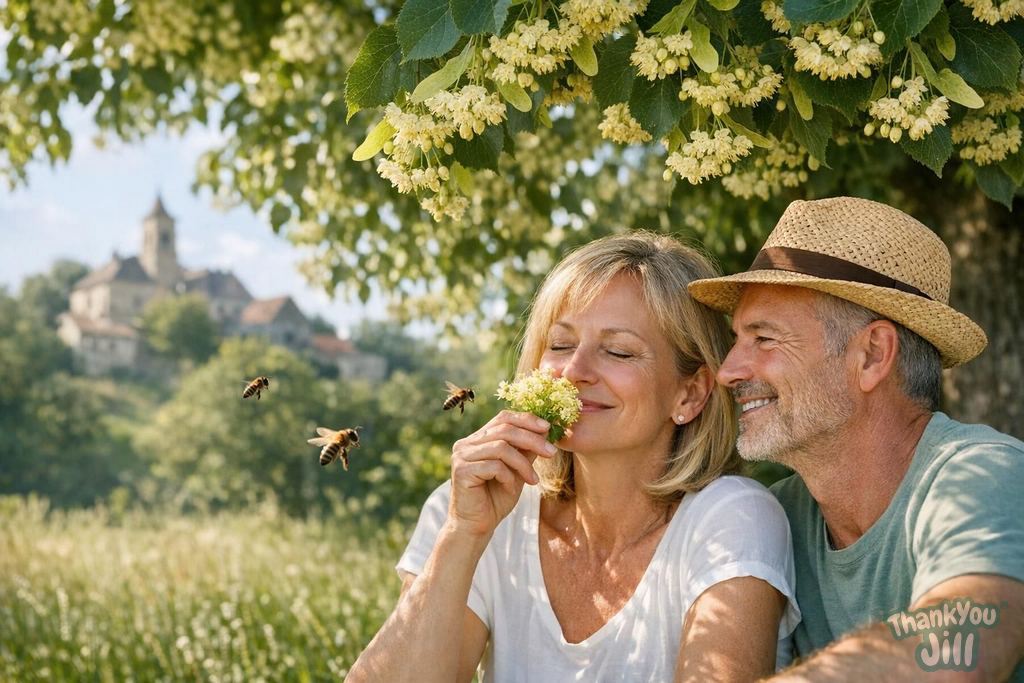
There's a moment in June when certain streets in Italian cities seem to change their smell. A sweet, honeyed, almost intoxicating fragrance drifts down from above — from the tall trees lining the avenues, their tiny yellowish flowers hanging in delicate clusters from the branches. It's the blooming linden, and anyone who has breathed in that scent even once never forgets it.
Linden: Two Species, One Unforgettable Scent
Italy is home to two main linden species that grow wild: the small-leaved linden or native linden (Tilia cordata) and the large-leaved linden (Tilia platyphyllos). The main difference lies in leaf size: small and heart-shaped in the first, large (up to 15 cm) in the second. Both share a distinctive feature that makes them instantly recognizable: the flowers are attached to an elongated, pale leafy bract that functions like a wing for seed dispersal. This winged bract is the linden's calling card — you'll often find it scattered on the ground beneath the trees. In parks and urban tree-lined streets, hybrid varieties (Tilia x europaea) are commonly planted for their pollution resistance and attractive crown shape.
Linden and Bees: A Love Story in June
Linden is one of the most important trees in European beekeeping. Its flowers produce abundant nectar rich in sugars, and bees forage on lindens with such intensity that you can literally hear it: a blooming linden is surrounded by a continuous hum audible from dozens of meters away. Linden honey is among Italy's most prized honeys: pale in color, almost white after crystallization, with an unmistakable floral fragrance and a fresh, slightly minty flavor. It's produced mainly in Piedmont (Alpine valleys), Lombardy, and parts of the northern Apennines, where wild linden forests remain abundant. Linden blooms for only 2-3 weeks in June — the bees know this and don't miss a single day.
Linden in Traditional Medicine and Herbal Therapy
Dried linden flowers (Flores Tiliae) are among the most widely used plant remedies in traditional European medicine. Linden tea is renowned for its diaphoretic properties (promotes sweating and reduces fever), antispasmodic effects (reduces muscle tension), and calming qualities (has a mild sedative effect on the nervous system). It's one of the most commonly prescribed herbal teas by traditional practitioners for flu, mild insomnia, and anxiety. Linden wood charcoal (obtained from wood pyrolysis) is used as an intestinal absorbent. Modern phytotherapy has confirmed many of these properties: linden flowers contain flavonoids (including quercetin and kaempferol), mucilages, essential oil (with farnesol as its main aromatic component), and tannins.
Linden in European Culture
Linden holds profound symbolic significance in Germanic, Slavic, and Italian culture. In Germany, the linden (Linde) is the tree of popular assemblies, open-air courts, and medieval village squares: beneath the linden, people gathered to discuss matters, render judgment, and celebrate weddings. Unter der Linden — beneath the lindens — is the title of one of the most famous medieval German poems (Walther von der Vogelweide, 13th century). Berlin's Unter den Linden avenue takes its name from the lindens that originally lined it. Throughout Italian villages and across Central Europe, centuries-old monumental lindens still stand — planted in squares as community trees, silent guardians of collective memory. Linden is also the preferred wood of sculptors creating religious figures in Alpine Europe: light, uniform, and remarkably easy to carve, it has given form to thousands of Madonnas, crucifixes, and saints in Alpine churches for centuries.
Linden Wood: The Carver's Favorite
Linden wood is pale, homogeneous, and almost free of grain and knots. It's the preferred choice of woodcarvers worldwide for how easily it works in every direction without splintering. Grinling Gibbons, the greatest woodcarver of Baroque Europe, used almost exclusively linden. Today, the bodies of electric guitars from some of the world's most famous brands (Fender, for instance) use linden for its lightness and balanced acoustic response.

The scent of blooming linden is one of those gifts summer offers without asking anything in return. Just ten seconds beneath a linden tree in June is enough to understand why all of Europe has built roads, legends, and remedies around it.
How to Experience Linden Every Day: From Tea to Tree-Lined Avenues
- Make tea with fresh flowers: If you can gather fresh linden flowers in June (from the tree or a certified organic supplier), brew a tea with 2-3 whole flowers per cup of warm water (90°C, not boiling). Steep for 8-10 minutes. The aroma and flavor are far more intense than dried flowers from an herbal shop.
- Harvest flowers at the right time: Pick flowers when they're just opening or still in bud — no more than 50% open. Fully opened flowers quickly lose their aromatic properties. Early morning is the best time to harvest.
- Drying: Spread flowers in a thin layer on absorbent paper in a shaded, well-ventilated spot. They'll dry in 5-7 days. Store in sealed glass jars, away from light, for no more than a year.
- Seek out authentic linden honey: Genuine linden honey comes from June-July blooms in areas where linden grows wild (Piedmont and Lombardy Alpine valleys). It's white and creamy after crystallization, with an intense floral aroma. Avoid honey that crystallizes immediately and has a yellow-orange color — it may be blended with other honeys.
- Walk beneath linden trees in the city: Many Italian cities (Turin, Milan, Rome, Bologna) have tree-lined avenues with lindens. In June, strolling beneath them at sunset when the fragrance is strongest is one of the most pleasant sensory experiences a city can offer. Bring children and teach them to recognize linden's scent: it's a sensory education worth a thousand books.
- Learn to identify the tree in summer and winter: In summer, the dense, dark green crown with yellowish flowers is unmistakable. In winter, look for the fallen winged bract on the ground: it's the linden's signature. Winter twigs have small, reddish, asymmetrical buds — another distinctive feature.
Linden is one of those trees that best demonstrates how nature and human culture have intertwined over millennia. The fragrance of its flowers is more than beauty: it's medicine, it's honey, it's wood for carving, it's a gathering place. Every linden on an avenue tells a story that began long before us.
Frequently Asked Questions
What is the main difference between small-leaved linden and large-leaved linden?
The main difference lies in leaf size: small-leaved linden (Tilia cordata) has small, heart-shaped leaves, while large-leaved linden (Tilia platyphyllos) has larger leaves, up to 15 cm in length.
How do you identify a linden tree in winter when it's not flowering?
In winter, you can identify linden by observing the winged bract fallen on the ground, which is typical of this tree, and the twigs with small, reddish, asymmetrical buds — distinctive characteristics of linden.
Why is linden so important for bees and honey production?
Linden produces abundant sugary nectar during its 2-3 week blooming period in June, intensely attracting bees. Linden honey is prized for its pale color and fragrance, with a fresh, slightly minty flavor.
How do you properly prepare tea with fresh linden flowers?
For an effective tea, use 2-3 fresh linden flowers per cup of warm water at 90°C, not boiling. Steep for 8-10 minutes. Harvest flowers when just opening or still in bud, preferably early in the morning, to preserve their aromatic properties.

Latest News




Comments
No comments yet. Be the first!
Leave a comment