


 Italiano
 Français
 Deutsch
 Español
 Português
 Svenska
 Suomi
Suomi
The Baobab
Africa's tree of life and its extraordinary role for wildlife
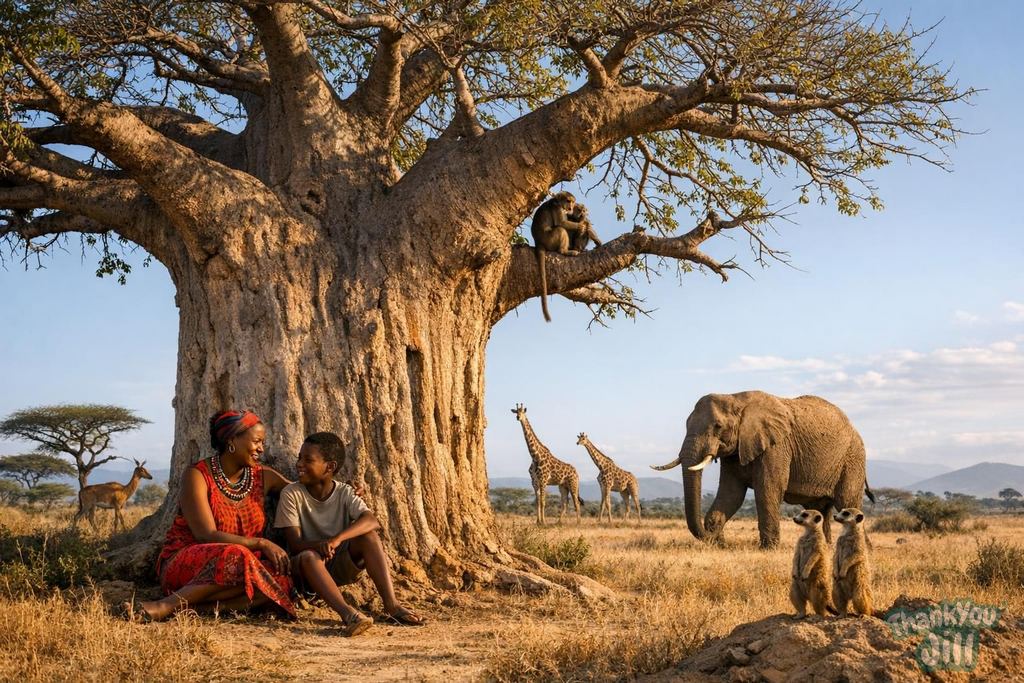
Antoine de Saint-Exupéry made it famous in The Little Prince as a threat to small planets. But the real baobab—the one that grows in African savannas, Madagascar, and northern Australia—is the exact opposite of a threat: it's a source of life for everything around it, one of the most critical ecological nodes in tropical arid ecosystems.
A water reservoir holding 120,000 liters
The first thing to understand about the baobab is its extraordinary capacity to store water. The grayish, bulbous trunk isn't woody like a beech or oak: it's made of spongy, fibrous tissues that absorb water like a sponge during the rainy season. An adult baobab can hold between 40,000 and 120,000 liters of water in its trunk—a reserve that allows it to survive dry seasons lasting 8-10 months. This water supply isn't just a survival strategy for the tree: it's a vital resource for dozens of animal species in an environment where water is the scarcest commodity. Elephants, during the driest seasons, pierce the baobab's bark with their tusks to access the internal water—a behavior documented across many areas of the African savanna and Miombo woodland. The baobab's wood, already dead in the central part of older trees, absorbs rain like a sponge and releases it slowly: a natural cistern that requires no maintenance.
The baobab as a hotel: who lives there
The natural cavities that form in the trunks of older baobabs (from the death of the central wood or erosion caused by elephants) host an incredible variety of animals. Inside the trunk: colonies of Apis mellifera scutellata (African honeybees), owls, hawks and nocturnal raptors, fruit bats, agamas, monitor lizards and lizards that use the cavities as thermal refuges. On the branches: weaver birds (Ploceidae) build their elaborate interwoven nests. The ground hornbill (Bucorvus leadbeateri), a savanna bird with an enormous beak, regularly nests in baobab cavities. Vultures (Gyps africanus) use the high branches as perches and vantage points. On the roots: mongooses, warthogs, snakes and monitors use the basal cavities as dens. The galago (bush baby, an African nocturnal primate) spends the day sleeping in baobab cavities and hunts insects among the branches at night.
Baobab flowers: a nocturnal appointment with bats
The flowers of the African baobab (Adansonia digitata) are large and white, with long hairy stamens that resemble an inverted shaving brush. They open exclusively at night, last less than 24 hours, and are pollinated mainly by fruit bats (Epomophorus wahlbergi and similar species) that feed on the abundant nectar. The baobab-bat relationship is a classic example of chiropterophily—adaptation to pollination by bats: white flowers (visible at night), nocturnal opening, fermented scent (attractive to bats), enormous quantities of nectar. In Madagascar, where fruit bats have been decimated in some areas, baobab reproduction is seriously compromised: without their nocturnal pollinators, many baobabs fail to fertilize their flowers.
The fruits: nourishment for great and small
The baobab fruit—called monkey bread in English—is a large woody capsule covered in green fuzz, containing white floury pulp around the seeds. The pulp is extremely rich in vitamin C (six times more than oranges by weight), calcium, magnesium and potassium. It has been consumed for millennia by African populations as food, beverage (dissolved in water), and medicine. The animal most dependent on baobab fruits is the African elephant: during the dry season, elephants can feed almost exclusively on baobab fruits, leaves and bark. In some areas of Botswana, the pressure from elephants on baobabs is so high that it causes the death of many adult specimens—a complex interaction between a keystone animal and a keystone plant in an already fragile ecosystem.
The baobab in Italy: where to see it
The baobab doesn't grow naturally in Italy (it can't tolerate winter frosts), but some notably large specimens can be found in southern botanical gardens and in some private collections. The Palermo Botanical Garden hosts a few examples. Several greenhouses in Italian botanical gardens have young plants. The only way to see a baobab in its natural context is a trip to sub-Saharan Africa, Madagascar, or northern Australia.

The baobab isn't a tree. It's an entire ecosystem that chose to take the form of a tree. Every crevice, every branch, every flower, every fruit is a gateway to another species that depends on it. Removing an old baobab from the savanna is like demolishing an entire building full of homes.
Bringing the baobab into everyday life: Italian products
- Baobab pulp powder: Available in organic food shops and online stores, dried and powdered baobab pulp is a superfood with one of the highest vitamin C contents among natural fruits. It has a tart, citrusy flavor. Use it added to smoothies, blended drinks, yogurt, and herbal teas. The recommended dose is 1-2 teaspoons daily.
- Baobab oil for skin: Extracted from the seeds, it's a light vegetable oil rich in essential fatty acids (omega-3, -6, -9) and vitamin E. It's used in natural cosmetics as a moisturizer and healing agent for dry skin, hair, and stretch mark care. Buy from brands with fair trade certification: the baobab supply chain involves African rural communities that earn income from harvesting wild fruits.
- Visit a nature photography exhibition: The Madagascar baobab (Avenue of the Baobabs near Morondava) is one of the world's most famous photographic subjects. Exhibitions on African nature almost always include images of baobabs at sunset. The Natural History Museums in Milan, Rome, and Florence periodically organize exhibitions of this type.
- With children: reread The Little Prince: The scene in Saint-Exupéry's novel about uprooting baobabs before they grow too large is an excellent entry point for explaining that real baobabs are the opposite: they're sources of life that must be protected, not cut down. The distance between fiction and reality is itself a lesson in critical reading.
- Support baobab conservation organizations: In Madagascar, where 5 of the 8 baobab species are endemic and some are threatened with extinction, organizations like Baobab Conservation and the Missouri Botanical Garden work to protect habitats. Even small donations help.
The baobab is one of those trees that changes how you look at the plant world: it reminds you that a single organism can be the backbone of an entire ecosystem, that a tree's shape is always the answer to a specific problem, and that 80,000 years of history (the age of the Pando colony) or even just 3,000 years of an African baobab represent a scale of time that defies every mental category we have.
Frequently Asked Questions
What is the baobab's role as a water reservoir in arid ecosystems?
The baobab stores between 40,000 and 120,000 liters of water in its spongy trunk, allowing it to survive dry seasons lasting 8-10 months. This reserve is also vital for animals like elephants, which extract water by piercing the bark.
How does the baobab support animal biodiversity through its cavities?
The baobab's natural cavities host many species: bees, raptors, bats, lizards and primates use these spaces as shelters or dens, while weaver birds build nests on the branches, creating an autonomous and complex ecosystem around the tree.
Why do baobab flowers open only at night and who pollinates them?
Baobab flowers open exclusively at night and last less than 24 hours, attracting mainly fruit bats that feed on the nectar. This chiropterophily is an evolutionary adaptation for nocturnal pollination, essential for the tree's reproduction.
What are the food and cosmetic uses derived from the baobab?
The fruit pulp is a superfood rich in vitamin C, used in powder form for smoothies and herbal teas. Oil extracted from the seeds is used in natural cosmetics as a moisturizer and healing agent for skin and hair, while also supporting African rural communities involved in the supply chain.
Latest News



Comments
No comments yet. Be the first!
Leave a comment