

 English
 Italiano
 Français
 Deutsch
 Español
 Português
 Svenska
 Suomi
Suomi
The Giant Sequoia
The most massive organism ever to live on Earth: history and biology
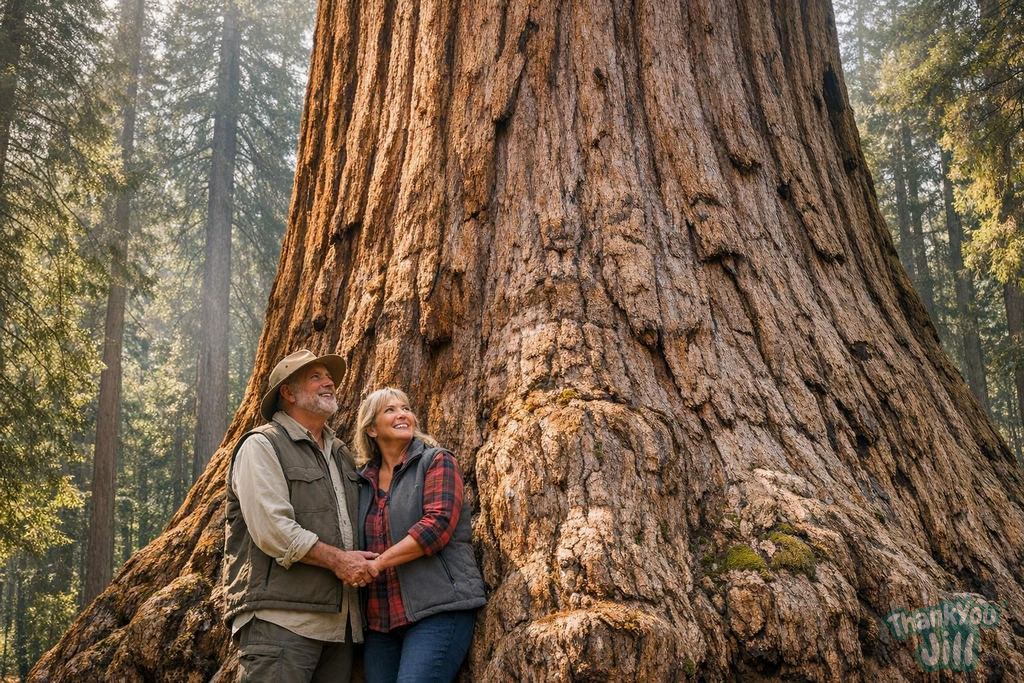
To understand the dimensions of a giant sequoia, a number isn't enough. You have to stand beneath it. Tilt your head back until your neck aches, search for the crown and fail to find it. Then place your hand on the reddish-orange trunk and feel that it's almost soft — spongy, warm, alive. And think that what you're touching has been alive since Rome wasn't yet an empire.
What is the giant sequoia
The Sequoiadendron giganteum (giant sequoia or big tree) is the species that holds the absolute record for biomass per individual organism on all of Earth. It's not the tallest (that record belongs to the coast redwood, Sequoia sempervirens), nor is it the oldest (that record belongs to the bristlecone pine), but it is the most massive: the General Sherman, the largest living specimen, contains approximately 1,487 cubic meters of wood and weighs about 1,385 tons — more than 200 adult elephants. It grows exclusively on the western slopes of California's Sierra Nevada, between 1,400 and 2,150 meters in elevation, in approximately 65-75 isolated groves that occupy a total of about 14,000 hectares. Its distribution is so restricted and fragmented that it's vulnerable: it's classified as a vulnerable species on the IUCN Red List.
How it grows so large: the secrets of biomass
The giant sequoia grows quickly by forest standards: in its first 20 years it can gain 60-90 cm in height per year. But the key to its extraordinary mass isn't speed: it's longevity combined with resistance to damage. The sequoia's bark can be up to 90 centimeters thick — an extraordinary thermal insulator that protects the living cambium from fire. The wood is impregnated with tannins and resins that make it virtually immune to fungal decomposition and insect attacks. The roots spread laterally for 30-50 meters but remain shallow (1-3 meters deep) — a vast network that intercepts every drop of available water. It's no wonder, then, that a sequoia can survive for 3,000 years accumulating biomass year after year, without ever having to "start over" due to disease or decomposition.
Fire as an ally: a surprising relationship
The giant sequoia has a relationship with fire that defies intuition. Its cones remain closed on the tree for years, even decades, waiting for the temperature of a fire to open them and release seeds. Sequoia seeds germinate better on burned soil: ash reduces soil acidity and eliminates competition from other species. The thick bark protects the cambium during low-intensity fires. In nature, before the systematic fire suppression that began in the 20th century, natural fires regularly swept through sequoia forests every 5-15 years, keeping the understory clean and favoring sequoia regeneration. The policy of total fire extinction adopted for decades instead accumulated enormous amounts of dry material in the understory of California's forests, making modern fires much more intense and destructive — capable of killing even giant sequoias, something that low-intensity natural fires rarely did. The Castle Fire of 2020 killed between 7% and 10% of all existing giant sequoiadendrons in a single event.
The sequoia in Italy: in parks and historic gardens
The giant sequoia was introduced to Europe in the second half of the 19th century as an ornamental plant with striking visual impact in grand parks and historic gardens. In Italy, notable specimens can be found in various locations: in the Monza Park (Lombardy), in the gardens of Villa Carlotta on Lake Como, in the Villa Demidoff Park at Pratolino (Florence), and in various botanical gardens. These Italian specimens are 150-180 years old and are already impressive — with trunks 3-5 meters in circumference — but they're still far from the dimensions of California's giants. They resist the cold of the Po Valley and Alps well (down to -20°C), but suffer from summer drought and the calcareous soils found in many Italian regions.
The coast redwood: the taller cousin
The giant sequoia's cousin, the coast redwood (Sequoia sempervirens), is the world's tallest tree (Hyperion: 115.92 meters) and grows exclusively in the coastal strip of Northern California and Oregon, wrapped in Pacific fog. It has a narrower trunk, different foliage (flattened needles in two rows), and can live 2,000 years. It too was introduced to Italy as an ornamental in the 19th century: specimens can be found in Liguria, Tuscany, and in the grand gardens of Lake Como, where the mild climate favors its growth.

The giant sequoia is so large that it changes your perspective in a physical way, not just a mental one. One moment you're standing beside its trunk and you feel as small as an ant. The next moment, you feel part of something immensely larger. Both sensations are true.
How to encounter the sequoia: in California and Italy
- Sequoia National Park (California): the place where giant sequoiadendrons are most concentrated and most accessible. The General Sherman trail is short (800 meters round trip) and suitable for all ages. The Park is reachable from Los Angeles in about 4-5 hours or from San Francisco in about 5 hours. The best season to visit is May-October. In winter, access can be blocked by snow.
- Mariposa Grove (Yosemite): the most visited giant sequoia grove in the world, in Yosemite National Park. Trails among the sequoias of varying lengths, accessible to families with children.
- Italian sequoias: if you can't go to California, look for sequoiadendrons in Italian historic parks. Monza Park is the most accessible: there are specimens 160 years old that, while not reaching California dimensions, are already impressive and wonderful. Admission to Monza Park is free.
- Measure your Italian sequoia: use the circumference method (already described in the article on tree records) to estimate the age of Italian specimens. A sequoia with a 400 cm circumference is about 150-160 years old — exactly the age of the first European plantings from the 19th century.
- Explain the scale to children: the giant sequoia is as tall as a building with 25-30 stories. Its trunk has a diameter of about 11 meters — like an 80-square-meter apartment. Its weight is 1,385 tons — like 200 adult African elephants. These comparisons make abstract numbers suddenly concrete.
- Watch the film "The Redwood": several documentaries about the coast redwood and giant sequoia are available on streaming platforms (BBC, Netflix, National Geographic). Some use aerial images and drone footage that convey the scale of these organisms better than any photograph. An excellent starting point before a visit or as a substitute if a visit isn't possible.
Encountering a giant sequoia is one of the most transformative experiences the natural world offers. It's not just a matter of size — it's the feeling of being in the presence of something that has traversed 3,000 years of human history while simply remaining itself. Nothing more, nothing less. And that simplicity, in the face of those dimensions, is moving.
Frequently Asked Questions
What characteristics allow the giant sequoia to reach such extraordinary dimensions?
The giant sequoia grows thanks to its longevity, resistance to damage, and bark up to 90 cm thick that protects it from fire. Additionally, the wood is rich in tannins and resins that prevent decomposition, while the shallow roots spread widely to absorb water.
How does fire affect the reproduction and survival of the giant sequoia?
Fire opens the sequoia's cones, releasing seeds that germinate better on burned soil, where competition is reduced. The thick bark protects the tree during low-intensity fires, promoting natural regeneration of sequoias in forests.
When is it best to visit giant sequoias in California for the best experience?
The best time to visit giant sequoias in California is from May to October, when the climate is most favorable and trails are accessible. In winter, snow can block access to parks like Sequoia National Park.
How can you estimate the age of a giant sequoia cultivated in Europe?
The age of a European sequoia can be estimated by measuring the trunk's circumference: for example, a circumference of 400 cm corresponds to about 150-160 years, typical of specimens planted in Europe in the 19th century.
Latest News


Comments
No comments yet. Be the first!
Leave a comment