

 English
 Italiano
 Français
 Deutsch
 Español
 Português
 Svenska
 Suomi
Suomi
The Little Owl
Nocturnal hunter among the trees: habits, curiosities, and symbolism
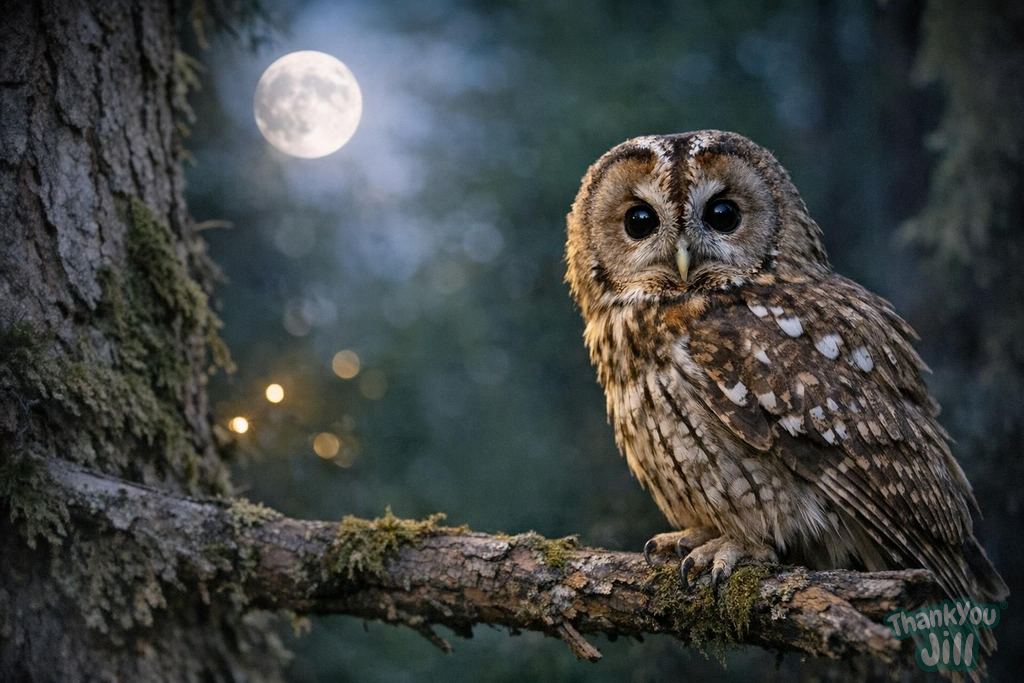
On certain evenings in the countryside, silence is broken by a sound that seems like a distant cry, melancholic, somewhat eerie. Ku-wìt. Again: ku-wìt. It's the little owl. It's not a harbinger of misfortune — it's just a small female nocturnal raptor announcing her territory from the branch of an old olive tree or the windowsill of a farmhouse. One of the oldest voices of rural Italy.
Who is the little owl
The little owl (Athene noctua) is the most widespread nocturnal raptor in Italy. It's small — about 22-25 cm, barely larger than a starling — with a round, broad head, piercing yellow eyes positioned frontally, white eyebrows that give it a perpetually frowning and suspicious expression. Its plumage is brownish with white spots and streaks that allow it to blend perfectly with tree bark. It's the only Italian nocturnal raptor that is frequently active during the day — you can see it perched in full sunlight on a telephone pole, a rock, or an exposed branch. Its distribution throughout Italy is ubiquitous: from plains to hills, from agricultural fields to cities, from forests to cemeteries. It's one of the most common birds in the Italian rural landscape, though its numbers have declined significantly in recent decades due to changes in agricultural practices and pesticide use.
Phenomenal hearing: hunting in absolute darkness
The little owl hunts primarily at night, and its main hunting tool isn't its eyes — it's hearing. The little owl's ears (like those of all Strigidae) are positioned asymmetrically on the skull: one ear is slightly higher than the other. This asymmetry allows it to locate the sound source not only horizontally (as we would) but also vertically, achieving precise three-dimensional localization. In laboratory experiments conducted in complete darkness, little owls locate and capture mice with 100% accuracy, guided only by the rustling of their movements in hay. The little owl perceives sounds up to 10 octaves — an auditory range far superior to human hearing. The facial disc — the characteristic "mask" of rounded feathers surrounding the face of all nocturnal raptors — functions as an acoustic parabola: it collects sound waves and concentrates them toward the ears, amplifying weak sounds by a factor of 4-5 compared to a normal "ear."
The little owl's trees
The little owl is closely tied to tree cavities for nesting. It nests in natural holes in oak, olive, cherry, walnut, and other fruit trees — especially in old specimens with large cavities. It also uses cavities created by woodpeckers, niches in walls, farmhouse attics, cracks in rocks. The disappearance of old fruit trees with natural cavities — replaced by intensive orchards with young, hole-free trees — is one of the main causes of the little owl's decline in the Italian agricultural landscape. The little owl is also one of the birds that benefits most from artificial nest boxes: establishing artificial nesting programs in agricultural areas has shown excellent results in supporting local populations.
The little owl in culture: between wisdom and bad omens
In ancient Greek culture, the little owl was the animal symbol of Athena, goddess of wisdom — hence its association with intelligence and learning, which has survived in university symbols and coins. The Greek one-euro coin still features Athena's little owl today, drawing from ancient Athenian drachmas. In medieval and modern Italian (and European) popular culture, the little owl is instead often associated with death and misfortune — its nocturnal call near a house was traditionally interpreted as an announcement of impending loss. This superstition led for centuries to the persecution of the little owl: they were impaled on stable doors to ward off bad luck. Today it is a protected species at national and international levels.
The little owl's diet: the pellet of nature's gourmands
The little owl feeds primarily on mice, voles, crickets, beetles, earthworms, and lizards. It's one of the most efficient natural biological controllers of rodents in agricultural fields: a pair of little owls with chicks consumes hundreds of mice during the breeding season — an ecosystem service of real economic value to farmers. The little owl (like all nocturnal raptors) produces pellets (or egagropiles): compact regurgitations of hair, bones, and insect chitin that it cannot digest. The little owl's pellets are found beneath their preferred perches and are easily recognizable. Dissecting them (with gloves and tweezers) reveals exactly what the little owl has eaten in the last 24-48 hours: a natural ecology laboratory accessible to children as well.

The little owl doesn't bring misfortune — it brings ecological order. Every night, while you sleep, it's out doing its job: keeping the populations of mice, crickets, and beetles in your territory in balance. It's the night shift you never had to pay for.
How to encourage little owls near your home: practical tips
- Install a little owl nest box: the ideal nest box for a little owl has internal dimensions of about 35×25×25 cm with an entrance hole of 8-9 cm in diameter. It should be positioned 3-5 meters high on a tree or building, with the opening facing east or northeast to avoid direct afternoon sun. Inside, place a layer of wood shavings (not sawdust: too fine). The box should be cleaned every year in September-October (after the breeding season).
- Don't use rodenticides: mouse poisons (second-generation anticoagulants like brodifacoum) accumulate in the tissues of poisoned rodents and kill the nocturnal raptors that eat them. It's the leading cause of secondary poisoning deaths in little owls and barn owls in Italy. If you have a mouse problem, use mechanical traps — or install a little owl nest box and let it do the work.
- Preserve old fruit trees: old olive, cherry, walnut, and oak trees with natural cavities are the primary habitat for little owls in the Italian agricultural landscape. If you have old trees with holes, don't cut them down for their age: they contain invisible ecosystems that depend on those cavities.
- Listen to the call at night: the little owl's call is very easy to learn and recognize. The high-pitched ku-wìt of the female (the "opening call"), answered by the deeper call of the male. In spring, during courtship periods (January-March), duets between male and female are frequent and prolonged on clear nights. Open your window on a March evening and listen.
- With children — the little owl's pellet: finding a pellet beneath a little owl's perch (look under roof eaves, at the base of trees with cavities, under telephone poles near fields) is a nature adventure accessible to everyone. Take it home, soak it in warm water for 10 minutes, then gently open it with tweezers and separate bones and hair. Identify the bones: that's a mouse femur, this is a vole skull. It's a zoology lab at zero cost.
- Report little owls in distress: injured or confused little owls during the day (they can be stunned by collisions with cars or windows) should be collected with gloves and taken to the nearest CRAS (Wildlife Recovery Center). Don't keep them at home: they are protected wild animals and require specialized care.
The little owl doesn't need vast forests: it's content with an old olive tree with a hole, a field with enough mice, a quiet night to hunt. The least we can do is stop poisoning their mice and leave them the old trees. The rest they do themselves, admirably, for millennia.
Frequently Asked Questions
How does the little owl locate prey in absolute darkness?
The little owl uses asymmetric hearing, with ears positioned at different heights, which allows it to locate sounds three-dimensionally. The facial disc amplifies weak sounds, enabling it to hunt with precision even without light.
What are the ideal characteristics of a little owl nest box?
The ideal nest box measures about 35×25×25 cm with an entrance hole of 8-9 cm in diameter. It should be positioned 3-5 meters high, with the opening facing east or northeast, and contain a layer of wood shavings that aren't too fine.
Why is it important to preserve old trees with cavities for the little owl?
Old trees with natural cavities are essential for the little owl's nesting. Their disappearance reduces available habitats, contributing to the decline of little owl populations, especially in intensive agricultural landscapes.
What happens if rodenticides are used in areas frequented by little owls?
The use of rodenticides causes secondary poisoning in little owls, which become poisoned by eating contaminated rodents. This is one of the leading causes of death in these nocturnal raptors, compromising their role in natural rodent control.

Latest News




Comments
No comments yet. Be the first!
Leave a comment