


 Italiano
 Français
 Deutsch
 Español
 Português
 Svenska
 Suomi
Suomi
The Tawny Owl
Silent master of the night among Italy's beech and oak forests
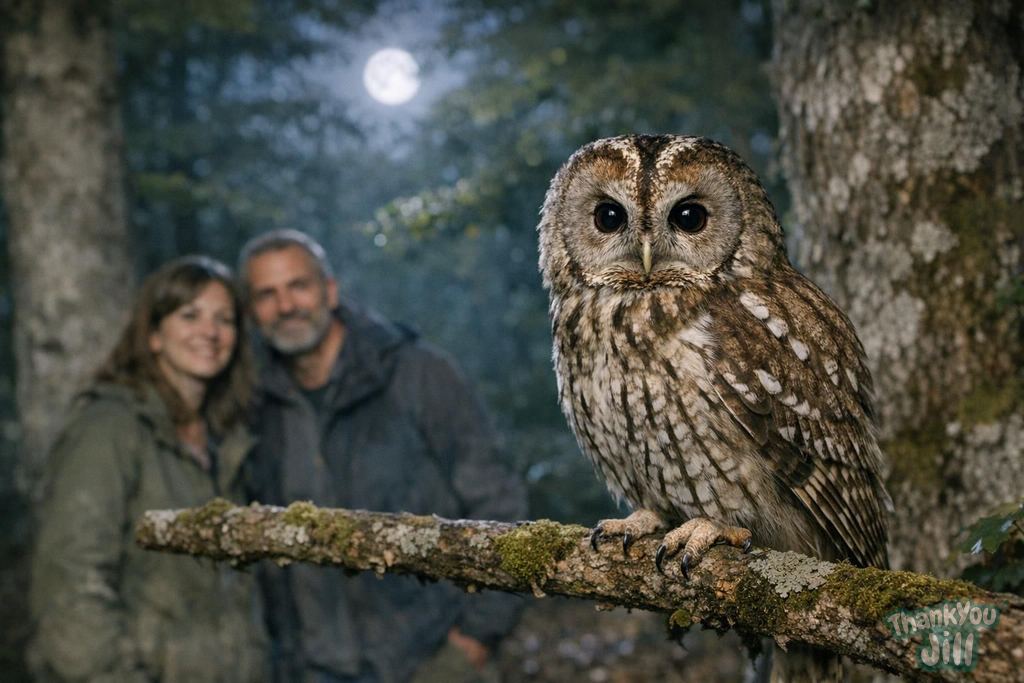
On autumn nights, in the beech and oak forests of the Apennines, you hear a sound that sends shivers down the spine of those unfamiliar with it: a long, modulated, deep howl that echoes between the trunks in the darkness. Hu-huhu-huuuuu. It's the tawny owl. It's not an omen — it's simply the largest and most powerful nocturnal raptor in Italy announcing its presence in the territory.
Who is the tawny owl
The tawny owl (Strix aluco) is the most common and widespread nocturnal raptor in Europe, present in all types of Italian woodland from the plains up to about 1,500 meters elevation. It's roughly the size of a pigeon, but far more massive: weighing 350-600 grams, its stocky form with a large head makes it seem even more imposing. Unlike owls with characteristic ear tufts, it has a completely round head with a marked facial disc that can be reddish-brown or gray depending on its morph. Its eyes are large and black — not yellow like in barn owls — and completely fixed in their sockets: to look to the side, the tawny owl must turn its entire head. To compensate for this eye rigidity, the tawny owl's neck (like that of all Strigidae) can rotate 270 degrees — three-quarters of a turn in both directions.
Silent flight: an engineering marvel of feathers
The flight of Strigidae is almost completely silent — a fundamental adaptation for a predator approaching prey at night, when every rustle puts them on alert. The secret lies in the structure of the flight feathers. In diurnal raptors (hawks, buzzards), the leading edge of the primary flight feathers (the largest wing feathers) is hard and sharp — producing a characteristic sound in flight. In the tawny owl (and all Strigidae), that edge is instead jagged, with a series of microscopic teeth that break up air turbulence, eliminating flight noise. The covert feathers are extremely soft and overlapped in a way that further absorbs vibrations. The result is that a tawny owl flying a meter away from you in complete darkness is completely inaudible — you only perceive the displacement of air from its passage.
Loyalty to territory and partner
The tawny owl is one of the most territory-faithful birds in existence. A pair of tawny owls can occupy the same woodland for 10-20 consecutive years, returning each year to the same cavity to nest. The two partners remain together for life (they are almost absolutely monogamous) and recognize each other by song: the male systematically responds to the female's call, and the nocturnal duets between the two partners are among the most beautiful and characteristic voices of the Italian night forest. The male brings food to the female throughout the entire incubation period (February-April) and for the first weeks after the chicks hatch: a considerable parental investment for a wild bird.
The tawny owl's territory and its relationship with trees
A tawny owl pair's territory is centered on a nesting cavity (almost always a natural cavity in an old tree, rarely a woodpecker cavity or artificial nest box) and extends over approximately 15-20 hectares of woodland. Within this territory, the two owls know every tree, every perching branch, every mouse-rich zone. Preferred perches — high branches with broad views, often the same ones for years — are recognizable by the accumulation of pellets and talon marks on the branch. The tawny owl depends on large trees with cavities for breeding: it's one of the species most affected by the reduction in old trees in intensively managed forests.
What it eats and how it hunts
The tawny owl is a generalist predator that adapts to available prey in its territory. In countryside and hill woodlands, the diet is dominated by mice, voles, shrews, and moles. In spring-summer, when abundant, it also preys on frogs, lizards, earthworms, beetles, and other large invertebrates. In urban areas with tree-filled parks, pigeons, blackbirds, and noctule bats can constitute a significant part of the diet. Hunting occurs almost exclusively from a fixed perch: the tawny owl waits motionless on a branch, orienting its facial disc toward every sound source. When it locates prey, it launches into an almost vertical silent flight and captures it with its talons. The localization is so precise that it can catch a mouse in tall grass in complete darkness.

The tawny owl flies through absolute darkness without making the slightest sound, and hears things we can't even perceive. It's invisibility made bird. And every night, in Italian forests, it does its job as sentinel of the darkness with a precision that no drone can match.
How to encounter the tawny owl: night outings and nest boxes
- Go out at night in autumn: the period of greatest vocal activity for the tawny owl is August-November, when young of the year disperse and adult pairs reassert themselves in their territories. Full moon nights are best: tawny owls sing more on clear nights. All you need is a woodland near home, a flashlight, silence, and patience.
- Learn the call: the male's territorial call is a long modulated whistle (huuuu with descending inflection, then pause, then hu-huhu-huuuuu). The female's call is higher-pitched and more direct (kewik or ku-wìt). Duets between the two are recognizable: one responds to the other within seconds. Apps like Merlin Bird ID and BirdNET identify the call with extremely high accuracy.
- Nest box for tawny owls: the tawny owl nest box is larger than those for barn owls: approximately 45×30×30 cm, with an entrance hole 18-20 cm in diameter, positioned 4-6 meters high on a tree with a large trunk (oak, beech, plane tree). It's accepted more readily if positioned in a woodland already frequented by tawny owls (recognizable by pellets beneath perches).
- Look for pellets in the morning: tawny owl pellets are larger than barn owl pellets (4-6 cm long, dark and shiny from mouse fur). They're found beneath preferred perches: at the base of large trees in cemeteries, under the eaves of church and farmhouse roofs, under bridges. Dissection is an excellent educational activity for middle schools.
- Watch for fledglings on the ground in spring: from May to July, young tawny owls just out of the nest (branchers) spend several days on the ground or on low branches while learning to fly. If you find one on the forest floor, don't pick it up: it's normal, the parents continue to feed it from a distance. Picking it up is counterproductive and illegal (protected species). Call a wildlife rescue center only if it's visibly injured or if there are cats in the area.
The tawny owl is one of those animals that makes you understand how much life exists in a forest at night — a parallel life, silent, invisible to those who visit the forest only by day. Learning to search for it is learning to see the entire forest, not just the illuminated half.
Frequently asked questions
What is the secret of the tawny owl's silent flight and how does it help with hunting?
The tawny owl's silent flight is due to the jagged structure of the flight feathers and soft covert feathers that absorb vibrations. This allows the tawny owl to approach prey without being heard, increasing the effectiveness of nocturnal hunting.
How can you recognize the territory of a tawny owl pair in woodlands?
A tawny owl pair's territory extends over 15-20 hectares and is centered on a nesting cavity in an old tree. Preferred perches are high branches with accumulations of pellets and talon marks, often used for years, indicating the pair's stable presence.
When is the best time to hear the tawny owl's call and how do you identify it?
The best period is August to November, especially on full moon nights, when tawny owls are most vocal. The male emits a long modulated whistle while the female has a higher-pitched call; duets between the two are distinctive and can be recognized with apps like Merlin Bird ID.
What should you do if you find a young tawny owl on the ground in spring?
Young tawny owls just out of the nest can stay on the ground or on low branches while learning to fly. You should not pick them up because the parents continue to feed them from a distance. It's advisable to call a wildlife rescue center only if the chick is injured or in danger from predators.

Latest News




Comments
No comments yet. Be the first!
Leave a comment