


 Italiano
 Français
 Deutsch
 Español
 Português
 Svenska
 Suomi
Suomi
The Golden Oriole
Italy's most vibrant woodland bird: arrives from Africa each spring
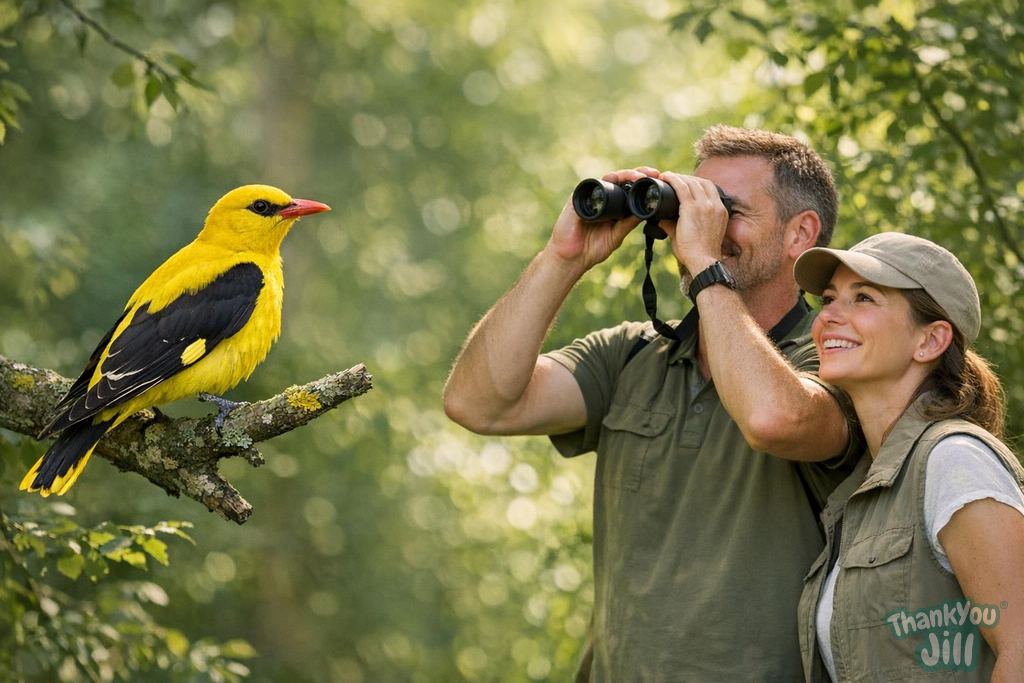
There are May mornings when you walk through a Po Valley forest and hear a call you don't expect: fluid, melodious, almost exotic — as if someone had brought a parrot into a poplar grove. Then you see it: brilliant golden yellow with black wings, the size of a blackbird, flying swiftly through the canopy. The golden oriole. One of Italy's most beautiful birds, and one of the most overlooked.
A tropical jewel in the Italian forest
The golden oriole (Oriolus oriolus) is Europe's only representative of the Oriolidae family — a family of predominantly tropical birds. The adult male is an intense, brilliant golden yellow with black wings and tail, and a black stripe running from the eye to the beak. The female is greenish-yellow with streaking on the breast — far more camouflaged and harder to spot among the foliage. Both have a reddish, robust, slightly curved beak suited to gathering fruit and insects. The male's appearance is so incongruous in the European forest landscape that, to anyone seeing it for the first time, it seems to have escaped from an exotic cage. Yet it's a genuinely wild Italian bird — albeit only for 4-5 months each year.
Migration: three months in Africa for seven months at home
The golden oriole is a trans-Saharan migrant: it spends winter in sub-Saharan Africa (central and eastern Africa, as far as South Africa) and returns to Italy every year between late April and early May for the breeding season. Migration is solitary, predominantly nocturnal, and takes 2-3 weeks in each direction. The journey covers approximately 8,000-10,000 km each way — an extraordinary physical feat for a bird weighing just 60-70 grams. Navigation relies on a combination of magnetic orientation, stellar navigation, and visual memory of landscapes. It arrives in Italy mainly in riparian woodlands of plains and hills — poplars, willows, elms, oaks — and departs for Africa between August and September, when Europe's insect season ends. Young birds born that year leave before the adults.
The nest: a suspended engineering marvel
The golden oriole's nest is one of the most elegant and ingenious in the Italian forest. Built by the female over 10-15 days, it has the shape of a deep cup suspended like a hammock, hanging in mid-air between two forked horizontal branches high in the canopy (5-15 meters from the ground). Materials used: dry grass, plant fibers, stems, soft materials — all woven with such precision that the nest appears almost textile-like. The structure is so sturdy that it sways in the wind without breaking and protects the eggs from bad weather thanks to its deep cup shape. Its position high in the canopy makes it nearly invisible from outside the forest. Finding a golden oriole nest is rare and fortunate: they produce only one per season, containing 3-4 white eggs with dark spots.
The song: the most beautiful call in the Italian forest?
The golden oriole's song is highly melodious and easily recognizable. The most characteristic phrase sounds like fiu-fiu-fiuuu or ooo-lio-leo — flute-like, warm, with an almost tropical inflection. The alarm call is harsh and unpleasant: a raspy screech that resembles a wildcat's cry. Golden orioles sing intensely in early morning and early afternoon, especially males defending territory. The song is so distinctive that in Italian folk culture the golden oriole is often called "galbula" or "verdon" in Venetian dialect, or "lori" in some regions: names evoking its color (gold, yellow-green) or the sound of its song.
Diet and ecological role
The golden oriole is an opportunistic omnivore: in spring it feeds mainly on large insects (caterpillars, beetles, grasshoppers, chrysalises) found among the foliage of high canopy trees. In summer and autumn, before migration, it shifts to a more frugivorous diet: wild cherries, blackberries, figs, mulberries, various berries. Its ecological role is important as a seed disperser (it swallows fruit whole and defecates seeds at a distance) and as a predator of defoliating canopy caterpillars, contributing to forest health.

The golden oriole travels 10,000 km twice a year to return to the forest where it was born. Every spring, when you hear its call, there's someone who has just returned from Africa to begin again. I don't know if you'd call it courage, but it's certainly not chance.
How to Spot the Golden Oriole: Tips for Beginners and Experienced Birdwatchers
- Search riparian woodlands in May and June: The golden oriole prefers poplar, willow, and elm forests along lowland rivers, as well as mixed oak and hornbeam woodlands in hilly areas. The Po, Ticino, Mincio, Adige, and Arno valleys in Tuscany are excellent habitats. You'll hear the bird's distinctive song long before you see it.
- Look high in the canopy: The golden oriole lives almost exclusively in the upper canopy of trees (16–65 feet). You won't find it on the ground or in low shrubs. Use binoculars and look for the striking yellow-and-black contrast against green foliage. Its flight is direct, fast, and slightly undulating—distinctive enough to recognize even in silhouette.
- Early morning is best: Between 6 and 9 a.m. in May and June, the golden oriole sings frequently and intensely. In good habitat areas, you may hear 2–3 males calling back and forth from different woodlands simultaneously.
- With children—learn the song: The golden oriole's call is one of the easiest bird songs to imitate in Italy: a series of 3–4 descending, flute-like notes, almost like a whistle. Try whistling it in the woods—sometimes males respond, thinking they've heard a rival in their territory. Don't overuse this technique, as it does stress the bird, but a single attempt makes for an unforgettable birdwatching experience for kids.
- Photographing it is a challenge: The golden oriole is nervous and difficult to photograph because it stays almost constantly within dense foliage. The best technique is to wait patiently in a singing bird's woodland, identify the branch it uses most often as a perch, and aim your telephoto lens there. Low morning sunlight illuminating the male's golden plumage is spectacular.
- Follow migration data: Platforms like eBird (Cornell Lab) and Ornitho.it collect real-time bird sightings. In April and May, tracking the golden oriole on these maps tells you when and where migration is arriving in your area—so you can prepare for observation.
The golden oriole is one of those birds you have to actively search for: they don't show themselves easily, they don't visit feeders, and they avoid suburban gardens. But when you finally see one in full light—that burnished gold against green leaves—you'll immediately understand why it's worth the effort.
Frequently Asked Questions
How do you tell a male golden oriole from a female during breeding season?
The male golden oriole is brilliant golden yellow with black wings and tail, plus a black stripe running from the eye to the bill. The female is greenish-yellow with streaking on the breast—much more camouflaged and harder to spot among the leaves.
What ecological role does the golden oriole play in European woodlands during its stay?
The golden oriole helps maintain forest health by preying on defoliating caterpillars and dispersing seeds from fruits like wild cherries and blackberries. It swallows fruit whole and defecates the seeds at a distance, promoting plant regeneration.
When and where is it easiest to observe the golden oriole in its natural habitat?
The golden oriole is most easily observed between May and June in the upper canopy of lowland riparian forests and hillside woodlands—poplars, willows, and oaks—especially in early morning between 6 and 9 a.m., when its song is most frequent and intense.
How is the golden oriole's nest built, and what makes it unique?
The golden oriole's nest is a deep cup-shaped pouch suspended hammock-like between two forked branches at 16–50 feet high. It's built from dry grass and plant fibers woven with precision, creating a sturdy structure resistant to wind and weather.
Latest News



Comments
No comments yet. Be the first!
Leave a comment