


 Italiano
 Français
 Deutsch
 Español
 Português
 Svenska
 Suomi
Suomi
The Stag Beetle
Europe's largest beetle and its dependence on deadwood
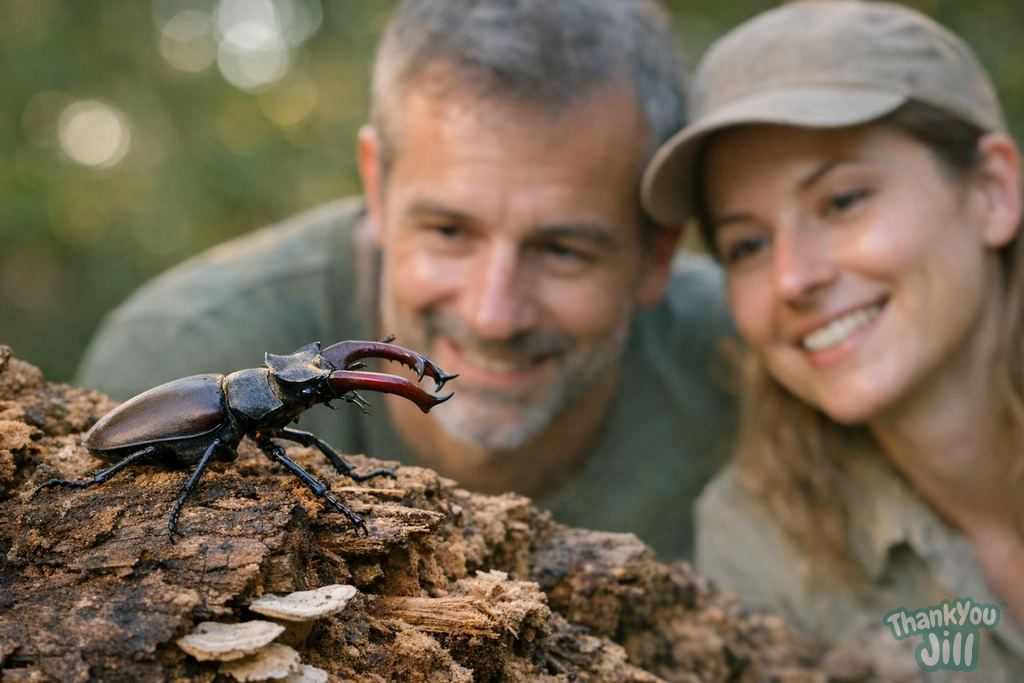
A beetle measuring 9 centimeters long, glossy black, with mandibles that resemble rust-colored deer antlers. It flies heavily at dusk with a loud buzzing sound, crashes into streetlights, falls to the ground, and struggles to right itself. It seems clumsy, vulnerable, almost out of place in the modern world. Yet the stag beetle has survived virtually unchanged for 50 million years, and remains one of Europe's most fascinating — and most threatened — insects.
nnMeet the stag beetle
nnThe stag beetle (Lucanus cervus) is Europe's largest beetle. Adult males reach 4.5–9 cm in length, including the enormous mandibles that resemble deer antlers (hence the name). These mandibles aren't used for biting but exclusively for combat with other males over access to females — they lock onto an opponent's mandibles and attempt to flip him off the branch. Despite their size, they bite weakly: the stag beetle's real biting power comes from the female's shorter but more robust mandibles, which can deliver a painful pinch if handled. Females are smaller (3–5 cm) and have normal-sized mandibles. Both sexes have glossy black elytra (the hardened forewings characteristic of beetles) with an almost metallic sheen.
nnThe larva: three to seven years in deadwood
nnAdult stag beetles live for only 3–8 weeks. During this time they barely feed (occasionally sipping sap from wounded trees), fly at dusk searching for mates, breed, and females lay eggs in decaying wood. But before this brief final chapter comes a much longer story: stag beetle larvae live 3–7 years (exceptionally up to 8) deep within deadwood, primarily in the roots and lower trunk of dead or dying oaks, occasionally in chestnuts, hazels, and beeches. The larva is large, white, and curved (up to 10 cm when mature), with the characteristic C-shape typical of lucanid larvae. It feeds on decomposing wood with help from bacteria and fungi in its gut that break down lignin and cellulose. Pupation occurs in soil near the roots; adults emerge in late summer and overwinter in the soil before surfacing in May–June of the following year.
nnDeadwood: the vanishing habitat
nnThe stag beetle depends entirely on large-diameter deadwood — stumps, roots, and trunks of oaks (and other broadleaves) at least 30–40 cm across in advanced decay. This habitat is increasingly rare in managed Italian forests, where deadwood is systematically removed for "tidiness," firewood, or fear of pest spread. In reality, broadleaf deadwood supports hundreds of specialized species — wood-feeding beetles, wood-decay fungi, bacteria, arthropods — that cannot exist without it. The stag beetle is the flagship species of this invisible ecosystem. Its presence in a forest signals sufficient deadwood from old oaks remains — a top-tier indicator of forest biodiversity. The species is listed in the Habitats Directive 92/43/EEC (Annexes II and IV) as a species of community interest requiring designation of Special Areas of Conservation.
nnThe evening flight: a spectacle not to miss
nnBetween June and July, on warm evenings after sunset, adult male stag beetles take to the air searching for females. They fly at human height or slightly higher, producing a deep, distinctive buzz — a sound somewhere between a large hornet and a miniature helicopter. They're attracted to artificial lights, and in villages near oak forests they're often found motionless at the base of streetlamps or hanging upside-down from nearby branches. Males battle fiercely on branches and trunks where fermented sap collects — one of Italy's most captivating summer wildlife spectacles, entirely accessible to anyone living near lowland and hill oak forests.

The stag beetle spends seven years in the darkness of a decaying root, then flies for three weeks. Three weeks out of seven years. And in those three weeks it does the only thing that matters: find a mate and secure three weeks of life for the next generation. It's a life with a precise shape, and that shape has endured for fifty million years.
How to Help the Stag Beetle: Concrete Actions in the Forest and Garden
- Don't burn or remove oak stumps: if you have a forest or land with oak trees, leave the stumps of felled oaks in place — buried 30-40 cm deep if possible. It's the simplest and most effective action to support stag beetles: a buried oak stump is an ideal egg-laying site that can host larvae for 10-15 years.
- Create a "log pile": in your garden, you can build a small pile of hardwood logs (oak, chestnut, beech) partially buried in the shade. Over 5-10 years, the decomposing wood will become habitat for stag beetles and dozens of other wood-decay invertebrate species. It's not a pile of "scrap wood" — it's a micro-ecosystem of exceptional biodiversity.
- Watch at dusk in June-July: on warm evenings in June-July, in areas with oak forests, head out at sunset and walk along the forest edges. Listen for the characteristic buzzing sound and look for males in flight. They're most visible in backlighting against the still-bright twilight sky. Street lamps near the forest are excellent observation points for nighttime watching.
- Report your sightings: the stag beetle is monitored across Europe through the Citizen Science Stag Beetle project (coordinated by the People's Trust for Endangered Species). In Italy, reports on iNaturalist contribute to the species' distribution map, which is essential for planning conservation areas.
- With children — find the larvae: if you have access to a partially rotting oak stump, you can carefully search for stag beetle larvae in the humus layer between wood and soil. The white, curved larvae, about the size of a finger, are unmistakable. Observe them, then return them to the wood exactly where you found them. The experience of holding a creature that has spent 4 years living in the wood and will become Europe's largest beetle is unforgettable for a child.
- Turn off or shield street lamps near oak forests: adult males, attracted to street lamps, fall to the ground and get crushed or eaten by predators. If you can alert your local council to shield lamps near areas where stag beetles are present, it's a concrete conservation action. Some municipalities have already adopted this measure.
The stag beetle is one of those animals that, when you see it for the first time flying at dusk with those impossible horns gleaming in the red light of twilight, makes you think the world is far stranger and more wonderful than what they teach you in school. And that sense of wonder — that small break from the ordinary — is reason enough to protect it.
Frequently Asked Questions
How can you tell if a forest is suitable for stag beetles?
A forest suitable for stag beetles must have large amounts of dead wood, such as oak stumps and logs in advanced stages of decomposition, which are essential for egg-laying and larval development over several years.
What role does dead wood play in the stag beetle's life?
Dead wood is crucial because it hosts stag beetle larvae for 3-7 years, providing nutrition through decomposition. Without this habitat, larvae cannot develop and the species risks disappearing.
When and how can you observe stag beetles in flight?
Flight occurs between June and July, at dusk, when males search for females. You can observe them near oak forests, often attracted to artificial lights like street lamps, while they emit a characteristic buzzing sound.
What concrete actions can you take to help stag beetles in your garden or forest?
You can leave buried oak stumps, create piles of decomposing hardwood logs, turn off or shield lamps near forests, and report sightings to support the species' conservation.

Latest News



Comments
No comments yet. Be the first!
Leave a comment