


 Italiano
 Français
 Deutsch
 Español
 Português
 Svenska
 Suomi
Suomi
Ants and Trees
Ancient and surprising alliances between ants and the plant world
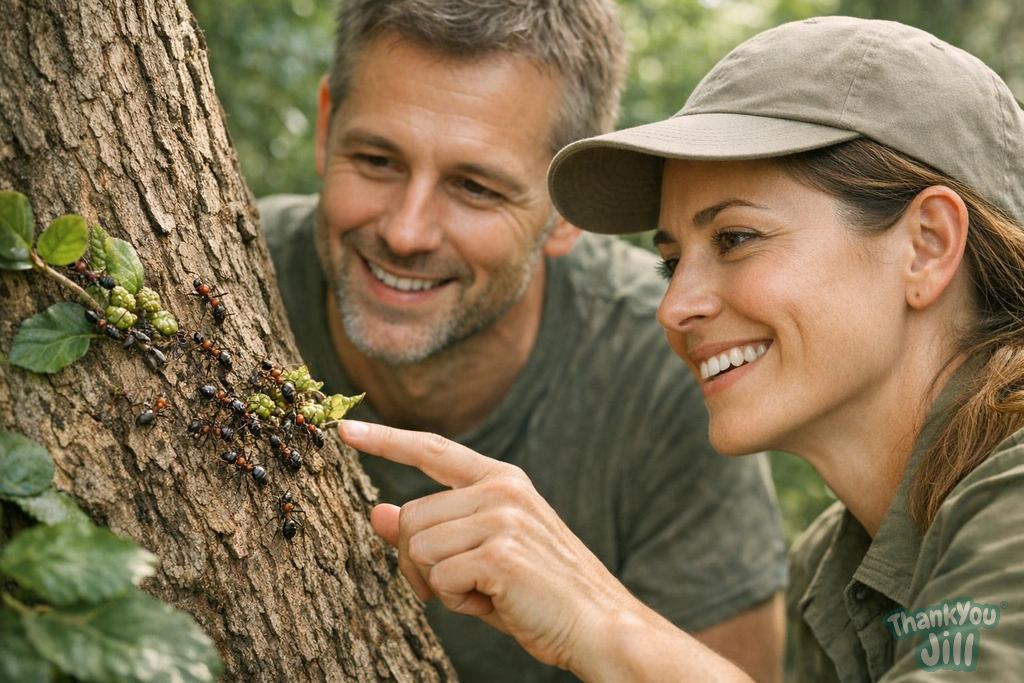
You walk along a forest trail and notice a procession of ants climbing up and down the trunk of an oak tree — thousands of them, tireless, in an orderly column. What are they doing? The answer is more complex than it seems, and reveals one of the oldest and most intricate relationships in forest biology: that between ants and trees.
The forest anthill: Formica rufa and coniferous forests
The red wood ant (Formica rufa) and its sister species (F. polyctena, F. lugubris) build the large dome-shaped anthills found in Italian coniferous forests — mounds of pine needles, twigs, and plant debris that can reach 1-2 meters in height and house 100,000 to 500,000 individuals. These anthills are one of the forest's most complex miniature ecosystems: inside, temperature is regulated with precision (ants open and close chambers in response to heat), humidity is controlled, waste is separated from vital areas. The colony can have one or more queens, and survives for decades. The ecological contribution of these anthills is enormous: each year, a Formica rufa colony captures between 3 and 10 million defoliating insects — caterpillars, larvae, and adults of species that would damage conifers if left unchecked. For this reason, Formica rufa has been used in Germany and other countries as a biological control agent in spruce reforestation, with artificial transplantation of colonies into the most vulnerable forests.
Farming ants: gall-makers and aphids
One of the most fascinating relationships between ants and trees involves aphids (plant lice). Many ant species (especially Lasius niger and Formica spp.) "farm" aphids on trees much like we farm livestock. Ants protect aphid colonies from predators (ladybugs, lacewings, hover flies), move them to new tender branches when old ones are exhausted, and carry them safely underground in winter. In return, aphids produce a droplet of sugary liquid (honeydew) that is stimulated by ants stroking the aphids with their antennae, which ants eagerly collect as a carbohydrate source. This aphid farming damages the host tree (aphids suck sap), but the damage is offset by ants' action as predators of other harmful insects on the same tree. The balance is delicate and varies with environmental conditions.
Ants and seed dispersal: myrmecochory
Many plants in the Italian forest have evolved a strategy to be dispersed by ants: they produce seeds with an elaiosome — a fleshy appendage rich in fats and proteins attached to the seed. Ants collect the seed, carry it to the anthill for the elaiosome, consume the nutritious appendage, and discard the seed in the waste pile near the anthill — perfectly intact, enriched by organic substrate, ready to germinate. This seed dispersal system is called myrmecochory and is surprisingly common: in Italy, among the species that use ants as dispersers are the violet (Viola spp.), the snowdrop (Galanthus nivalis), the toothwort (Cardamine spp.), the greater celandine (Chelidonium majus), and dozens of other understory plants. Myrmecochory has allowed these species to colonize the forest floor with remarkable precision: the anthill becomes a dispersal center that places seeds exactly in the type of microhabitat — organic, moist, shaded — where they germinate best.
Carpenter ants: the dead wood carpenter
The carpenter ant (Camponotus herculeanus and sister species) is one of Europe's largest ants (queens up to 15 mm) and excavates its galleries in dead or partially decaying wood of trees — especially in alpine conifers. Unlike tropical termites, it does not eat the wood: it excavates and uses it as structural support for anthill chambers. The galleries are smooth and finished — almost polished. The impact on decaying wood is part of the natural decomposition process and is not considered an ecological problem in forests. In human structures (wooden beams with high moisture) it can become problematic.

Ants solved the problem of agriculture 50 million years before we did: they cultivate fungi, farm aphids, collect seeds, and defend their forest from pests. They are the oldest and most numerous civilization on Earth. And they never needed our approval.
How to observe ants in the forest: practical activities
- Find a Formica rufa anthill: in forests of Scots pine, larch, and fir in the Alps and northern Apennines, the large Formica rufa mounds are visible year-round (though activity is reduced in winter). Observe them from 50 cm away without touching: the density of traffic, the speed of response to the shadow of your hand (immediate, nervous), ants carrying larvae, pine needles, dead insects. In 10 minutes of silent observation you see the logistics of a miniature metropolis.
- Observe aphid colonies protected by ants: in spring-summer, look for branches of cherry, rose, elderberry, or linden with colonies of dark or green aphids. Watch the ants stroke them with their antennae to collect honeydew. It's easy to see in any Italian garden from April to September. Then explain to children that this is agriculture in the biological sense: breeding, protection, harvesting.
- Myrmecochory with violets: in spring, in deciduous forests, look for violet plants (Viola spp.) near an ant trail. Observe if some are carrying seeds: violet seeds with the white elaiosome attached are visible to the naked eye when freshly fallen. Following an ant carrying a violet seed to the anthill is one of the most remarkable nature observation exercises in the spring forest.
- Don't destroy anthills: beyond direct ecological damage, destroying a Formica rufa anthill is illegal in Italy (protected species). If you find an anthill on a busy trail, report it to the trail manager or forest ranger rather than removing it.
- With children — the ant trail: leave a small piece of biscuit 2 meters from an anthill entrance and observe how long it takes to be found (scouts wander randomly until they find it). Then watch how the pheromone trail forms: the first arrivals take an irregular route, then the trail becomes increasingly straight as more ants reinforce the trace. It's an experiment in emergent behavior without any equipment needed.
- Observe a carpenter ant nest: on a decaying conifer stump in the Alps, look for the smooth and polished galleries of Camponotus. If you can gently disassemble a section of already decaying wood (not a living tree), you'll see the internal chambers with eggs, larvae, and adult ants. It's an ecosystem in a box.
Ants are the most easily observable insect in any setting — forest, garden, urban park, terrace. Yet most people look at them without seeing them. Learn to focus your attention on a single ant and follow it for 5 minutes: where it goes, what it does, how it interacts with others. That single ant is a node in a complex network involving the entire forest around you. Seeing it is already looking at the forest with different eyes.
Frequently Asked Questions
What is the role of Formica rufa ants in protecting coniferous forests?
Formica rufa ants capture millions of defoliating insects each year that would damage conifers, acting as an effective natural biological control agent in forests, helping to maintain ecological balance.
How does ant farming of aphids work and what are the consequences for trees?
Ants protect and move aphids, which produce sugary honeydew in return. This farming damages the tree because aphids suck sap, but ants compensate by preying on other harmful insects, maintaining a variable balance.
What is myrmecochory and how does it promote seed dispersal in the forest?
Myrmecochory is seed dispersal through ants, which collect seeds with a nutritious appendage (elaiosome), consume the elaiosome, and deposit the seed near the anthill, in an ideal environment for germination, promoting understory colonization.
What is the ecological impact of carpenter ants (Camponotus) on dead wood of trees?
Carpenter ants excavate galleries in dead wood without eating it, contributing to natural decomposition. This process does not damage the forest ecosystem, but can cause problems if it occurs in human wooden structures with high moisture.
Latest News

Comments
No comments yet. Be the first!
Leave a comment