


 Italiano
 Français
 Deutsch
 Español
 Português
 Svenska
 Suomi
Suomi
Tree Butterflies
Which species depend on which trees to complete their life cycle
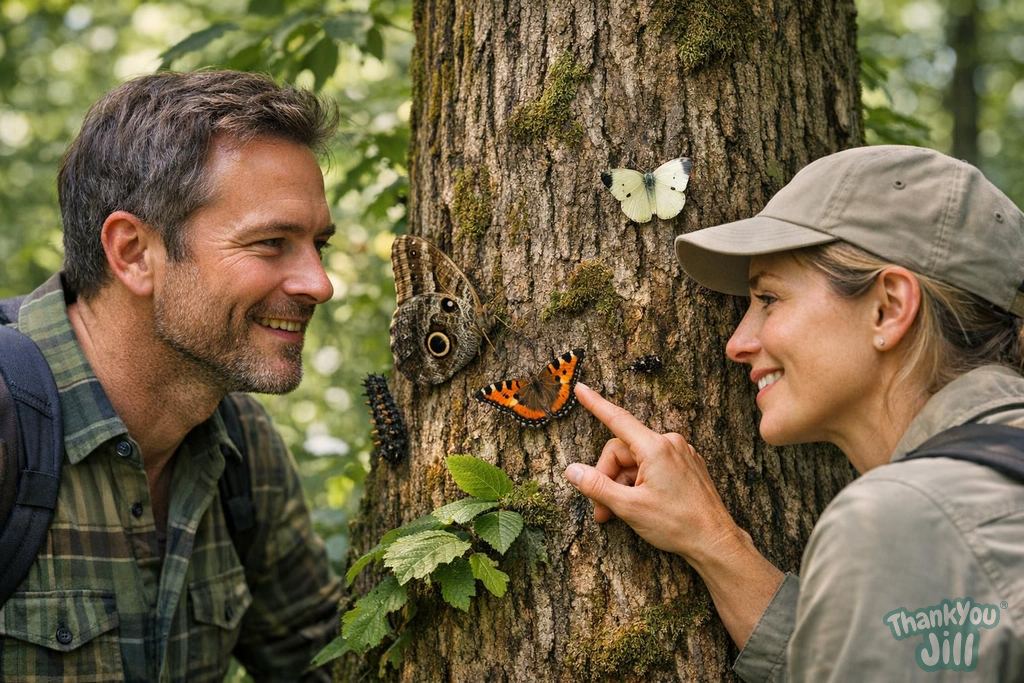
Every butterfly you see fluttering across a sunny meadow has a story that begins on a specific tree or plant. The caterpillar that will become that butterfly can eat only one or very few plant species. If that plant disappears from the territory, the butterfly disappears with it. The bond is so tight that naturalists have a name for it: host plant. And the Italian forest is full of these invisible and fragile alliances.
Host plants: the rule of the selective caterpillar
Adult butterflies visit many different flowers for nectar. But females lay their eggs almost exclusively on the specific host plant of their caterpillars. This is not evolutionary whimsy: it is adaptive specialization. Each plant has its own chemical defenses (alkaloids, tannins, glucosides) against herbivores. Caterpillars of each butterfly species have evolved to tolerate the chemical defenses of one or a few specific host plants — and often to sequester those chemical compounds for their own advantage (making themselves toxic to predators). The result is that butterfly distribution follows almost exactly the distribution of their host plants. Where there is no oak, there is no Quercusia quercus (purple hairstreak). Where there is no wild apple, there is no Saturnia pyri. Where there is no nettle, there is no small tortoiseshell — even though nettle is not a tree, it is the most emblematic case of this bond.
The main butterflies linked to Italian trees
Here are the most important associations between Italian butterflies and trees. The scarce swallowtail (Iphiclides podalirius, whose name evokes its ancient airplane-like wing shape): caterpillars live exclusively on trees of the genus Prunus (wild cherry, plum, blackthorn, almond). It is one of Italy's most beautiful butterflies, with black and white kite-shaped wings. The swallowtail (Papilio machaon): caterpillars feed on umbellifers — not trees but plants of the forest edge and damp meadows (wild fennel, wild carrot, parsnip). The white admiral (Limenitis camilla): caterpillars live on woodland honeysuckle, which typically grows intertwined with shrubs at the margins of oak forests. The purple hairstreak (Quercusia quercus): one of the most beautiful of the Italian forest, with brilliant violet-colored wings. Caterpillars feed exclusively on oak leaves. Adults live in the high canopy and are rarely visible. The pine lappet (Dendrolimus pini): a very common species whose caterpillars feed on Scots pine needles and can cause significant defoliation in poplar groves and plantations in years of high density. The pine processionary (Thaumetopoea pityocampa): among the most important (and most problematic) forest lepidopterans in Italy, with urticating caterpillars that live in silken nests on pines and descend in spring in long processions toward the ground to pupate. The giant silk moth (Saturnia pyri): the largest moth in Europe (wingspan up to 17 cm), with an enormous bright green larva that feeds on apple, pear, cherry, and walnut trees.
Climate change and forest butterflies
Butterflies are among the most sensitive biological indicators of climate change. European studies show that the distribution of many species is shifting northward and to higher elevations at a rate of 2-6 km per year — a pace that many species cannot keep up with because host plants do not shift at the same speed. In Italy, some alpine species are losing habitat because high-altitude host plants cannot colonize peaks quickly enough to follow warming. Other Mediterranean species are colonizing increasingly northern areas where host plants are already present. Monitoring these dynamics is one of the main tasks of current Italian entomological research.
Forest butterflies: where and when to observe them
Forest clearings, margins between forest and meadow, strips of shrubs along trail edges — these transition environments (ecotones) are the places with the greatest butterfly diversity in Italy. The best season varies by species: the scarce swallowtail (I. podalirius) appears as early as April; many summer species peak in June-July; some autumn species (tortoiseshells, nymphalids) are still active in September-October on warm days. The best month for maximum diversity is June in the hill and mid-mountain zones (700-1,200 m) of the Apennines and the Prealps.

A butterfly flying over a meadow did not choose that meadow by chance. Its ancestors spent millions of years adapting to a single plant. If that plant disappears, the butterfly disappears. The bond is so tight and so fragile that a single herbicide, a cleared forest patch, or a removed hedge is enough to break it permanently.
How to encourage butterflies in your garden and territory
- Plant the right host plants: to attract the most beautiful butterflies of Italian forests to your gardens, plant their host plants. Wild blackthorn (Prunus spinosa) for the scarce swallowtail (I. podalirius). Wild cherry for the cherry pierid. Honeysuckle for Limenitis camilla. Alder buckthorn (Frangula alnus) for the common brimstone. Bramble for the common blue (Celastrina argiolus). You don't need a large garden: even a corner with 2-3 of these shrubs is enough.
- Leave nettles in a corner of your garden: nettle is the host plant of the small tortoiseshell (Aglais urticae), the red admiral (Vanessa atalanta), the peacock (Aglais io), and numerous minor species. A clump of nettles in a sunny, sheltered corner of the garden is a nursery for these beautiful species. Cut the nettles in half in mid-August after the second generation of caterpillars to encourage spring regrowth.
- Don't use systemic insecticides on flowers: neonicotinoids and other systemic insecticides that are absorbed by the entire plant remain in pollen and nectar, poisoning adult butterflies that visit them. Avoid systemic products on all plants with flowers accessible to butterflies.
- With children — the butterfly notebook: every butterfly observed in the forest or garden is drawn or photographed and identified (using the iNaturalist app or an illustrated guide). Then search for its host plant: which tree or shrub does its caterpillar use? The butterfly-plant connection becomes a biological investigation project that extends throughout the summer.
- Visit mountain forest clearings in June: clearings among beech forests and mixed woods of the Apennines at 600-1,200 m elevation in June are among the places with the greatest butterfly diversity in Italy. Appennino Tosco-Emiliano National Park, Monti Sibillini Park, Majella Park: all have clearings rich in lepidopterans easily accessible via marked trails.
Italian forest butterflies don't ask for perfect gardens. They ask that someone let wild blackthorn grow on the field edge, that someone leave a corner of nettles, that someone not spray herbicide on the forest margin. Small sacrifices of order that make room for the most beautiful life there is.
Frequently Asked Questions
What is the relationship between butterflies and host plants in forest ecosystems?
Butterflies lay their eggs only on specific host plants, on which caterpillars feed. This bond is fundamental because butterfly survival depends on the presence of these plants, often trees or shrubs, that provide the food necessary for caterpillars.
How does climate change affect the distribution of butterflies linked to trees?
Climate change shifts butterflies northward or to higher elevations, but host plants often do not shift as rapidly. This misalignment can cause habitat loss for many species, especially in mountain environments where plants cannot colonize new areas quickly enough.
How can you encourage the presence of butterflies linked to trees in your garden?
To attract butterflies, it is useful to plant their specific host plants, such as wild blackthorn, wild cherry, or honeysuckle. Additionally, leaving corners with nettles and avoiding systemic insecticides protects caterpillars and adult butterflies, creating a favorable habitat even in small spaces.
What are the best places and times to observe butterflies linked to trees in forests?
Clearings, margins between forest and meadow, and strips of shrubs are ideal locations. Maximum diversity is observed in June, especially in hill and mid-mountain zones (700-1,200 m). Some species appear as early as April, others remain active until September-October.

Latest News




Comments
No comments yet. Be the first!
Leave a comment