


 Italiano
 Français
 Deutsch
 Español
 Português
 Svenska
 Suomi
Suomi
The World Tree
Yggdrasil and Sacred Trees in the Great Mythologies of Humanity
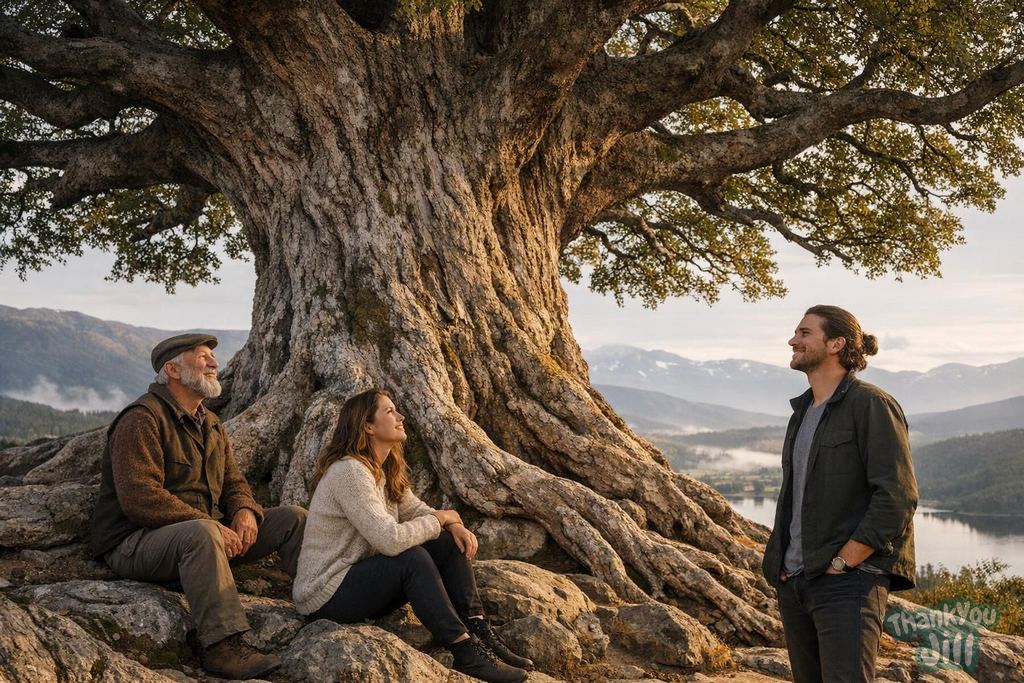
Long before we understood why trees grow, humanity revered them. The tree was there before us — taller, older, more resilient. Its roots sank into the earth of our ancestors and its branches reached toward the sky of the gods. It's natural that nearly every civilization, independently of the others, imagined a tree at the center of everything. The world tree.
Yggdrasil: The Great Ash of the Norse Cosmos
Yggdrasil is the great cosmic tree of Norse (Viking) mythology, described primarily in Snorri Sturluson's Prose Edda (13th century) and the Poetic Edda. It is an immense ash tree that supports the nine worlds of the universe: its roots sink into three wells — Urðarbrunnr (the well of fate, where the Norns weave the destiny of men), Mímisbrunnr (the well of wisdom, where Odin sacrificed an eye to drink), and Hvergelmir (the primordial well, in the realm of the dead Niflheimr). An eagle sits at the top of the tree. A serpent coils along the trunk. A squirrel carries messages between eagle and serpent. Four deer graze among the branches, eating the leaves. The squirrel Ratatoskr runs up and down the trunk, carrying insults from the eagle to the serpent and back again. Yggdrasil is the axis of the cosmos — the axis mundi — connecting the below, the middle, and the above. It is alive, it suffers (the deer gnaw at it, the serpent gnaws at its roots), but it endures. It is the supporting structure of the universe.
The Ashvattha: The Sacred Fig of India
In Hindu cosmology, the Ashvattha (Ficus religiosa, the sacred fig or peepal) is the cosmic tree par excellence. In the Bhagavad Gita, Krishna describes a cosmic Ashvattha with roots above and branches below — an inversion that symbolizes the transcendent nature of the universe, with divine roots in heaven and branches descending into the material world. Under an Ashvattha, Siddhartha Gautama achieved enlightenment and became the Buddha — the Bodhi tree still stands today at the center of the Bodh Gaya complex in India. The sacred figs of Indian villages remain places of worship today, marked by red cloth and votive lamps at the base of the trunk. The concept of the cosmic tree is also found in Jainism and Tibetan Buddhism, where the tree is associated with enlightenment and the connection between different planes of reality.
The Mesopotamian and Middle Eastern Tree of Life
In Assyrian and Babylonian reliefs (9th-7th century BCE), a recurring motif appears: a stylized tree, flanked by winged figures or ritual kings touching it with cones of incense. Scholars call it the Mesopotamian Tree of Life (or Sacred Tree). Its botanical identification is debated — it could be a date palm (the economically most important plant of Mesopotamia), a pomegranate, or a symbolic representation of the vegetable cosmos. The Tree of Life also appears in the Book of Genesis, in the Garden of Eden: the tree whose fruit is forbidden, whose knowledge makes men like gods. The pomegranate, sacred to Aphrodite and a symbol of fertility in Greek and Phoenician culture, and the Cedar of Lebanon, used to build Solomon's Temple and associated with immortality in Middle Eastern cultures, both have deep symbolic roots in the tradition of the sacred Middle Eastern tree.
The Ceiba and Sacred Trees in American Cultures
In pre-Columbian cultures too, the cosmic tree plays a central role. In Maya cosmology, the Yaxché (the Great Ceiba, Ceiba pentandra) is the world tree that supports the sky and connects Xibalba (the underworld), the Earth, and the Sky. Monumental Ceibas were sacred and could not be felled. In Aztec cosmologies, five sacred trees supported the sky at the four cardinal points plus the center. In many Siberian and Central Asian cultures, shamanism uses a birch or cosmic pine as the axis of the world along which the shaman climbs to the upper planes during trance — the direct precursor to the Norse Yggdrasil.
The Cosmic Tree: A Universal Archetype
The fact that the cosmic tree appears in cultures so distant in space and time — from Scandinavia to India, from Mesopotamia to pre-Columbian America — suggests that it is what psychologist Carl Jung called an archetype: a primordial image shared by the collective human unconscious. The tree with roots in the earth and its crown in the sky is the most natural metaphor for vertical connection — between the dead (in the earth), the living (on the earth), and the divine (in the sky). A living being that traverses all three planes of existence. It is hardly surprising that humanity, everywhere, has seen in it the symbol of the cosmos.

Every civilization planted a tree at the center of the world. They didn't consult each other. Each discovered it alone, looking up through the branches and thinking: this touches the sky. This must be sacred. It's not superstition: it's the deepest intuition about the role of trees in the life of our planet.
How to Explore the Mythology of Trees: Readings, Places, and Activities
- Read the Edda: The Italian translation of Snorri Sturluson's Prose Edda (available in affordable editions from Adelphi or Einaudi) is one of the most fascinating mythological readings that exist. The chapter on Yggdrasil — with the eagle at the top, the serpent at the roots, the deer grazing, the squirrel running up and down — is one of the most vivid arboreal cosmologies in world literature. Accessible from age 12 and up.
- Visit a historic sacred forest in Italy: In many parts of Italy there are forests and trees with prehistoric sacred significance — the forests of the Falisci in Lazio, the votive forests of the Tuscan-Emilian Apennines, the monumental oaks of Calabria traditionally associated with agrarian rites. The FAI and TCI guides mark many of these sites.
- With children — build your own Yggdrasil: Invite children to build their own "personal world tree" with paper, sticks, and colors. What's in the roots? (grandparents, memories, underground things). What's in the trunk? (family, home, daily life). What's at the top? (dreams, the future, the stars). This creative activity naturally connects mythology and psychology for children.
- Study the iconography of sacred trees: In Italian archaeological museums (National Museum of Naples, Etruscan Museum of Villa Giulia in Rome, Egyptian Museum of Turin) you'll find representations of sacred trees in sculptures, painted vases, and stelae. The motif of the tree of life appears in Etruscan, Greek, and Egyptian contexts — often as a decorative element with roots in deeper cosmological meanings.
- Participate in a Forest Therapy experience: Many Forest Bathing guides (Shinrin-yoku) in Italy integrate symbolic and narrative elements about the cultural significance of trees during walks. Finding a certified guide (list on ISFEE — Italian Institute of Forest Therapy) for a forest session often includes this mythological dimension alongside the scientific one.
The world tree is not just mythology. It is the instinctive response of every human being who stops beneath a large, old tree and feels, for a moment, something greater than themselves. That feeling — which the Vikings called Yggdrasil, which the Indians called Ashvattha — has not disappeared. It is still there, every time we stop under a hundred-year-old beech and look up through the branches. The archetype is still alive. It's just waiting for someone to recognize it.
Frequently Asked Questions
What is the symbolic meaning of Yggdrasil in Norse mythology?
Yggdrasil is the great cosmic ash tree that supports the nine worlds in the Norse universe. Its roots sink into three sacred wells, connecting fate, wisdom, and the realm of the dead, representing the axis of the cosmos that unites sky, earth, and underworld.
How does the Indian Ashvattha differ from other cosmic trees?
The Ashvattha, or sacred fig, has roots above and branches below, symbolizing the transcendent nature of the universe. It is associated with spiritual enlightenment, as in the case of the Buddha, and represents the connection between the divine and the material world in Hindu and Buddhist tradition.
Why is the tree of life a universal archetype across different cultures?
The tree of life symbolizes the vertical connection between the dead, the living, and the divine, traversing the planes of existence. Its presence in cultures distant in time and space indicates a primordial image shared by the collective human unconscious, according to Jung's theory of archetypes.
What are some recommended activities for exploring the mythological meaning of trees?
You can read texts like the Norse Edda, visit historic sacred forests, build models of Yggdrasil with children, study the iconography of sacred trees in museums, and participate in Forest Therapy experiences that integrate symbolic and narrative elements about trees.

Latest News




Comments
No comments yet. Be the first!
Leave a comment