

 English
 Italiano
 Français
 Deutsch
 Español
 Português
 Svenska
 Suomi
Suomi
The Oak and the Lightning
Zeus, Jupiter, and the Worship of Sacred Trees in Classical Antiquity
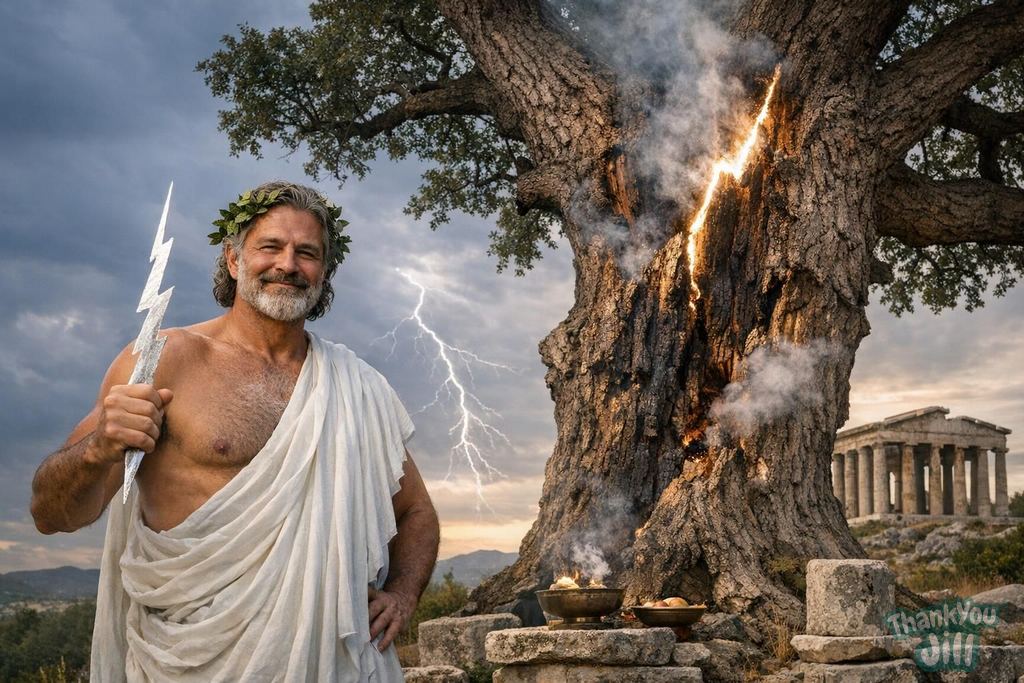
In an open field in Greek Epirus, at the foot of the mountains, stood a great and ancient oak. Its leaves rustled even without wind, and the priests—the Selli, who slept on the ground and never washed their feet—interpreted that rustling as the voice of the god. It was the Oracle of Dodona, the oldest sanctuary in Greece. And the god who spoke through the oak was Zeus.
The Oracle of Dodona: The Oak as Divine Voice
The Oracle of Dodona, in northwestern Greek Epirus, is documented from the eighth century B.C. onward and is likely the oldest oracular sanctuary in Greece—older even than Delphi. At its heart stood a sacred oak (Quercus pedunculata), whose fruit (acorns) were considered humanity's first food in Hesiodic tradition. The rustling of leaves, the sound of bronze vessels hanging from branches that touched in the wind, the flight of sacred doves—all were interpreted by priests as messages from Zeus. The sanctuary endured for centuries, visited by Achilles, Odysseus (in the Odyssey), and Alexander the Great. The Zeus-oak association is no accident: the oak is the tree most frequently struck by lightning (due to its height in open fields and the water content in its tissues), and Zeus was the god of the thunderbolt. To venerate the oak was to venerate the lightning—the supreme divine weapon.
The Sanctuary of Jupiter on the Capitoline and Crowns of Oak
In Rome, Jupiter Optimus Maximus—the Roman counterpart to Zeus—was associated with the oak in multiple ways. The Temple of Jupiter Capitolinus was originally surrounded by sacred oaks. The civic crown (corona civica), Rome's highest military honor after the triumph, was made of oak leaves and was awarded to the soldier who had saved a comrade's life in battle. It was the purest honor—not gold, not silver, but oak leaves: a gift from Jupiter's tree. Jupiter's eagle (the same bird that perches atop Yggdrasil) was often depicted carrying an oak branch in its talons. Any particularly large and isolated oak in the Roman countryside could be considered sacred to Jupiter and protected from cutting or damage—one of history's earliest forms of legal tree protection.
The Druids and the Oak Grove: The Forest as Temple
The druids—the priests of Celtic cultures in western Europe (Gaul, Britain, Ireland)—conducted their religious rites in sacred oak groves. The term "druid" likely derives from the proto-Celtic root dru-wid, a combination of dru (oak or solidity) and wid (to see/to know)—the "sage of the oak" or "he who sees through the oak." The mistletoe that grows on the oak (a relatively rare parasitic plant) was especially sacred: druids harvested it with a golden sickle on the night of the full moon, never allowing it to touch the ground (it was caught in a white cloth), and used it in purification ceremonies and as a universal medicine. The oak bearing mistletoe was the quintessence of the sacred in Celtic culture. Caesar, in his Gallic Wars, describes Celtic priests officiating in oak groves—the nemeton—as places of worship, assembly, and justice.
The Cult of Trees in Prehistoric Italy
Long before the Greeks and Romans, pre-Roman Italic cultures possessed a profound tradition of tree veneration. Sacred groves (in Latin lucus) were present in every Latin, Sabine, and Oscan city—wooded areas set apart from agricultural use and dedicated to a specific deity. Sacred groves had their own legal jurisdiction: felling a tree in a lucus required complex religious expiation. Even in the first century A.D., Pliny the Elder described Italian sacred groves where unauthorized tree-felling carried severe penalties. The Faliscans, a people of northeastern Latium, venerated groves of cerro oak (a species of oak) as seats of local divinities. Many Italian place names derive from these traditions: Luceria, Nemus, Nemi (the famous lake with Diana's grove)—all etymologies connected to the sacred grove.

The oak struck by lightning is not cursed—it is chosen. Zeus does not punish the tree: he touches it. The ancient cultures were not wrong to see the oak as the boundary between earth and sky. They simply lacked the physics to explain why lightning selects it. They had mythology instead, which is another way of understanding.
Exploring the sacred history of trees in Italy: places and pathways
- Visit Lake Nemi (Lazio): this famous lake in the Castelli Romani region once hosted the sanctuary of Diana Nemorensis (Diana of the Woods), one of the most evocative sites of tree worship in ancient Italy. The oak forest surrounding the lake was sacred, and the priest-king of the sanctuary (the Rex Nemorensis) had to be a fugitive who had killed his predecessor in a ritual combat in the woods. James Frazer made this the foundation of his monumental The Golden Bough (1890). Today the park is open to visitors, and the Museum of Roman Ships is located in the town of Nemi.
- Seek out the monumental oaks in your region: every Italian region has its own ancient oaks tied to local stories of sacred significance or territorial boundaries. Some centuries-old oaks in Italian villages are still associated with gatherings, festivals, and traditions — they are the modern survival of tree worship from antiquity.
- Read The Golden Bough by James Frazer: this classic of religious anthropology examines the worship of oaks and trees throughout the ancient world. The abridged edition (single volume) is available in Italian and is accessible even to non-specialists. It's one of those books that changes how you look at an oak forest.
- With children — the forest as temple: take children into an old oak forest and ask: why do you think ancient peoples considered this place sacred? What do you feel here that you don't feel in the city? The rustling of leaves, the dappled shade, the scale of the trees — all things children perceive immediately. The conversation that emerges is mythology lived firsthand.
- Study oak iconography in Italian art: oaks appear in countless Italian paintings — in Renaissance painting as landscape background, in altarpieces as recognizable Italian trees, in majolica and traditional crafts. Searching for them in local museums is an unexpected way to enter the history of Italian botanical iconography.
The worship of the oak never really ended. It transformed, became secular, was rationalized — but the feeling of standing in the presence of something extraordinarily enduring and alive beneath a centuries-old oak is the same sensation the priests of Dodona felt twenty-five hundred years ago. The tree is still there. We simply stopped listening to it.
Frequently asked questions
Why was the oak considered sacred and associated with Zeus and Jupiter in antiquity?
The oak was sacred because it was frequently struck by lightning, a symbol of the divine power of Zeus and Jupiter. The rustling of its leaves was interpreted as messages from the gods, making it a sacred tree and the center of cults and oracles like the one at Dodona.
How was mistletoe used in Celtic religion connected to the oak?
Mistletoe, a rare parasitic plant on the oak, was harvested by druids with a golden sickle during the full moon without touching the ground. It was used in purification ceremonies and as a universal medicine, representing the quintessence of the sacred in Celtic culture.
What was the significance of the Roman civic crown made from oak leaves?
The civic crown was the highest military honor in Rome after a triumph, awarded to those who saved a fellow soldier in battle. Made from oak leaves, it symbolized the gift of the sacred tree to Jupiter, representing purity and divine protection.
How did the worship of sacred trees manifest in pre-Roman Italian cultures?
In pre-Roman Italian cultures, sacred groves (lucus) were protected areas dedicated to deities, with legal jurisdiction. Felling trees in these groves required religious expiation, and violations carried severe penalties, demonstrating a profound respect and protection of sacred trees.

Latest News



Comments
No comments yet. Be the first!
Leave a comment