


 Italiano
 Français
 Deutsch
 Español
 Português
 Svenska
 Suomi
Suomi
Trees in the Bible
From Eden to the Cedars of Lebanon: The Role of Trees in Biblical Narrative
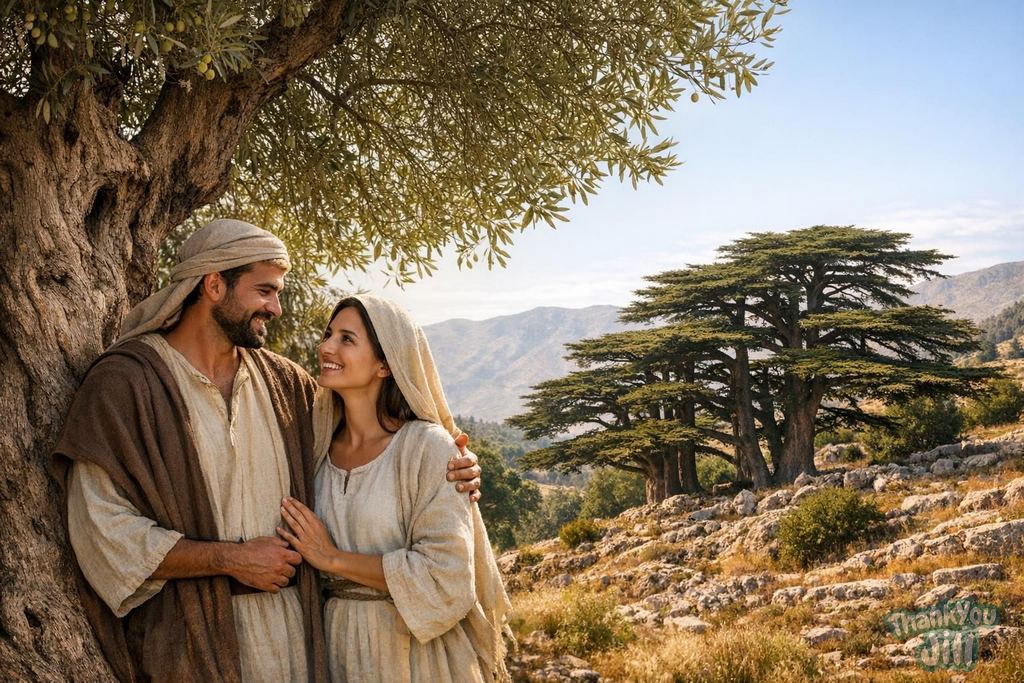
Open the Bible to the first page. You won't reach the second without encountering a tree. The Garden of Eden is a fruit-bearing forest. The Tree of Life and the Tree of Knowledge of Good and Evil stand at its center. In biblical narrative, the entire history of humanity begins with two trees. And it doesn't end there.
Eden and the Two Foundational Trees
In the Book of Genesis (2-3), the Garden of Eden contains two special trees at its center: the Tree of Life, whose fruit would grant immortality, and the Tree of Knowledge of Good and Evil, which God forbids eating from. The fruit of the tree of knowledge—traditionally depicted as an apple in European iconography, but not identified in the Hebrew Bible—is eaten by Eve and Adam at the serpent's urging. The consequence is expulsion from Eden and the loss of immortality. Christian tradition has seen in this episode the original sin. The Tree of Life appears again in the Book of Revelation (22:2), in the final Paradise, as a tree bearing fruit each month whose leaves heal the nations. The botanical identification of Eden's two trees has been debated for centuries: candidates proposed by Jewish and Christian tradition include the fig (the plant with which Adam and Eve covered themselves), the pomegranate, the carob, the cedar, or a tree no longer in existence.
Noah's Olive Branch: Peace After the Flood
One of the Bible's most famous botanical episodes is the dove with an olive branch that returns to Noah's Ark after the Flood (Genesis 8:11), signaling that the waters have receded and the earth is habitable again. The olive as a symbol of peace and reconciliation between God and humanity enters Western cultural consciousness here—a symbolic meaning that survives intact to this day (the olive branch as a gesture of peace, the United Nations logo with the olive branch). The olive was the economically most important plant of the ancient Levant: its presence on dry land was the best possible news for a farmer of the ancient Middle East.
The Cedar of Lebanon: Greatness and Glory
The Cedar of Lebanon (Cedrus libani) is the most celebrated tree of the Old Testament. It appears more than 70 times—in the Psalms, in the Book of Kings, in Ezekiel, in the Song of Songs. Its wood was used by Solomon to build the Temple of Jerusalem (1 Kings 5-6): the most prized material available in the ancient Middle East for its fragrance, hardness, and resistance to decay. The Cedar of Lebanon forests, now reduced to a few protected specimens (the symbol on Lebanon's flag is still the cedar), once densely covered the Lebanese mountains. The book of Ezekiel (17, 31) uses the cedar as a metaphor for greatness—the Cedar of Lebanon, with beautiful branches and thick shade, with its top reaching among the clouds—to symbolize the great kingdoms of history. The destruction of the Cedars of Lebanon by great empires (Phoenicians, Assyrians, Romans) was one of the first documented deforestations in human history.
The Fig, the Vine, the Burning Bush: Other Botanical Protagonists
The fig (Ficus carica) is the third most cited tree in the Bible after the vine and the olive. Adam and Eve cover themselves with fig leaves. Jesus curses the fig tree without fruit. The prophets use the fig as a metaphor for the people of Israel. The vine and wine are omnipresent in the biblical text—Noah plants the first vineyard after the Flood. The date palm (Phoenix dactylifera) appears at the Palm of Deborah (Judges 4:5) and in Jesus's triumphal entry into Jerusalem. The sycamore (Ficus sycomorus) is the tree that Zacchaeus climbs to see Jesus. The burning bush (likely a Rubus or Acacia) is where Moses receives the revelation of God's name. Every tree in biblical narrative carries symbolic and cultural weight that spans millennia.

The Bible begins with two trees in a garden and ends with a tree that heals the nations. In between, every important story passes through a plant. It's no coincidence: it's the trace of agricultural and pastoral civilizations that understood life depended on trees. That understanding, buried in the texts, is still true.
How to Explore Biblical Botany: Practical Paths
- Visit a Biblical Garden: In Italy, there are some realizations of "biblical gardens"—collections of plants cited in the Bible. The most well-known is at the Monastery of San Miniato al Monte in Florence. In Israel, the Neot Kedumim Biblical Landscape Reserve is the most complete realization. These collections allow you to physically see the plants that populate the sacred text.
- Seek out Cedars of Lebanon in Italian historic gardens: Cedars of Lebanon were introduced to Italian gardens in the 17th-18th centuries as exotic trees of great visual impact. Monumental specimens can be found at Villa Borghese in Rome, in Monza Park, in the gardens of the Royal Palace of Caserta, at Villa Carlotta on Lake Como. Seeing a 200-year-old Cedar of Lebanon with its characteristic flat crown and stratified horizontal branches is an impressive sight.
- Read God's Orchard by Mauro Mariotti: This Italian book analyzes the plants of the Bible from a botanical perspective, identifying species by species the plants cited in the sacred text with scientific rigor. It's an accessible read for both believers and non-believers, rich in botanical and cultural details.
- With children—a biblical herbarium: Ask children to read a chapter of Genesis (the story of the Flood is best suited for this activity) and find all the plants mentioned. Then search together: what do they look like? Do they grow in Italy too? The fig, the olive, the vine—you probably already know some of them. Creating a mini-herbarium of Bible plants with leaves collected locally connects the sacred text to concrete territory.
- Plant an olive tree as a symbolic gesture: Planting an olive—the tree of peace, of covenant, of memory—is one of the most meaningful acts a family, school, or community can undertake. ThankYouJill's mission moves in this direction: every olive tree planted is a small replica of the symbolic gesture that the Bible associates with reconciliation.
The trees of the Bible are not merely characters in an ancient story. They are still alive—the olive, the fig, the cedar, the vine—in the Italian and Middle Eastern landscape. Recognizing them as you read the text and then finding them again outside your window is one of the most concrete ways to connect written culture to the living natural world.
Frequently Asked Questions
What is the symbolic meaning of the Tree of Life and the Tree of Knowledge in the Garden of Eden?
The Tree of Life represents immortality, while the Tree of Knowledge of Good and Evil symbolizes forbidden knowledge. Eating its fruit leads to expulsion from Eden and the loss of immortality, an event interpreted as original sin.
Why has the olive branch become a universal symbol of peace?
The olive branch appears in the Bible when Noah's dove returns with it after the Flood, signaling the end of the waters and the rebirth of the earth. Since then, the olive has been a symbol of peace and reconciliation, a meaning that endures to this day.
How is the Cedar of Lebanon used in biblical narrative and what value did its wood have?
The Cedar of Lebanon symbolizes greatness and glory, used to build Solomon's Temple thanks to its prized, durable, and fragrant wood. It is cited over 70 times in the Bible as a metaphor for power and majesty.
What are some of the most cited plants in the Bible besides the olive and cedar, and what role do they play?
The fig, the vine, and the burning bush are among the most cited plants. The fig is a symbol of the people of Israel, the vine represents life and wine, while the burning bush is the place of divine revelation to Moses, each carrying strong symbolic value.

Latest News


Comments
No comments yet. Be the first!
Leave a comment