


 Italiano
 Français
 Deutsch
 Español
 Português
 Svenska
 Suomi
Suomi
How to Recognize a Sick Tree
The warning signs of distress you shouldn't ignore in forests and gardens
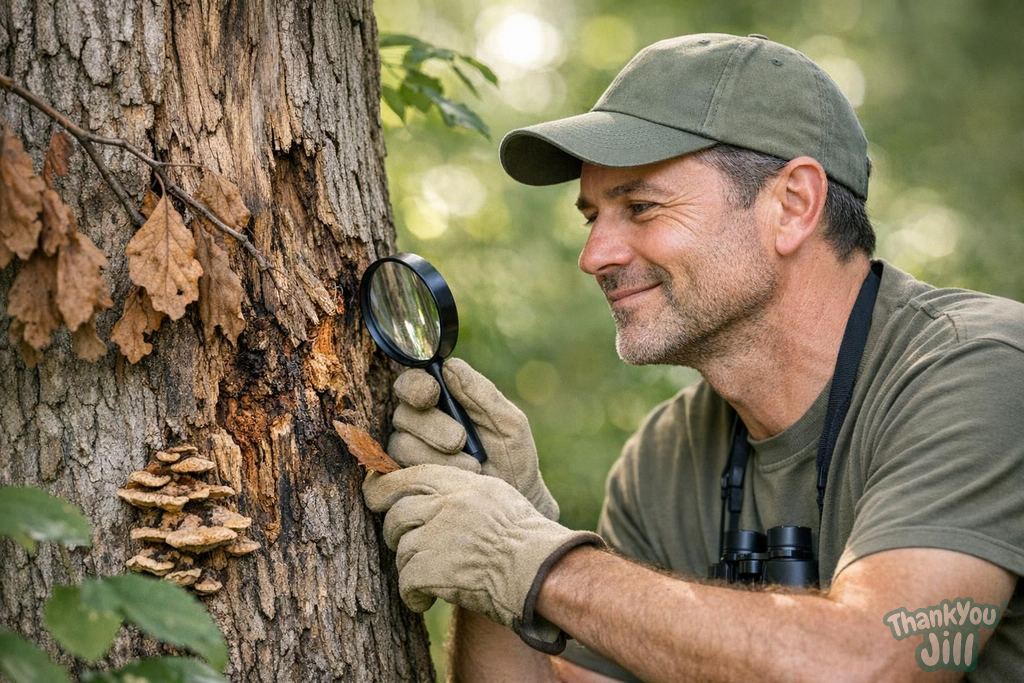
Trees can't tell us when they're suffering. They don't call a doctor, complain, or send distress signals. But they do communicate — through peeling bark, yellowing leaves out of season, fungi growing at the base of the trunk, and branches that snap too easily. Learning to read these signals is one of the most practical ways we can contribute to the health of the trees around us.
nnLeaf signals: your first window into tree health
nnLeaves are the primary indicator of a tree's health status. Early yellowing (chlorosis): can signal iron or manganese deficiency (in alkaline soils), water stress, soil compaction that restricts root respiration, or fungal root infection. Leaf spots in various colors: often caused by fungi (Marssonina on oaks, Venturia on apple trees), bacteria (Pseudomonas), mites, or pollution. Deformed, curled, or bumpy leaves: frequently caused by aphids, mites, or insect galls — in most cases not life-threatening to the tree. Leaves dropping prematurely in summer: a sign of severe water stress or root damage — requires attention. Leaves smaller than normal: a chronic indicator of root or water problems.
nnBark signals: reading the tree's history
nnBark is the archive of a tree's story. Bark peeling in large patches revealing brown dead wood underneath: possible bacterial or fungal canker. Abundant resinous ooze (in conifers): response to bark beetle attack, mechanical damage, or fungal infection. Galls or growths on the bark: various causes, often not serious; some bacterial galls (like crown gall, caused by Agrobacterium tumefaciens) can be debilitating. Dark bark lesions with foul odor: often associated with the fungus Phytophthora cinnamomi — one of the most dangerous pathogens for oaks. Visible cavities in the trunk: not necessarily dangerous if surrounding wood is healthy, but warrant evaluation by an arborist. Fermented sap oozing out (wetwood or "slime flux"): caused by bacteria fermenting sap in the wood — sign of internal bacterial infection, often in mature trees.
nnSignals at the base and in the roots
nnThe most concerning signals for a tree's structural stability often appear at the base of the trunk and in visible roots. Fruiting bodies of wood-decay fungi at the trunk base: fruiting structures of Ganoderma lucidum, Fomes fomentarius, Meripilus giganteus, Inonotus hispidus, and similar species almost always indicate internal wood decay — decomposition of supporting tissue that significantly reduces the tree's mechanical strength. Not all trees with these fungi are immediately dangerous, but they require professional assessment. Swelling or leaning at the base: possible sign of root breakage or failure of the anchoring system. Soil heaving during wind near the base: sign of broken anchor roots. Roots cut by excavation or construction: can compromise a tree's stability in the following months even without visible immediate symptoms.
nnBranch structure signals
nnDead branches in the canopy of an otherwise green tree: normal in limited amounts (inner branches lose light and die naturally), concerning if affecting large portions of the canopy — indicates water stress, root damage, or systemic disease. Branch forks with included bark: forks where bark is "included" between the two branches (visible as a dark vertical groove in the crotch) are structurally weak — they tend to split under snow, ice, or strong wind loads. Branches with visible decay (brown, spongy wood inside a broken branch or cavity): significant reduction in the branch's mechanical strength.

A sick tree doesn't cry out for help loudly. It shows you a fungus at its base, a leaf that falls too soon, bark that changes color. If you learn to read these silent messages, you become the forest's doctor — and sometimes early diagnosis makes the difference between a tree that survives and one that doesn't.
What to do when you spot a tree that concerns you
- Take photos and document: When you notice warning signs on a tree (especially in public spaces), photograph the trunk, base, any fungi, and dead branches. Dated photos with GPS location are essential for any report you file.
- Tell the difference between urgent and non-urgent: A tree with yellowing leaves is concerning but not urgent. A tree with large fruiting bodies of Ganoderma or Meripilus at the base, leaning to one side, with lifted roots, or near a busy public area — that's urgent and needs immediate reporting to your local council or area manager. If there's immediate danger (tree already partially fallen, branches hanging over a road), call emergency services.
- Report to your local council: For public trees (along streets, in parks), contact your council's Parks and Green Spaces department or Public Works office. Many councils have online reporting portals or dedicated apps. Include: precise address or GPS coordinates, photos, and a description of what you've observed.
- Hire an arborist for trees on your property: For trees in your garden, a certified ISA arborist can perform a VTA (Visual Tree Assessment) — a professional visual evaluation of structural stability that includes inspection of the base, trunk, main branches, and signs of decay. It's relatively affordable (€50–150 per tree) and will tell you whether the tree is safe or what care it needs.
- With children — become tree detectives: Take kids to a park or woodland and challenge them to find 3 signs of a "tree talking to us": a fungus on a trunk, a leaf with spots, peeling bark, or a dead branch in a green canopy. Explain that each sign is the tree sending a message. Photograph each "message" and research together what it might mean using a forestry disease guide or the iNaturalist app.
Learning to spot a sick tree doesn't make you an expert arborist. It means learning to look — with the same care you'd give a friend who isn't well. A tree showing signs of distress is asking for help in the only way it can. It's up to us to understand and respond.
Frequently asked questions
What are the most obvious leaf signs that a tree is sick?
Leaf signs include early yellowing, spots of various colors, deformations, premature leaf drop in summer, and smaller-than-normal leaves. These can point to nutrient deficiencies, fungal infections, water stress, or root problems.
How can you tell if a fungus at the base of the trunk means the tree is in danger?
Wood-decay fungi like Ganoderma or Meripilus at the base indicate internal wood rot, which weakens structural stability. While not always an immediate threat, it requires professional assessment to prevent risk.
When should you act urgently on a sick tree showing signs of instability?
Act urgently if the tree is leaning at the base, has lifted roots, large wood-decay fungi near busy areas, or branches hanging over walkways or roads. In these cases, report immediately to authorities or call emergency services if danger is imminent.
How can an arborist help assess a sick tree in your garden?
A certified arborist can perform a Visual Tree Assessment (VTA), evaluating structural stability, decay, and damage. This professional inspection helps you understand whether the tree is safe or needs specific care, at reasonable cost.
Latest News


Comments
No comments yet. Be the first!
Leave a comment