


 Italiano
 Français
 Deutsch
 Español
 Português
 Svenska
 Suomi
Suomi
Trees and Children
Teaching young ones to respect the living beings of the forest
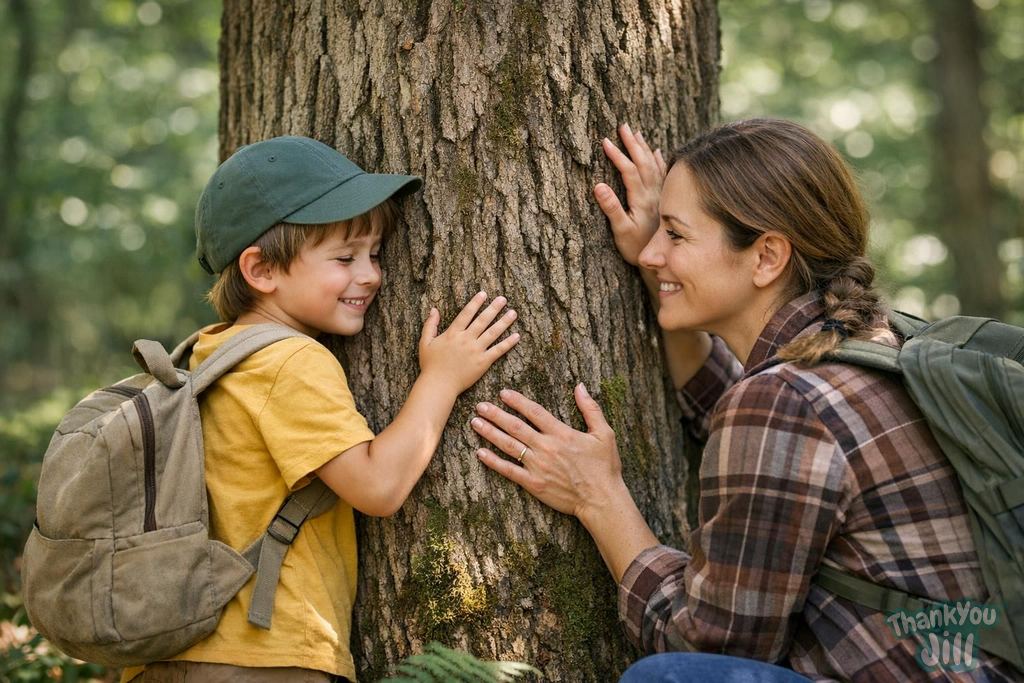
There's a window in childhood — between ages 4 and 12 — when our relationship with nature forms in an almost permanent way. The experiences of this period become part of the emotional and cognitive structure of the adult we become. A child who has hugged a beech tree, who has collected acorns in their grandfather's park, who knows the name of the cherry tree they play under — that child has a map of the world that includes trees. And that map stays with them for life.
Why nature education in childhood matters so much
Research in developmental psychology documents that contact with nature in childhood produces lasting effects: reduced anxiety (children who regularly play in natural environments show lower cortisol levels and better emotional regulation); development of sustained attention (Kaplan's "attention restoration theory" documents that natural environments restore our capacity for focus better than artificial ones); development of environmental responsibility (longitudinal studies show that adults with direct nature contact experiences in childhood exhibit more sustainable environmental behaviors); development of biophilia (the term coined by E.O. Wilson to describe the innate human affinity for other living organisms — which develops through contact, not just knowledge). The paradox of our time is that current generations of children spend more time indoors, more time on digital devices, and less time in natural environments than any previous generation. The result is a growing disconnection from nature — what Richard Louv called "nature deficit disorder" in his book Last Child in the Woods (2005).
The most effective activities for building the child-tree bond
Not all outdoor activities build the same kind of connection with nature. The most effective ones for a relationship with trees specifically combine physical contact (touching, smelling, collecting), naming (learning names), continuity (returning to the same trees over time), and responsibility (caring for a tree). Activities that meet more of these criteria have the most lasting impact. The three-tree tour: choose 3 trees in a nearby park or forest that become "your family's trees." Visit them every month. Give them names. Watch how they change through the seasons. Photograph them. This continuity with specific individuals is far more effective than a hundred visits to different places. Leaf collecting: collecting and pressing leaves is one of the oldest and most effective nature activities. Not to keep children still — but to help them observe differences between different species, developing the ability to distinguish and classify. Building a birdhouse: already described in detail elsewhere, but worth mentioning here for its educational effectiveness — the child who builds and installs a nesting box then monitors it, participates in the nesting season, feels responsible.
The role of grandparents and intergenerational knowledge transfer
One of the most interesting areas of research in ethnobotany and cultural ecology concerns intergenerational transmission of plant knowledge. Grandparents who lived in rural environments know the trees of their territory in a practical, direct way — they know when to harvest, how to use them, what their history is. This knowledge is lost if it isn't actively passed down. Forest outings with grandparents — where the grandfather knows the name of the chestnut tree, knows how to open a chestnut burr, can distinguish rowan from hawthorn — are among the most valuable nature experiences a child can have. Not just for the information: for the relational model they transmit. The grandfather who respects the tree teaches his grandchild to respect it without needing explanations.

A child who knows the name of the beech tree they play under has something that can't be taken away: a piece of the world they recognize. When they grow up and see a beech tree, they won't see just any tree. They'll see something familiar, something with a name, something they know. And things we know, we usually don't destroy.
Practical ideas for every age: 2 to 12 years old
- Ages 2-4 — Sensory contact: Touch the rough bark of an oak and the smooth bark of a beech. Smell a pine twig. Collect an acorn and a leaf. At this age, names and explanations aren't needed — what matters is physical contact with the diversity of textures, scents, and colors. Every outing in nature is enough.
- Ages 5-7 — Names and stories: Start giving trees names. "This one is called a chestnut tree — did you know that children long ago ate its chestnuts when there was nothing else to eat?" Simple stories linked to trees are the most natural way for children this age to memorize names and create emotional associations.
- Ages 8-10 — Responsibility: Give your child responsibility for something concrete: watering a newly planted tree, building a birdhouse, keeping a seasonal diary of a specific tree. Responsibility creates a sense of belonging.
- Ages 11-12 — Citizen science: At this age, children can actively participate in real monitoring projects: iNaturalist to identify and map species, phenology to record flowering dates, tree census of your neighborhood. Contributing to something real is motivating and builds competence.
- At every age — the "don't break" rule: Always teach: don't break living branches, don't carve the bark, don't trample forest floor vegetation, don't disturb nests. These aren't bureaucratic rules — they're respect for a living being that can't defend itself. Explain the why, every time. "The branch you broke was alive. The tree feels that wound the way we feel a cut." It's not romanticism — it's accurate plant neurobiology.
Tree education doesn't happen in one afternoon. It happens over a hundred afternoons, in every season, in the same places, with the same trees. It happens with the same patience with which a tree grows: slowly, continuously, without rushing to see results. But the results come. And when they do, they last a lifetime.
Frequently Asked Questions
What activities are most effective for teaching children to respect trees?
The most effective activities combine physical contact (touching, smelling), naming (learning names), continuity (visiting the same trees over time), and responsibility (caring for a tree). Examples include the three-tree tour, leaf collecting, and building birdhouses.
How can intergenerational knowledge transfer help children respect trees?
Grandparents who know trees well pass on practical knowledge and nature-related stories, creating a relational model of respect. Forest outings with grandparents strengthen emotional bonds and environmental awareness in children.
How do tree education activities vary based on children's ages?
From ages 2-4, sensory contact with nature is emphasized; from 5-7, names and stories are introduced; from 8-10, concrete responsibilities like watering or keeping a diary are given; from 11-12, children participate in citizen science projects to monitor trees.
Why is it important to teach children the "don't break" rule for trees?
Teaching children not to break living branches, carve bark, or disturb vegetation helps develop respect for living beings. This rule is based on plant neurobiology principles and helps children understand that trees feel wounds the way we do.

Latest News




Comments
No comments yet. Be the first!
Leave a comment