


 Italiano
 Français
 Deutsch
 Español
 Português
 Svenska
 Suomi
Suomi
Educational Forests and Natural Parks
Where to Take Children to Learn About Trees: The Italian Guide
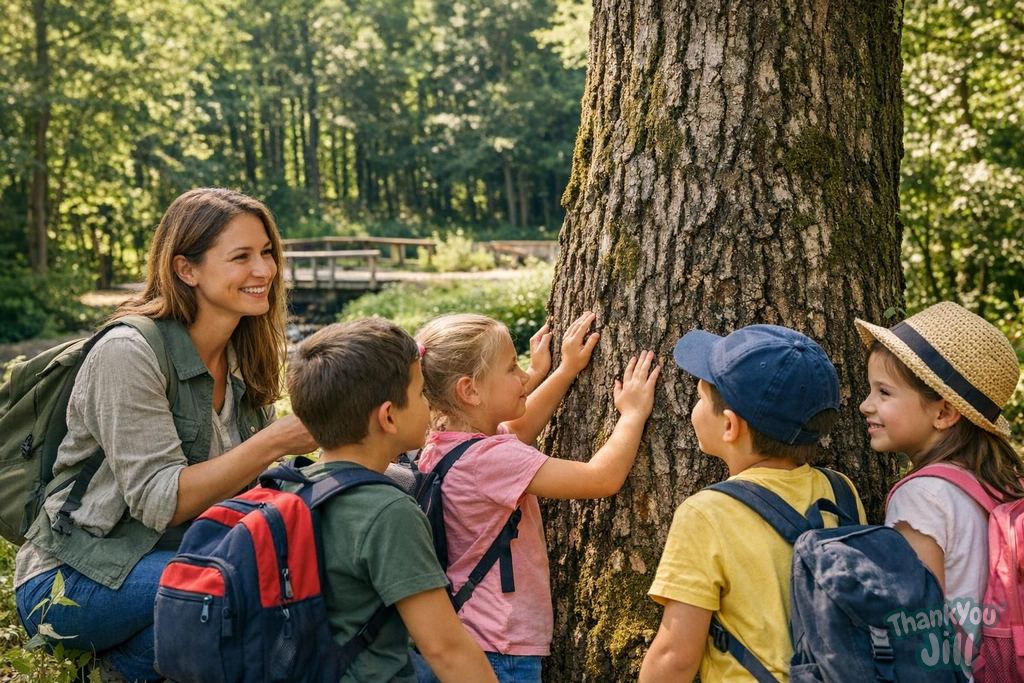
The most beautiful classroom in the world has walls of bark, a floor of leaves, and a ceiling of branches. And in Italy there are hundreds of these classrooms — educational forests, natural parks with educational programs, nature reserves with specialized guides, botanical gardens with school trails. The problem isn't a lack of opportunities: it's knowing where to find them.
Italy's National Parks: The Richest System
Italy has 25 National Parks covering about 5% of the national territory. Nearly all offer environmental education programs for schools and families, with certified naturalist guides, thematic trails, and visitor centers with interactive exhibits. Among the National Parks with the most structured forest education programs: Casentino Forests National Park (Tuscany-Emilia Romagna): one of Italy's most beautiful forest parks, featuring beech forests, fir groves, and chestnut woods. The Pratovecchio and Campigna Visitor Centers offer educational trails for schools and families about tree life, forest animals, and the history of the Casentino forests. Gran Sasso and Monti della Laga National Park (Abruzzo): some of the Apennines' most beautiful beech forests, with wolf tracking, guided birdwatching, and educational trails on forest phenology. Calabria National Park (Sila, Aspromonte, Pollino): the last great forests of Southern Italy, with thousand-year-old Calabrian pines and primordial beech forests. Ticino Park (Lombardy-Piedmont): Northern Italy's most biodiverse river park, with well-developed educational programs accessible to northern cities.
Municipal Educational Forests: Close to Home
Many Italian municipalities have created educational forests in recent years — wooded areas equipped with trails, informational signs, observation points, and educational materials for local schools. These forests are often adjacent to schools or easily accessible on foot — allowing regular educational outings instead of rare distant field trips. The City of Bologna has created 5 "belt forests" with structured educational trails for local schools. Turin has the "Bosco della Pellerina" with environmental education programs managed by cooperatives. Milan has the "ForestaMi" project with urban forests under development. Verona, Florence, and Naples each have structured educational green spaces. To find educational forests in your area: contact your municipality's Environment or Education Department, or search online for "educational forest + your municipality name."
Botanical Gardens: Living Museums of Trees
Italy's university botanical gardens are among Europe's oldest scientific institutions and house extraordinary tree collections. The Padua Botanical Garden (1545, UNESCO) is the world's oldest university botanical garden still in its original location. The Palermo Botanical Garden houses one of Europe's richest collections of tropical trees. The Pisa Botanical Garden (1543) is the second oldest. Many botanical gardens offer specific educational programs for schools with specialized guides. A guided tour of a botanical garden with a knowledgeable guide is one of the best ways to introduce children of any age to the world's tree diversity.

The most beautiful educational forest is the one near your home — the one you return to every week, in every season, and where the trees begin to have names and stories. You don't need the Amazon Rainforest to discover that trees are extraordinary. The local forest is enough, with a curious child and an adult who knows how to stop and listen.
How to Organize the Perfect Educational Visit: A Practical Guide
- Before the visit — preparation: Read a book about trees or the forest you'll be visiting with the children (for example, for the Casentino Forests, the downloadable park brochure). Show them on a map where the park is located. Assign an "observation task" — each child must find something specific: the strangest bark, the largest leaf, the most beautiful mushroom, the bird that sings the most.
- During the visit — slow down: Forest trips with families or schools often fail due to rushing. Make frequent and long stops. Spend 5 minutes under a hundred-year-old beech tree. Sit on the grass in an open area and listen to the sounds for 3 minutes. Show children that nature is appreciated by standing still, not by walking fast.
- Use naturalist guides: National Park guides have expertise that no average parent or teacher can possess. A live account from an expert guide — who recognizes wolf tracks, knows the name of every mushroom, and shows you a woodpecker's nest — has far greater educational impact than reading any book. Always book in advance (guides are often available upon request at the Park's visitor center).
- After the visit — storytelling: Ask children to tell, draw, or write about what they saw. Not as homework — to fix the experiences in memory. The child who draws the beech tree they touched, who tells about the thrush they saw, consolidates the experience and transforms it into permanent knowledge.
- Resources for finding educational activities: The Ministry of Environment website (www.minambiente.it), the National Parks portal (www.parks.it), the CEAS platform (Environmental Education and Sustainability Centers) managed by the Regions — all these portals have lists of nature-based educational activities available throughout Italy.
A child who has walked through a beech forest, who has seen a woodpecker at work, who has held a stag beetle larva in their hand — that child carries with them something no classroom can provide. It's not an alternative to formal education: it's its completion. The forest teaches things differently than books. Both are necessary.
Frequently Asked Questions
How do you choose the most suitable educational forest for a visit with children?
To choose the ideal educational forest, consider proximity to home, the presence of thematic trails suited to your children's age, and the availability of expert naturalist guides. Also verify whether the site offers educational materials and interactive activities to engage younger visitors.
What are the benefits of participating in guided visits with experts in natural parks?
Guided visits with experts offer deeper learning through direct knowledge of flora, fauna, and natural traces. Guides know how to tell stories and share details that enrich the experience, making the visit educational and engaging for both children and adults.
When is it worthwhile to organize regular visits to the educational forest near home?
Organizing regular visits allows children to become familiar with the natural environment across all seasons, recognizing trees and animals over time. This approach promotes continuous learning and a deeper relationship with nature, compared to occasional distant field trips.
How do you prepare children before a visit to an educational park?
Before the visit, it's helpful to read books or brochures about trees and the park you'll be visiting, show the location on a map, and assign specific observation tasks. This stimulates curiosity and makes the experience more engaging and meaningful during the outing.
Latest News
Comments
No comments yet. Be the first!
Leave a comment