


 Italiano
 Français
 Deutsch
 Español
 Português
 Svenska
 Suomi
Suomi
Decluttering
The KonMari Method Applied
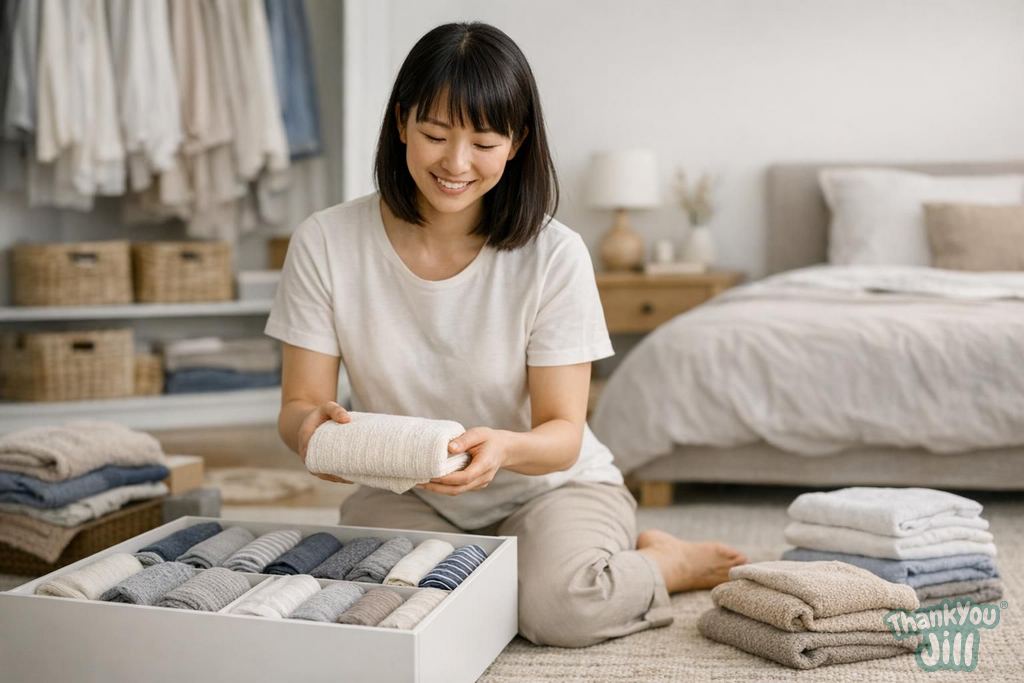
Marie Kondo's KonMari method (published in the book "The Life-Changing Magic of Tidying Up" in 2011) has become a global phenomenon, selling over 14 million copies worldwide and inspiring a Netflix series. Its success is no accident: it proposes a radically different approach to tidying than traditional methods (not "organize what you have better" but "keep only what's worth keeping") and offers a concrete, practical method with a strong psychological and emotional component.
The Fundamental Principle: "Spark Joy" as a Selection Criterion
The heart of the KonMari method is the question you ask yourself about every object: "Does this spark joy?" In Japanese, "tokimeku" means experiencing a sense of pleasure and positive excitement when holding an object in your hands. It's not a question about practical usefulness (Is this useful?) or the rationality of the purchase (I paid a lot for it!): it's a question about your direct emotional and sensory relationship with the object. This criterion has some practical advantages: it's immediate (you perceive it in seconds when holding the object), it bypasses rationalizations (I should keep it just in case), and it works regardless of the object's monetary value. The limitation: not everything in life "sparks joy" in the emotional sense of the term (tax documents, first-aid supplies, useful work tools that lack charm). Kondo acknowledges this and proposes specific categories like "useful tools" that you keep for their function, not for the joy they produce.
The KonMari Method in Practice: The Six Categories in the Right Order
Kondo suggests tackling decluttering by category rather than by room, and in a specific order designed to start with the easiest decisions (clothes) and progress to the hardest (sentimental items). 1. Clothes: gather ALL your clothing in one pile on your bed (including items in other closets or storage areas). Hold each piece, feel if it "sparks joy," and separate into keep/thank-and-release piles. 2. Books: do the same with all books in your home. 3. Documents: papers and documents. 4. Komono (miscellaneous items): the largest and most heterogeneous category (kitchen, bathroom, home office, hobbies, electronics). 5. Sentimental items: photographs, letters, objects from the past. This comes last because it's emotionally harder. The order isn't arbitrary: each previous category trains your discernment skills for the ones that follow.
Managing the Guilt of Decluttering
The main emotional blocks to decluttering: "I paid a lot for it" (sunk cost fallacy: money already spent won't come back if you keep the object; throwing away an expensive item isn't additional waste, it's accepting waste that's already happened), "I might need it someday" (according to Kondo, that "someday" almost never comes: if you haven't used it in 1-2 years, the odds of using it are minimal), "It was a gift" (gifts have already fulfilled their function at the moment they were given with affection: you don't need to keep them for life), "It belonged to my parents/grandmother" (inherited objects carry particularly strong emotional weight: tackle them after practicing with the "easy" categories). The gratitude ritual that Kondo suggests (mentally thanking each object you let go of for the service it provided) might seem odd, but it serves a concrete psychological function: it reduces the sense of loss and regret.
The KonMari Method Applied to Your Kitchen
The KonMari method works remarkably well in the kitchen and pantry too. Gather all your food items (including those in the fridge and freezer), and eliminate anything that's expired or that you don't think you'll use in the next 2-3 months. Apply the same logic to kitchen utensils: do you have four identical spoons? Keep one or two, maximum. Three graters? One multi-purpose one is enough. Gadgets you bought enthusiastically and never used (juicers, spiralizers, slicers)? If you haven't used them in the past six months, you probably won't. A kitchen with fewer items is easier to clean, more efficient to use, and more pleasant to spend time in. The "magic power of tidying" works in the kitchen just as well as in the closet.

A closet full of clothes you never wear doesn't make you feel richer: it makes you lose five minutes every morning figuring out what to put on. The 500 books you'll never reread don't make you more cultured: they make you feel indebted to yourself every time you look at them. Decluttering isn't about losing things: it's about reclaiming space, time, and clarity. Start with your clothes. Today.
What to Do After Decluttering: Where Your Items Go
The objects you let go of shouldn't end up in a landfill: Clothes in good condition: secondhand markets (Humana, Red Cross, charity shops), Vinted for online sales, direct donation to family or friends. Books: antiquarian bookstores, local book swap groups (Bookcrossing.com, local Facebook groups), libraries that accept donations. Working electronics: recycling centers (waste disposal sites), Vinted, Subito.it. Furniture: Facebook Marketplace, Subito.it, Nextdoor app for your neighborhood, donation to families in need through Caritas. Valuable items: pawn shops, collectors, eBay. The two-week rule: put items to donate in sealed boxes. If after two weeks you haven't looked for anything from that box, take it away without opening it.
Maintaining Order After Your Big Decluttering
The KonMari method doesn't work if you accumulate new items at the same rate you're eliminating old ones. Maintenance requires: the "one in, one out" rule (every new item that enters your home means one equivalent item leaves), seasonal wardrobe reviews (every season change: 30 minutes to assess what you haven't worn and let it go), a shopping list with a 48-hour waiting period (no impulse purchases), a designated fixed space for every object (an object with no place has no reason to exist in your home). Decluttering done once produces lasting benefits only if your buying habits change: it's a process of cultural change, not just physical cleaning.
The KonMari Method in Family Life: How to Involve Everyone Without Conflict
The KonMari method becomes complicated when you live with a partner or children who don't share the same enthusiasm for tidying. Kondo's fundamental rule: never touch other people's belongings without their consent. Decluttering shared spaces (kitchen, living room) must be collaborative and agreed upon. How to involve your partner: lead by example (start with your personal spaces and show the positive change it produces), suggest short, specific sessions (30 minutes on the bathroom cabinet, not "let's do the whole house this weekend"), respect their pace: some people have a much more emotional relationship with objects than others. With children over 4-5 years old: involve them in choosing what toys to donate to children who don't have any. The prosocial motivation ("those toys will go to a child who needs them") is much more effective than the aesthetic motivation ("we'll keep only what sparks joy").
Frequently Asked Questions
What is the correct order for applying the KonMari method to decluttering?
The KonMari method suggests tackling decluttering by categories in this order: clothes, books, documents, komono (miscellaneous items), and finally sentimental items. This order helps develop your discernment skills, starting with the easiest decisions and progressing to the emotionally hardest ones.
How do you overcome the guilt associated with decluttering according to the KonMari method?
To overcome guilt, the method encourages you to recognize that money already spent is lost (sunk cost fallacy), that items unused for years probably won't be needed, and that gifts have already fulfilled their purpose. The gratitude ritual toward objects helps reduce regret and the sense of loss.
How do you maintain order after completing decluttering with the KonMari method?
Maintenance requires the "one in, one out" rule, seasonal reviews to eliminate what you don't use, avoiding impulse purchases with a 48-hour waiting period, and assigning a fixed space to every object. Changing your buying habits is essential for lasting benefits.
How do you apply the KonMari method in the kitchen for effective decluttering?
In the kitchen, gather all your food and utensils, eliminate anything expired or unused for months. Reduce duplicates and gadgets you've never used. A kitchen with fewer items is easier to clean, more efficient, and more pleasant to use, applying the same principle of "spark joy" and functional usefulness.


Latest News




Comments
No comments yet. Be the first!
Leave a comment