


 Italiano
 Français
 Deutsch
 Español
 Português
 Svenska
 Suomi
Suomi
Home Workouts Without Equipment
15-Minute Routine
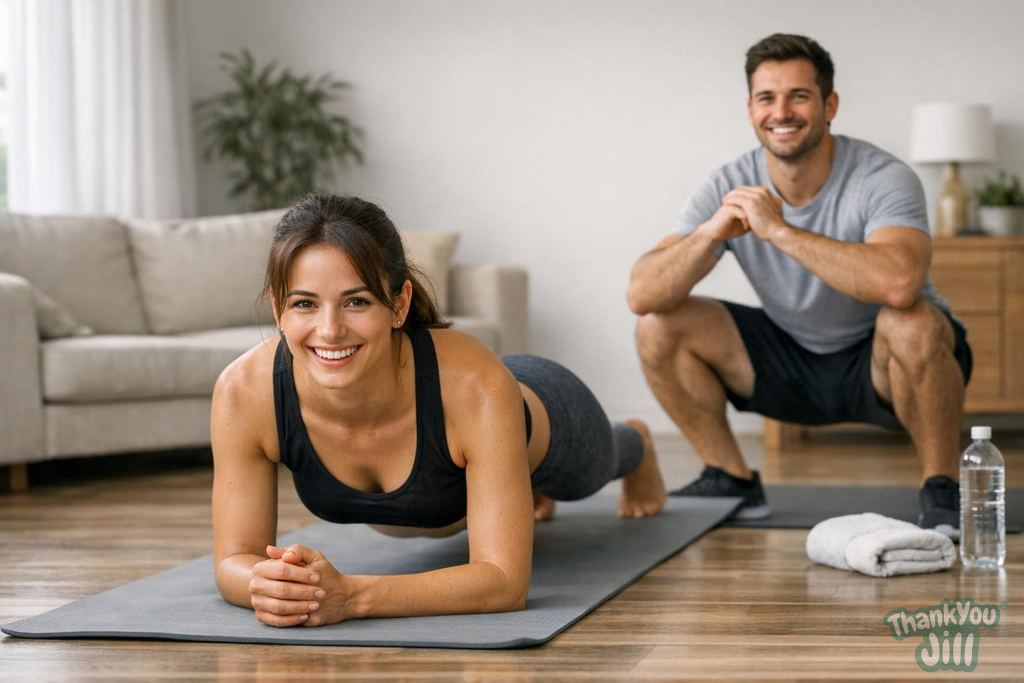
Bodyweight training (calisthenics) has a history spanning millennia: Greek soldiers, Olympic gymnasts, sumo wrestlers, and military personnel throughout history have trained without equipment. Modern research confirms what traditional practice has always known: bodyweight exercises produce muscular, cardiovascular, and neuromuscular adaptations comparable to weight training, provided the intensity is appropriate. The main advantage: zero cost, zero commute, zero equipment, and the ability to train in any 2x2 meter space.
The fundamentals of bodyweight training: basic movement patterns
All bodyweight training is built on six fundamental movement patterns that engage all major muscle groups. Horizontal push (chest, triceps, front shoulders): push-ups. Versions for all levels: knee push-ups (beginners), standard push-ups, elevated push-ups (advanced). Horizontal pull (back, biceps): inverted rows under a table (place your hands under the edge of a sturdy table, body at an angle, pull your chest toward the table). Vertical push (shoulders, triceps): dips between two chairs, pike push-ups (inverted V). Squat (quadriceps, glutes, hamstrings): bodyweight squat, sumo squat, lunges. Hip hinge (glutes, hamstrings, lower back): glute bridge, single-leg bridge, hip hinge. Core (abs, obliques, stabilizers): plank, hollow body hold, mountain climbers, dead bug.
The 15-minute routine: complete program
This routine covers all fundamental patterns and can be performed anywhere. Circuit to repeat 3 times, 40 seconds of work + 20 seconds of rest for each exercise. Exercise 1: bodyweight squat. Feet shoulder-width apart, descend until your thighs are parallel to the floor, rise back up. 40 seconds. Exercise 2: push-ups (using the variation appropriate for your level). 40 seconds. Exercise 3: glute bridge. Lying down, knees bent, feet on the ground, lift your hips until you form a straight line from shoulders to hips to knees. 40 seconds. Exercise 4: plank. Supported on forearms and toes, body rigid like a board, hold. 40 seconds. Exercise 5: alternating lunges. Step forward, descend until your back knee nearly touches the ground, rise and alternate. 40 seconds. Exercise 6: mountain climbers. In plank position, alternate your knees toward your chest at a moderate pace. 40 seconds. Rest between circuits: 90 seconds. Total time: approximately 15 minutes.
How to progress over time: the principle of progressive overload
Your body adapts to training: to continue progressing, you must gradually increase difficulty over time. In bodyweight training, progressions follow a specific order. Squat progressions: standard squat → squat with pause at bottom (3 seconds) → jump squat → assisted pistol squat → pistol squat. Push-up progressions: knee push-ups → standard push-ups → elevated push-ups → archer push-ups → assisted one-arm push-ups → one-arm push-ups. Plank progressions: forearm plank → hand plank → plank with leg lift → RKC plank (maximum tension throughout the body). The practical rule: when you can complete all repetitions or seconds with good form for 2-3 consecutive sessions, it's time to progress to the more difficult variation. Never progress at the expense of form: premature progression with poor form causes injury instead of adaptation.
Frequency and recovery: how many times per week
For beginners: 3 sessions per week with at least one rest day between sessions (e.g., Monday-Wednesday-Friday). For those already active: 4-5 sessions with division by movement pattern (e.g., push/pull one day, legs/core the next). Recovery is part of training: muscles grow during rest, not during the workout. Signs of insufficient recovery: performance that worsens instead of improving, muscle soreness that doesn't resolve within 48 hours, worsening sleep, increased irritability. In these cases: reduce frequency or intensity instead of increasing it. The golden rule of fitness: the most productive training session is one from which you can fully recover before the next.

Push-ups, squats, planks, lunges, glute bridges: five exercises that engage your entire body, require nothing special, and produce, with consistency, exactly the adaptations you're looking for. Fifteen minutes three times a week. The cost: zero. The obstacle: only the habit of getting started. Start with just one push-up a day. Really: just one. Then see what happens.
Building the habit of training: the science of habit formation
James Clear, in his book "Atomic Habits," describes the habit formation process with the loop: cue → routine → reward. For home training: fixed cue (always at the same time, in the same space: the mat already laid out the night before is the visual cue that triggers the routine), minimal routine (on difficult days, commit only to warming up. Often you'll end up doing the full workout), immediate reward (track each session with a mark on the calendar: the unbroken streak becomes the motivation not to break it), reduced friction (workout clothes already prepared the night before, the video already open on your phone). Research by Phillippa Lally (University College London, 2010) showed that forming a habit takes an average of 66 days (not 21 as often claimed). The first 30 days are most critical: never skip two consecutive sessions.
Warm-up and cool-down: the most neglected parts
A 3-5 minute warm-up significantly reduces injury risk and improves session performance. Effective 5-minute warm-up: jumping jacks 60 seconds (activates the cardiovascular system and warms up joints), torso rotations 30 seconds per side, arm circles 30 seconds, slow bodyweight squats 10 repetitions, hip circles (hip rotations) 10 per side, lunges with torso twist 5 per side. Cool-down of 3-5 minutes: static stretching of the major muscles used (quadriceps, glutes, chest, shoulders, hamstrings). Cool-down doesn't accelerate muscle recovery (delayed-onset muscle soreness DOMS depends on muscle microtrauma, not gradual temperature reduction), but it improves flexibility and reduces stiffness in the following days if practiced regularly.
Free resources for training at home
YouTube is the world's largest free gym. Quality Italian and international channels for bodyweight training: FitnessFAQ (English): the reference channel for progressive calisthenics, with scientifically accurate guides. Officina della Forma (Italian): complete bodyweight training programs for all levels. Athlean-X (English): Jeff Cavaliere, a physical therapist, explains the biomechanics of every exercise. Yoga with Adriene (English but accessible): yoga as a complementary mobility and strength activity. Darebee.com: free database of hundreds of bodyweight training routines with visual diagrams. Nike Training Club app: free, hundreds of guided bodyweight workouts, from 5 to 60 minutes, for all levels.
Frequently Asked Questions
How can I progress in bodyweight exercises without equipment?
To progress in bodyweight training, gradually increase the difficulty of exercises by following specific progressions, such as moving from knee push-ups to one-arm push-ups. Always maintain proper form to avoid injury.
What's the ideal frequency for training at home without equipment?
For beginners, it's recommended to train 3 times a week with at least one rest day between sessions. More experienced individuals can progress to 4-5 weekly sessions, dividing workouts by muscle groups or movement patterns.
Why is warm-up and cool-down important in bodyweight exercises?
A 3-5 minute warm-up reduces injury risk and improves performance by warming up muscles and joints. Cool-down helps improve flexibility and reduce muscle stiffness in the following days, though it doesn't accelerate muscle recovery.
How can I build the habit of training regularly at home?
Establish a fixed cue like training at the same time and place, start with minimal routines to avoid skipping sessions, use immediate rewards like marking each workout, and reduce obstacles by preparing everything in advance.
Latest News




Comments
No comments yet. Be the first!
Leave a comment