


 Italiano
 Français
 Deutsch
 Español
 Português
 Svenska
 Suomi
Suomi
Adapted Utensils
Promoting Independence at the Table
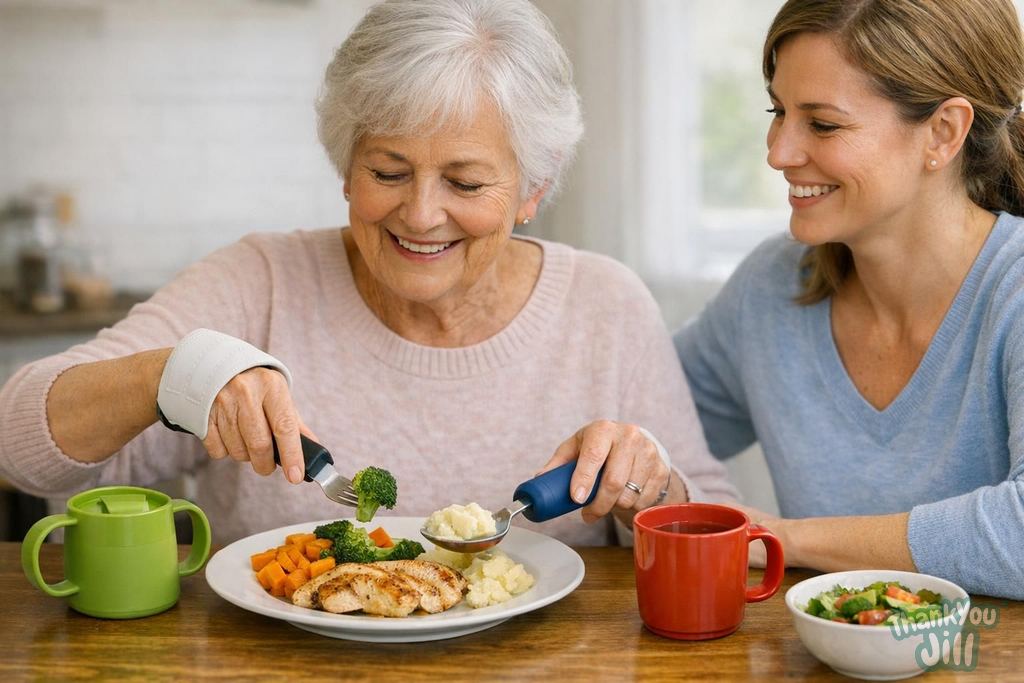
The ability to eat independently is one of the most fundamental skills for quality of life: losing the capacity to feed oneself is psychologically devastating and increases feelings of dependence and loss of control. For many people with upper limb motor disabilities, tremors, weak grip strength, or reduced coordination, adapted utensils can make the difference between eating alone and needing to be fed. The market for mealtime aids is growing and offers solutions for many different situations.
Adapted Utensils: For Every Type of Difficulty
Utensils with thickened handles (adapted grip): for those who struggle to hold thin objects due to reduced grip strength (arthritis, muscle weakness, stroke aftereffects). The thicker handle (2.5-3 cm in diameter) distributes force across more points of the palm. Many models feature non-slip silicone coating. Cost: €8-25 per set. Manufacturers: Etac, Homecraft Rolyan, OXO Good Grips. Angled utensils: for those unable to rotate their wrist (tetraplegia, severe rheumatoid arthritis, post-surgical effects). Food is brought to the mouth without requiring wrist supination. Available in various angles (90°, 45°). Manufacturers: Etac Relax, Samarit. Weighted utensils: for those with tremors (Parkinson's disease, essential tremor). The added weight (approximately 120-250 g compared to 50 g for standard utensils) dampens the amplitude of tremors. Effectiveness documented in Parkinson's studies. Manufacturers: Liftware (Google), Etac Relax Weighted. Liftware Steady: goes beyond weighted utensils—it's an electronic stabilizer that uses sensors and motors to actively compensate for trembling movements, keeping the spoon steady. High cost (€280) but documented effectiveness. Universal utensils (with hand strap): for those unable to open their hand or maintain grip. An adjustable strap secures the utensil to the hand even without active gripping. Manufacturers: Patterson Medical, Etac.
Non-Slip Plates and Surfaces
Plates with raised edge and pusher: a 3-4 cm internal vertical edge allows you to gather food by pushing it against the edge instead of using bread or a fork to stop the food. Essential for those using only one hand (unilateral stroke aftereffects). Available in ceramic, plastic, stainless steel. Cost: €15-40. Manufacturers: Etac, Homecraft, Maddak. Non-slip mats (dycem): dycem is a special PVC material with high adhesion on both sides. Placed under a plate or cup, it prevents slipping on any surface without needing to grip it. Essential for those using only one hand. Cost: €5-15 per sheet or mat. Available in bright colors (helpful for people with vision problems who struggle to distinguish the plate from the table). Guard rings (non-slip ring): applied to the edge of a regular plate, transforming it into a rimmed plate: economical (€3-8) and compatible with any plate already at home. Compartmentalized plates: for people who don't want foods to mix (relevant in some autism patients or those with specific sensory preferences) or to facilitate viewing distinct foods. Suction cup under the plate: to secure the plate to the table with tiles or smooth surfaces: an economical alternative to dycem.
Adapted Cups and Mugs
Mugs with two handles: distribute weight across both hands for those lacking sufficient strength or stability with one hand alone. Useful in Parkinson's, general weakness. Mugs with valve spout (adult sippy cups): allow drinking without tilting the head or cup. Useful in high tetraplegia, dysphagia (the spout slows liquid flow), limited cervical mobility. Manufacturers: Nosey Cup, Flexi-Cut Cup (the edge is cut at the nose to allow drinking without tilting the head). Straws: rigid straws (stainless steel, glass) or flexible ones allow drinking without lifting the cup. Long, flexible straws are useful for bedridden individuals. Caution with dysphagia: straws can increase liquid flow, making swallowing more difficult for some people—verify with a speech therapist. Hydration bottles with valve: sports bottles with bite valves or spouts: very practical for autonomous hydration even with limited hand grip. Water dispenser with foot pump: for those unable to open faucets or lift pitchers, water dispensers with electric or foot pumps enable autonomous hydration.

Eating alone is dignity. A €20 angled fork can make the difference between needing someone's help at every meal and bringing food to your mouth independently. Tableware aids aren't gadgets—they're tools of independence. Ask an occupational therapist to evaluate which ones are most suitable for your specific situation.
The Occupational Therapist: The Key Professional
The occupational therapist (OT) is the healthcare professional specialized in analyzing daily activities (including meals) and in evaluating and prescribing the most appropriate aids for each person and situation. The OT's assessment for mealtime includes: analysis of upper limb functionality (grip strength, pinch, coordination, range of motion), evaluation of sitting posture (position greatly influences eating ability), assessment of autonomy in different meal phases (opening containers, pouring, cutting, bringing to mouth, drinking), selection and customization of the most appropriate aids, training in using the chosen aids. The OT can prescribe aids with a specialist prescription (NHS): many mealtime aids fall within the tariff nomenclature for prosthetics and aids (D.M. 332/1999, being updated with D.M. Health 2023). The OT can be found in: hospitals (rehabilitation units), nursing homes, day centers, private rehabilitation clinics. Assessment is reimbursable by the NHS if prescribed by a specialist physician.
Kitchen Aids: Preparing Meals with One Hand
For those using only one hand (hemiplegia, amputation, paralysis), meal preparation is the main challenge. Specific aids: adapted kitchen board (cutting board with clamps and nails): a board with raised corners (holds vegetables during cutting), hooks (to hold bread steady while cutting), and suction cup underneath (secures to the table). With these tools, cutting bread, vegetables, and meat with one hand alone becomes possible. Cost: €40-80. Electric or automatic jar openers: essential for those lacking sufficient strength to open jars. Available from €10-40. Bottle dispenser: for those unable to hold the bottle and pour simultaneously. Spring funnels that attach to an inverted bottle. Pots with two handles: more stable than pots with a side handle for those with weak grip or only one functional arm. Ladles with T-shaped or ring handles: allow a different grip, better suited for those unable to fully close their hand. Vertical vegetable peeler (sitting on the table): used by pressing the vegetable downward instead of holding the peeler horizontally: better suited for those with less wrist strength.
Where to Buy Mealtime Aids in Italy
Main sources for mealtime aids in Italy: specialized pharmacies and medical supply stores: pharmacies with orthopedic departments and orthopedic aid shops generally have basic ranges of adapted utensils, rimmed plates, and special cups. Staff aren't always trained on aids specific to disability: it's better to already have the OT's evaluation. Specialized online shops: Ottobock (ottobock.com), Maddak (maddak.com), Aidapt (aidapt.co.uk), Homecraft Rolyan (in the Sammons Preston catalog): major international distributors with shipping to Italy. Competitive prices, wide selection. STAR Centers and regional aid centers: in each region there are NHS or affiliated aid centers that physically display aids, allowing you to try them before purchase. The list of regional aid centers is on SIVA (Aid Information and Evaluation Service) at the SIVA Portal (portale.siva.it). NHS and reimbursement: the Aid Tariff Nomenclature (D.M. 332/1999, being updated) provides free or reduced co-payment supply of many mealtime aids for people with specific disabilities. Request a specialist prescription from your physiatrist or neurologist.
Frequently Asked Questions
What types of adapted utensils are most suitable for those with hand tremors?
Weighted utensils, with added weight of 120-250 g, help dampen tremors, while utensils with electronic stabilizers like Liftware Steady actively compensate for trembling movements, keeping the spoon steady. They're particularly useful for Parkinson's disease or essential tremor.
How do you choose a suitable plate for someone eating with only one hand?
Plates with a 3-4 cm raised edge allow you to push food against the edge to gather it easily, while non-slip mats or suction cups secure the plate to the table, preventing unwanted movement. These aids promote table independence for those with only one functional hand.
When is it worthwhile to use angled utensils and what problems do they solve?
Angled utensils are indicated for those unable to rotate their wrist, such as in tetraplegia or severe rheumatoid arthritis. They allow food to be brought to the mouth without wrist supination, promoting meal independence and reducing fatigue in movements.
What is the occupational therapist's role in choosing adapted utensils for meals?
The occupational therapist evaluates upper limb functionality, posture, and autonomy during meals, prescribing and customizing the most suitable aids. They provide training in use and can prescribe aids with a specialist prescription, ensuring effective, personalized solutions for each person.


Latest News




Comments
No comments yet. Be the first!
Leave a comment