


 Italiano
 Français
 Deutsch
 Español
 Português
 Svenska
 Suomi
Suomi
Easy Recipes for People with Limited Mobility
Practical one-pot and slow cooker recipes
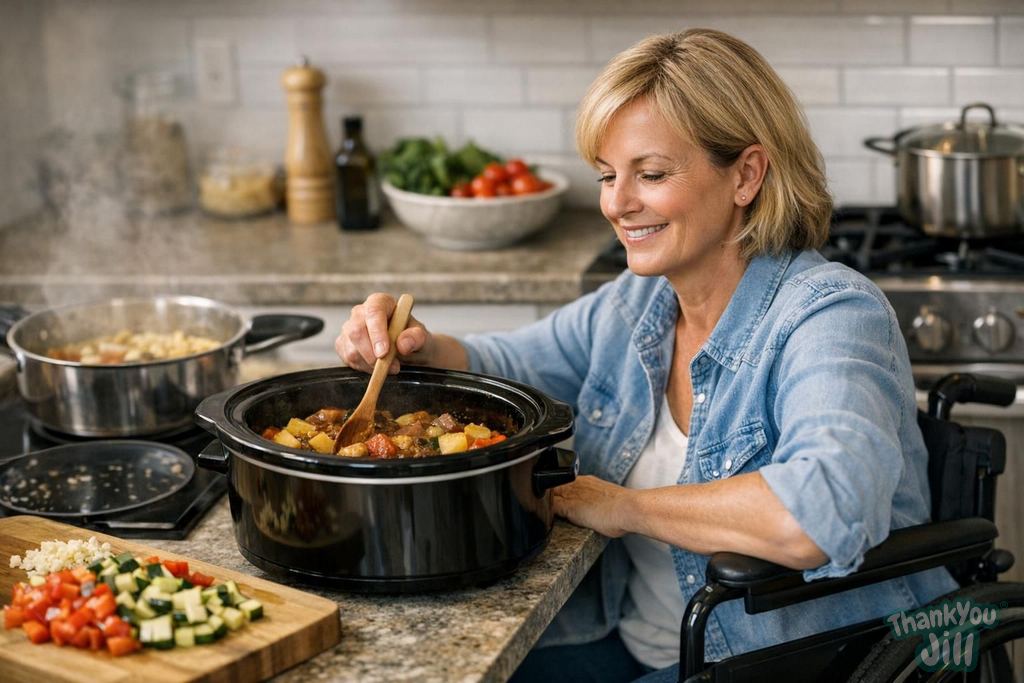
The ability to cook independently is a fundamental component of autonomy and quality of life. For people with reduced upper limb mobility (incomplete tetraplegia, muscular dystrophy, severe rheumatoid arthritis, Parkinson's disease, stroke aftermath), cooking may seem impossible. In reality, with the right techniques and adapted tools, most people with upper limb motor disabilities can prepare at least some meals independently. The goal isn't to cook as before: it's to cook differently, with adapted solutions that enable participation and self-sufficiency.
Setting up an adapted kitchen
Before changing recipes, adapt the kitchen itself. Work surface at wheelchair height: if the person cooks while seated, work surfaces and stovetops must be accessible at the right height (approximately 80-85 cm for a standard wheelchair). In non-adapted kitchens: use an adjustable table or mobile island. Everything within reach: reorganize cabinets and shelves so frequently used ingredients and tools are on the two most accessible upper and lower levels (not high up and not on the floor). Easy-to-use appliances with one hand or reduced grip: microwave with large buttons, multicooker/slow cooker (low effort to use), immersion blender with adapted grip, food processor with fixed bowl (everything happens inside the processor, nothing to hold). Automatic jar openers: essential. Cutting board with clamps (see article on adapted tools). Measuring cups with lever or spout (not glasses to fill and pour). Non-slip work surface (dycem): stabilizes pots and containers during preparation.
Cooking techniques for one-handed use
Many kitchen operations that seem to require two hands can be done with one with the right adjustments. Cutting: use a cutting board with corner clamps to hold vegetables while you cut them. Hold the knife in your functional hand. For bread: use a bread guide (a metal frame that holds bread steady). Opening jars: use an electric jar opener or the edge of the sink (rest the jar on the edge, apply pressure with your palm, twist with the other hand). Stirring: use a bowl with non-slip base (it won't move) or with suction cups. The spiral spoon (stirring spoon with ring handle): held with the whole hand rather than fingers. Peeling: Y-shaped vegetable peeler (vertical, press downward instead of holding horizontally). Pouring liquids: pitcher with side handle and wide spout. Ladle with hook that rests on the pot rim (no need to hold it suspended). Using the oven: use lightweight baking sheets (not heavy cast iron ones). Use oven mitt gloves instead of square pot holders. Position the oven rack at a height you can comfortably reach without bending or stretching.
Low-effort recipes: the principles
The best recipes for people with motor limitations follow these principles. Minimum number of steps: prefer one-pot recipes (everything cooks in a single pot or pan). Passive cooking (oven, slow cooker): food cooks on its own without you needing to stir or turn it constantly. Batch preparation: prepare large quantities once a week (e.g., Sunday) and store in portions in the refrigerator/freezer. Each day a portion comes out of the freezer into the microwave: 5 minutes and the meal is ready. Pre-made ingredients: use frozen vegetable mixes already cleaned and cut, canned legumes already cooked, tomato puree, ready-made broth. It's not "cheating": it's optimizing available energy. Textures suited to grip abilities: minimize foods that require cutting during the meal (prefer bite-sized pieces from cooking).

You don't cook worse with one hand or from a wheelchair: you cook differently. One-pot rigatoni with frozen vegetables and tomato puree requires opening three jars, putting everything in the pot, and waiting 15 minutes. With a cutting board with clamps and an automatic jar opener: complete independence. Adapted cooking isn't a sacrifice: it's a different intelligence of the same pleasure.
Three practical low-effort recipes
Pasta with sauce and vegetables (one-pot, 15 minutes): in a large pot (with bilateral side handles: more stable) bring 1 liter of salted water to a boil. Add 200 g of short pasta (rigatoni, penne rigate). Add directly to the pot 150 g of frozen vegetable mix already cut (zucchini, eggplant, peppers). After 10-12 minutes drain (use a colander with bilateral handles or a cooking basket with handle). Season directly in the pot with 3 tablespoons of warmed tomato puree and a drizzle of oil. Done. Legume soup (slow cooker, 8 hours unattended): the evening before, put in the slow cooker 200 g of red lentils (no soaking required), 1 can of crushed peeled tomatoes, 1 liter of ready-made vegetable broth, one tablespoon of curry powder, salt. Set the slow cooker to LOW for 8 hours. In the morning the soup is ready and hot. Partially blend with an immersion blender if you prefer a creamy texture. Keeps in the refrigerator for 5 days. Oven frittata (one pan, 20 minutes): preheat oven to 180°C. In a bowl with non-slip base, beat 3 eggs with a fork. Add 50 ml of milk, grated cheese, salt, small pieces of pre-cooked vegetables (you can use leftover vegetables). Pour into a small pan lined with parchment paper (no need to grease). Bake for 20 minutes. The oven frittata doesn't need to be flipped: it cooks evenly without intervention.
The occupational therapist for adapted cooking
An occupational therapist (OT) specializing in ADL (Activities of Daily Living) can assess the home of a person with disability and make specific recommendations for adapted cooking. An OT kitchen assessment includes: evaluation of upper limb functionality (grip strength, coordination, range of motion), evaluation of posture and kitchen accessibility, trial of specific cooking activities (opening a jar, cutting, pouring: to identify critical points), prescription of specific aids for each difficulty identified, possible training in the use of aids. The OT can also suggest structural modifications to the kitchen (lowering work surfaces, installing lever faucets instead of knobs) which in many cases are reimbursable by the national health service if prescribed as aids. To find an OT specializing in ADL: local health authorities have OTs on staff for home assessments (request a prescription from your GP or specialist), private rehabilitation clinics have OTs with ADL specialization, AITO (Italian Association of Occupational Therapists, aito.it) has a register of Italian OTs with declared specializations.
Online resources and apps for adapted cooking
Digital resources for those cooking with limited mobility: YouTube "One Handed Cooking" and "Cooking with MS" (English): dedicated channels with video tutorials on adapted techniques and recipes. Very practical for seeing techniques in action. Hemi-Help (hemihelp.org.uk): British organization with resources for those with hemiplegia (one side of the body affected). Dedicated section on adapted cooking with downloadable guides. The Art of One Handed Cooking (book by Kathy L. Laurenhue): the reference text in English for one-handed cooking. Cookpad and Giallo Zafferano apps: allow you to filter recipes by number of ingredients and difficulty level. Not specific to disabilities but recipes with few ingredients and passive cooking are often the most suitable. Forums of associations for people with MS, ALS, dystrophy: communities where people share practical daily solutions, including those for adapted cooking. Essential as a source of practical advice from those with direct experience.
Frequently Asked Questions
How do I organize a kitchen to make meal preparation easier with reduced upper limb mobility?
To make cooking easier with reduced mobility, it's important to have work surfaces at wheelchair height (80-85 cm), accessible shelves, appliances with simple controls, and adapted tools like automatic jar openers and cutting boards with clamps to stabilize ingredients.
What techniques allow me to cook safely and efficiently with one hand?
Use adapted tools like cutting boards with clamps, Y-shaped vegetable peelers, non-slip bowls, and ladles with hooks. For opening jars, prefer electric jar openers or use stable surfaces. Choose lightweight baking sheets and position the oven rack at a comfortable height to avoid strain.
When is it best to use one-pot or slow cooker recipes for someone with limited mobility?
One-pot and slow cooker recipes are ideal because they reduce steps and physical effort. They allow passive cooking without needing to stir frequently, making it easier to prepare nutritious meals independently with minimal effort while maintaining kitchen independence.
How can an occupational therapist help with adapted cooking for people with motor disabilities?
The occupational therapist evaluates limb functionality, posture, and kitchen accessibility, prescribes specific aids, suggests structural modifications, and provides training in using adapted tools, improving autonomy and safety in meal preparation.

Latest News




Comments
No comments yet. Be the first!
Leave a comment