

 English
 Italiano
 Français
 Deutsch
 Español
 Português
 Svenska
 Suomi
Suomi
Accessible Gardens
Design for Everyone
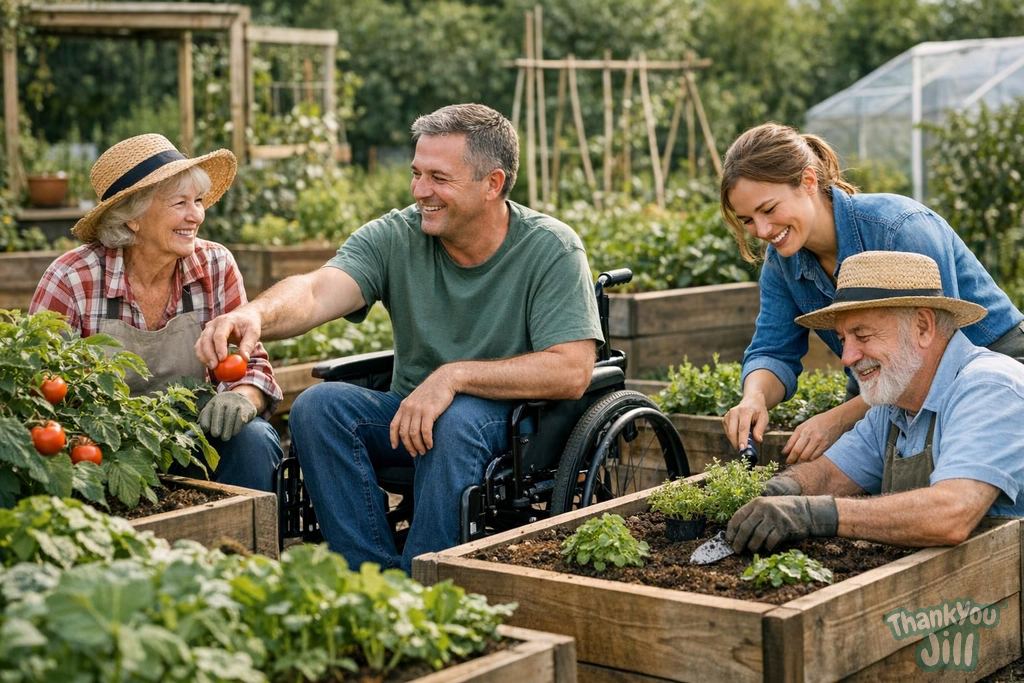
Horticultural therapy is a recognized practice in many countries as a rehabilitation tool and wellness promoter for people with physical, cognitive, and psychological disabilities. Research-documented benefits include: stress and anxiety reduction, improved fine motor function, cognitive stimulation, sense of purpose and efficacy, and socialization. However, for a garden to be accessible, it requires careful design that removes physical and sensory barriers. Universal design applied to horticulture isn't just about people with disabilities—a well-designed garden is more comfortable for everyone, regardless of age or physical ability.
Raised Beds: The Essential Solution
The raised bed is the most effective solution for making a garden accessible to wheelchair users, those who cannot bend to the ground, and elderly people with joint pain. Optimal height for wheelchair users: 70–80 cm from the ground (allows comfortable arm work without lifting from the seat). Optimal height for standing users with bending difficulties: 80–90 cm. Recommended maximum depth: 60 cm from the front edge (allows reaching the center without excessive leaning). If the bed is accessible from both sides: total depth up to 120 cm. Border width: at least 5–8 cm of flat edge for support or tool placement. The border can be widened to 15–20 cm to serve as seating (helpful for those who struggle to stand for long). Materials: treated wood (not CCA-treated: toxic to vegetables), chestnut or robinia wood (naturally rot-resistant), brick, or stone. Avoid concrete in direct contact with soil (raises pH). Adequate drainage system: holes in the bed bottom, gravel layer beneath the soil.
Accessible Pathways and Surfaces in the Garden
Paths between beds must be accessible to wheelchairs and walkers. Minimum width: 90 cm for wheelchair passage, 120 cm for two wheelchairs to pass. Surface: compact, non-slip materials. Best options: compacted gravel (calcite or fine gravel 3–6 mm, laid over weed-blocking fabric)—good traction, economical, permeable. Brick or natural stone pavers—durable, attractive, but costly. Porous concrete or permeable resin—modern, highly durable solution. Avoid: coarse gravel (difficult for wheelchairs), grass (slippery when wet), loose sand (sinks). Maximum slope: 5% along main paths (1 cm per 20 cm—doesn't feel steep but remains accessible for manual wheelchairs). Path edges: low wooden or brick curbs (5–8 cm) that guide white canes for the blind and prevent wheelchair wheels from slipping off. Path lighting: ground-level LED lights or luminous posts for evening accessibility and those with reduced vision.
Adapted Tools for the Accessible Garden
Traditional gardening tools require strong grip, strength, and coordination that may be limited for people with disabilities. Long, ergonomic handles: reduce bending for standing users and allow reaching the center of raised beds without excessive leaning for seated users. Pistol-grip tools: reduce wrist stress and allow more natural grip for those with reduced hand strength. Lightweight tools (fiberglass or aluminum instead of heavy steel): essential for those with limited strength. Ring-grip or velcro-fastened handles: for those unable to close their hand around traditional handles. Water guns with triggers (not continuous manual pressure): allow watering without constant lever pressure. Lightweight watering cans with two-handed handles: distribute weight across both hands. Specialized manufacturers: EZee Reach Ergonomic Garden Tools (UK), Radius Garden (USA), Wolf-Garten (Germany)—ergonomic tool lines widely available in Italy.
Sensory Garden for People with Visual or Cognitive Disabilities
A garden accessible to people with visual or cognitive disabilities requires specific sensory design. For the blind and visually impaired: aromatic plants along pathway edges (lavender, rosemary, mint, sage—recognizable by scent and leaf texture), braille or raised-relief labels for each cultivated species, color contrast in pathways (light path on dark background or vice versa—helps those with residual vision), plants with highly varied leaf textures (rough/smooth/fuzzy—rich tactile and educational experience), garden sounds (rustling leaves, water in a decorative fountain—sound orientation). For people with cognitive disabilities: simple, intuitive layout (one row per crop type, bright colors to distinguish areas), clear and predictable routines (same day each week for garden activities), fast-growing plants with immediate visual reward (radishes: ready in 25 days; basil; green beans; strawberries), visual support with growth-phase photos displayed in the garden to track progress.

A raised bed at 75 cm height, a 120 cm-wide path with compacted gravel, and a lightweight two-handed watering can—with a 300–500 euro investment, a garden corner or terrace becomes accessible to a wheelchair user who can grow their own basil and tomatoes in complete independence. Greenery tended by one's own hands isn't a luxury—it's concrete, demonstrable wellness.
Examples of Accessible Gardens in Italy
Accessible and therapeutic horticulture initiatives are growing in Italy. Orti di Castel Romano (Rome): Rome municipal project with therapeutic gardens for people with mobility and cognitive disabilities, managed in collaboration with social cooperatives. Careggi Garden (Florence): therapeutic gardens in the Careggi hospital area, used in rehabilitation programs for neurological patients. Accessible agritourism with therapeutic gardens: some agritourism facilities have designed accessible gardens as an inclusive tourism offering (see article on accessible tourism). ColtivAMI (Milan): urban social horticulture project that includes gardens accessible to people with disabilities. Accessible school garden project (various municipalities): many schools with students with disabilities are designing accessible school gardens as inclusive educational workshops. Guidelines for designing accessible green spaces are published by INARCH (National Institute of Architecture) and some regions (Tuscany Region has specific guidelines for accessible green spaces).
How to Request Funding for an Accessible Garden
Building an accessible garden can be funded through several channels. INAIL: the National Institute for Insurance Against Workplace Injuries provides grants for adapting domestic environments (including outdoor areas like gardens and terraces) for people with disabilities acquired from workplace injuries. INPS: grants for adapting the domestic environment are available for those with 100% civil disability status with accompanying allowance (D.Lgs 112/1998 art. 41). Regions and municipalities: many local authorities have funds for improving accessibility of private homes (Law 13/1989 on architectural barriers). The garden falls within the home under some regulatory interpretations. PNRR bans for social inclusion: the Italian PNRR has funding lines for accessibility and social inclusion that include accessible community spaces. For collective facilities (nursing homes, day centers, schools): specific regional and national bans exist for therapeutic horticulture projects. The Italian Association for Therapeutic Gardening (AIGT) supports professionals in the field and has contacts with major funding bodies.
Horticultural Therapy: Scientific Evidence
Horticultural therapy has a growing scientific literature documenting health benefits for people with various conditions. Documented physical benefits: improved grip strength and fine coordination (activities like transplanting and seeding), increased moderate physical activity (walking in the garden, carrying light crates), sun exposure with vitamin D production, improved sleep quality (outdoor activity). Psychological benefits: reduction of depressive and anxiety symptoms (meta-analysis by Soga et al., 2017, on 22 studies), increased self-esteem and sense of efficacy, reduced cortisol (biochemical stress marker) in adults gardening for 30 minutes. Cognitive benefits: stimulation of procedural memory (sequence of cultivation operations), multisensory stimulation (smell, touch, sight, taste), documented benefits in dementia patients (gardening as reminiscence activity and agitation reduction). Social benefits: shared participation, communication, reduced isolation. The American Horticultural Therapy Association (AHTA) and the European equivalent AHTE have professional practice standards for certified horticultural therapists.
Frequently Asked Questions
What are the optimal dimensions for a raised bed in a garden accessible to wheelchair users?
The ideal height is between 70 and 80 cm to allow comfortable work without rising from the seat. The recommended maximum depth is 60 cm per side, or up to 120 cm if accessible from both sides, with a border at least 5–8 cm wide for support or tool placement.
How should pathways be designed to ensure accessibility in a garden for people with mobility disabilities?
Pathways must have a minimum width of 90 cm for a single wheelchair and 120 cm for two wheelchairs to pass. The surface must be compact and non-slip, such as compacted fine gravel or pavers. The recommended maximum slope is 5%, with low edges to guide and prevent wheel slipping.
What features should gardening tools have to be suitable for people with reduced strength or coordination?
Tools must have long, ergonomic handles, pistol or ring grips, be lightweight (fiberglass or aluminum), and include features like velcro to aid grip. Lightweight watering cans with two-handed handles and trigger-operated water guns are useful for reducing effort.
How can a garden be designed to be accessible to people with visual or cognitive disabilities?
Use aromatic plants recognizable by scent and texture, braille or raised-relief labels, color contrasts in pathways, and orienting sounds. For cognitive disabilities, prefer simple layout, predictable routines, fast-growing plants, and visual supports with growth-phase photos.


Latest News




Comments
No comments yet. Be the first!
Leave a comment