


 Italiano
 Français
 Deutsch
 Español
 Português
 Svenska
 Suomi
Suomi
Smart Home Technology
Technologies for Independence
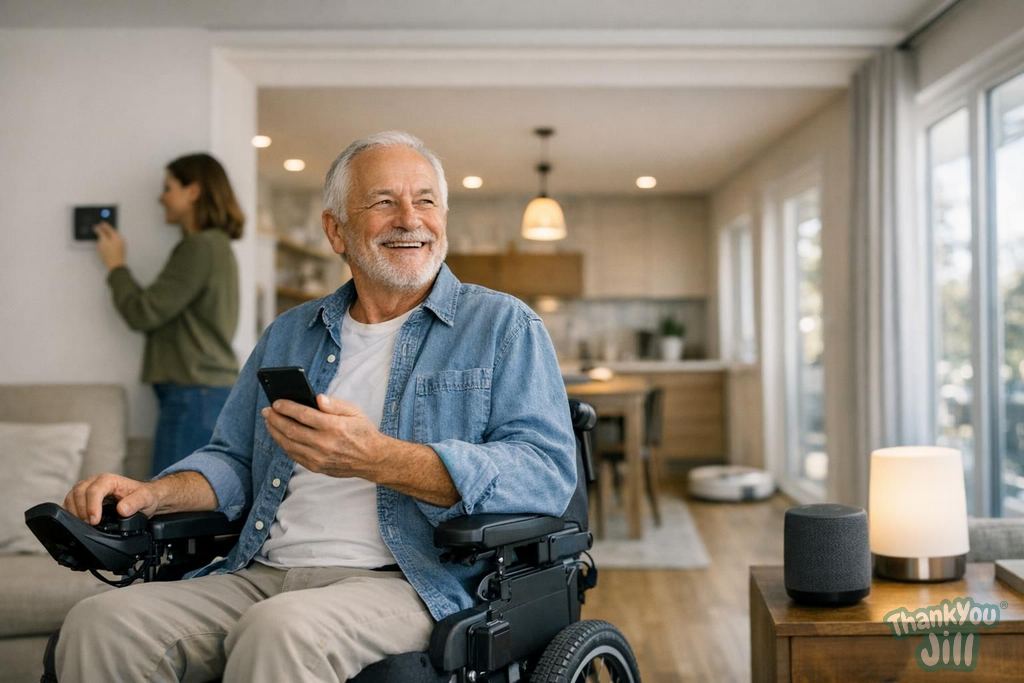
Home automation applied to accessibility and independence for people with disabilities is one of the fastest-growing technology sectors with the greatest potential to improve quality of life. For someone with tetraplegia, advanced multiple sclerosis, ALS, or any condition that severely limits upper limb mobility, the ability to control your home by voice, with minimal physical movement, or with your eyes makes the difference between total dependence on a caregiver and a meaningful level of independence. The concept of "smart home" overlaps here with "accessible home": home automation technologies developed for the convenience of non-disabled people become tools of inclusion and independence for those with disabilities.
Voice Control: The Revolution in Home Independence
Voice control is the most accessible and transformative home automation technology for people with motor disabilities. The main voice control ecosystems in Italy: Amazon Alexa (Amazon Echo): the most widespread in Italy for home automation. Compatible with thousands of devices (Philips Hue lights, Ikea Tradfri, Sonoff, Shelly), smart locks, thermostats, motorized blinds, smart plugs. Controlled entirely by voice. Google Home (Google Nest): Google ecosystem, compatible with Android and Google services (calendar, email). Apple HomeKit (Apple HomePod mini): Apple ecosystem, maximum privacy (on-device processing), compatibility with MFi-certified devices. For people with disabilities, voice control enables: turning lights on and off without reaching the switch, adjusting heating temperature, answering the intercom and opening the gate, calling a caregiver or doctor, reading messages and news, listening to music, managing medication reminders. The voice assistant as a safety system: people with severe disabilities living alone can use the wake word ("Alexa, call emergency" or "Hey Google, call 911") as a rapid alert system. Many systems allow you to configure emergency contacts to call with a single voice command.
Smart Lights, Plugs, and Switches: The Core of Accessible Home Automation
Managing lights is the first step in accessible home automation. Main solutions: WiFi smart bulbs (Philips Hue, IKEA Tradfri, Yeelight): replace regular bulbs, controlled via app or voice assistant, require no changes to electrical wiring. Cost per bulb: €10-30. Smart switches (Shelly Plus i4, Sonoff, Aqara): installed behind existing switches, adding remote/voice control without changing the faceplate. Ideal solution if you don't want or can't modify the wiring. Cost: €15-35 per switch. Smart plugs (Meross, SONOFF S26, TP-Link Kasa): allow you to control any connected appliance (lamp, TV, fan, charger) by voice or smartphone. Cost: €10-20 per plug. Motion sensors with automatic activation: sensors that detect movement and automatically turn on lights (e.g., in hallways, bathrooms): reduce the need to interact with switches. Particularly useful for people with limited nighttime mobility. Wireless physical buttons (Philips Hue Button, Ikea Tradfri Steering Wheel): positioned anywhere without wiring (battery-powered), programmable to control groups of lights or other devices. Very useful as a complement to voice control for those who prefer simple physical interaction.
Smart Locks, Intercoms, and Automatic Access
Managing access (front door, gate, building entrance) is one of the most significant barriers to independence for people with disabilities. Smart locks (August Smart Lock, Nuki, Yale Linus): replace existing locks without changing the door. Open with smartphone, fingerprint, numeric PIN, or temporary codes for caregivers. Compatible with Amazon Alexa and Google Home: voice-activated opening. Cost: €150-350. Smart video intercom (Ring Video Doorbell, Netatmo, Bticino Classe 300 with App): allows you to see and speak with visitors via smartphone without reaching the physical intercom. Remote lock opening via app. Compatible with Alexa. Automatic gates and doors: motors for existing gates controllable via app (Came, Nice, BFT): added to manual gates to convert them to automatic. Compatible with home automation integration. Motorized ramps and home elevators: for internal stairs, lifting platforms (Thyssen, Stannah, Cibes) enable vertical circulation in multi-story homes. Require professional installation and significant costs (€5,000-30,000) but may be partially tax-deductible (Ecobonus or Superbonus for removing architectural barriers).
Advanced Control for Severe Disabilities: Eye Tracking and Switches
For people with very severe disabilities (complete tetraplegia, advanced ALS, locked-in syndrome) who cannot use voice or gestures, alternative control systems exist. Eye tracking (eye-controlled): infrared cameras that track eye movements, allowing control of the computer and, through the computer, the entire integrated home automation. Devices: Tobii Dynavox, MyTobii (for PC), EyeControl (smartphone), PCEye (USB for PC). These devices allow you to write, navigate, control the TV, make calls, manage home automation—all using only eye movements. Single switch and switch scanning: a single button (activated by any small residual movement: breath, head movement, finger pressure, muscle contraction detected by electromyography) that controls the scanning interface (the system proposes options one at a time, the person selects with the switch). Compatible with Augmentative and Alternative Communication (AAC) systems. Control via brain signals (BCI, Brain-Computer Interface): still experimental technology but advancing rapidly. Some people with ALS or complete tetraplegia participate in clinical trials of BCI that allow control of computers and home automation with thoughts.

A €15 smart bulb + an Amazon Echo voice assistant for €40: for €55, someone who can't raise their arm to the switch can turn their room's light on and off by voice. This isn't the future: it's today. Accessible home automation doesn't require expensive renovations: it starts with a bulb and a smart plug. Then it expands as needed.
Health and Safety Assistants at Home
Beyond comfort, home automation has direct applications for the health and safety of people with disabilities living alone. Fall detection sensors: wearable devices (smartwatches, bracelets) that automatically detect falls and send alerts to caregivers or emergency services. Apple Watch (Emergency SOS and fall detection features), Samsung Galaxy Watch, medical devices like Tunstall, Doro Care. Gas, smoke, and CO detectors: integrable into smart home automation to send push notifications to the caregiver's smartphone in addition to local audio alarms. Smart thermostats (Nest, Netatmo, Tado): voice and app control of temperature. Important for people who can't reach the physical thermostat, and to prevent overheating (risk in some neurological conditions where thermoregulation is impaired). Automatic medication dispensers (Pillo, MedMinder, Medido): automatically dispense medications at scheduled times, send alerts if doses aren't taken, notify caregivers or doctors. Essential for people with cognitive deficits or those taking multiple medications at fixed times. Sleep and activity monitoring (Withings Sleep Mat, Apple HealthKit): collect data on sleep quality and daily activity, useful for remote monitoring by caregivers and doctors.
Getting Started with Accessible Home Automation: A Practical Path
You don't need to install everything at once. A practical step-by-step approach. Phase 1 (€0-100): install a voice assistant (Amazon Echo Dot: €40-50), add 2-3 smart bulbs in the most-used rooms, connect a smart plug to the TV. Learn basic voice commands. Phase 2 (€100-300): add smart switches in main areas, install a motion sensor for automatic hallway lighting, connect the thermostat to the voice system if compatible. Phase 3 (€300-800): install a smart lock on your front door, add a smart video intercom, connect motorized blinds (if present), integrate safety sensors (smoke, gas, CO). Phase 4 (€800+): advanced control systems for severe disabilities (eye tracking, switch control), advanced home automation platforms with complex automations (IFTTT, Home Assistant open source, Apple Shortcuts). Choosing your ecosystem is important: Amazon Alexa is currently the most compatible with Italian home automation. Always verify device compatibility before purchasing (look for "works with Alexa" or "works with Google Home" on the label).
Tax Deductions for Accessible Home Automation
Some expenses for accessible home automation are tax-deductible. Law 13/1989 (architectural barriers): 75% deduction for interventions to remove architectural barriers, including some home automation systems that improve accessibility (elevators, automatic door openers, voice control systems for people with documented disabilities). Ecobonus 50% (Irpef): applies to building renovations that include home automation as part of a larger intervention (integrated home automation system with windows, electrical system, etc.). Reduced VAT at 4%: for the purchase of technical aids and home automation devices for people with disabilities (requires a medical prescription attesting the necessity for the specific disability). The 4% VAT applies to devices such as electronic locks, voice control systems, video intercoms, fall detectors, and other devices classifiable as aids. Consult an accountant or INPS welfare office for the documentation needed to access specific deductions for your situation.
Frequently Asked Questions
What are the benefits of voice control in home automation for people with motor disabilities?
Voice control allows you to manage lights, doors, thermostats, and communications without physical movement, increasing independence and reducing caregiver dependence. It also enables rapid emergency calls through voice commands.
How do you choose between smart bulbs, smart switches, and smart plugs for an accessible smart home?
Smart bulbs are easy to install and replace regular ones, smart switches integrate behind existing ones without wiring modifications, while smart plugs control appliances. The choice depends on control needs and installation ease.
When is it worth installing advanced control systems like eye tracking or switches for severe disabilities?
These systems are indicated for people with severe disabilities who cannot use voice or gestures. They allow control of home automation with eye movements or small residual signals, offering independence even in conditions of extremely limited mobility.
What is the initial cost impact for starting accessible home automation and what are the implementation phases?
With approximately €50-100 you can start with a voice assistant and smart bulbs. Subsequently, you add smart switches, sensors, and locks up to advanced systems. Accessible home automation is scalable and doesn't require high upfront investments.

Latest News




Comments
No comments yet. Be the first!
Leave a comment