


 Italiano
 Français
 Deutsch
 Español
 Português
 Svenska
 Suomi
Suomi
Architectural Barriers
How to Report Them
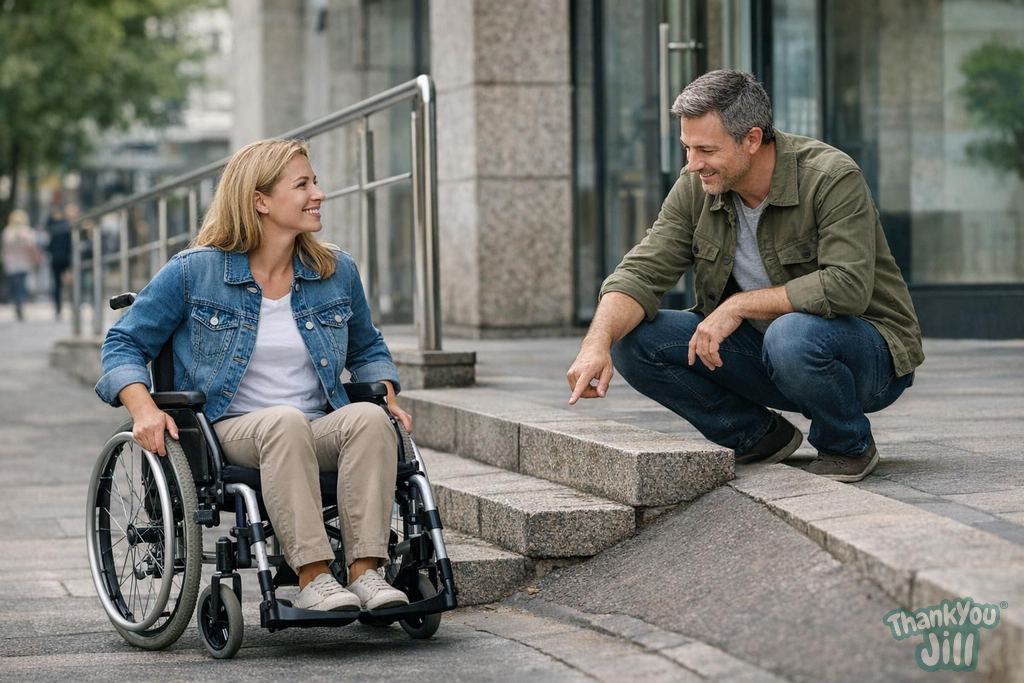
Reporting architectural barriers is a concrete civic action that can improve the lives of thousands of people. A barrier reported correctly and followed up consistently has a good chance of being removed: many interventions are economically straightforward (sidewalk repair, handle replacement, removable ramp installation) and depend only on political will and someone to take action. Architectural barriers are defined by Italian regulations (DM 236/1989) as "physical obstacles that cause inconvenience to the mobility of anyone and in particular those who, for any reason, have reduced or permanently or temporarily impaired motor capacity." The definition includes not only barriers for wheelchairs but also those for strollers, elderly people with walkers, people with luggage, or those with visual difficulties.
The most common barriers in Italian public spaces
The most frequent types of architectural barriers in Italian cities. Sidewalks: absence of ramps at pedestrian crossings (the most common: every intersection without a ramp is a barrier), sidewalks too narrow (less than 90 cm: not passable in a wheelchair), level differences and depressions in the pavement (risk of falling for everyone), parking that occupies the sidewalk (a very frequent illegal barrier). Public transport: railway stations and subway stations without elevators or with chronically broken elevators, absence of audio description at information screens (hearing disability), bus stops without raised platforms (the bus ramp doesn't lower completely). Public buildings: entrances with steps without ramps (municipal offices, health clinics, post offices, banks), inaccessible public bathrooms (insufficiently large, toilet too low, lack of grab bars), doors too heavy or revolving, absent or too small elevators. Natural and cultural spaces: nature trails without accessible alternatives, museums and historic churches with wheelchair-impossible access, beaches without equipped paths for water access.
How to report a barrier: official channels
Channel 1 - The Municipality: for barriers in municipal public spaces (streets, sidewalks, parks, municipal buildings). The Municipality's Technical Office is the main recipient. How to proceed: send an email or certified email to the Municipality's Technical Office with: detailed description of the barrier, precise address (street, street number, intersection), clear photographs, regulatory reference (e.g., DM 236/1989, art. X which prohibits the absence of ramps at pedestrian crossings). Request a response within 30 days (the public administration is obligated to respond). If it doesn't respond: after 30 days you can send a follow-up, then file a complaint with the Administrative Court for administrative silence. Channel 2 - ANAS and Region for state and regional roads: for barriers on state (SS) and regional roads. Channel 3 - RFI (Italian Railway Network) for stations: the RFI green number (800898088) and Trenitalia's online reporting system accept barrier reports. Channel 4 - Local public transport companies: for barriers on buses, metro, trams. Each company (ATM Milan, ATAC Rome, GTT Turin) has a customer relations office that accepts reports. Channel 5 - National Labor Inspectorate for barriers in workplaces: provincial labor inspectorates verify compliance with accessibility standards in workplaces.
Civic reporting apps: the easiest way
Civic reporting apps allow you to photograph and geo-locate the barrier and send it directly to the competent office with just a few taps. General civic reporting apps: Municipia (official app of many Italian municipalities for civic reports), SegnalaCI (available for various municipalities), CittadinanzAttiva app (for reports of public interest). Wheelmap.org (wheelmap.org): the most important platform specific to architectural barriers. Crowd-sourced map of public place accessibility. When you report a place as "not accessible" you help thousands of other users plan their movements. Fixer (app for reporting urban problems): available in some Italian cities (Rome, Milan). Allows you to send the report with photos and geo-location directly to the competent office. How to make your report more effective: clear and full photos plus close-up of the specific barrier, precise address (GPS coordinates if possible), specific regulatory reference ("absence of ramp at pedestrian crossing in violation of DM 236/1989 art. 8.2.1"), request for specific action ("I request installation of the ramp within 30 days"), follow-up: if you don't receive a response, follow up in writing and attach all previous communications.

The barrier in front of your school, your office, your bus stop won't disappear on its own. But if you photograph it, geo-locate it, and send it to the Municipality's technical office with the correct regulatory reference, you've done something concrete that could improve the lives of dozens of people every day. It takes 5 minutes. It's worth trying.
Advocacy organizations for barrier removal
Organizations representing people with disabilities play a fundamental role in pushing for barrier removal. The main ones in Italy: FISH (Italian Federation for Overcoming Disability, fishonlus.it): the broadest network of organizations of people with disabilities. Conducts political advocacy at national and European level, has a legal office that supports relevant reports. FAND (Federation of National Associations of People with Disabilities, fand.it): second national network. Anffas (association of families of people with intellectual disabilities, anffas.net): strong on cognitive accessibility issues. Coordina (at international level): the movement for universal design and accessibility. Accessibile.info (Vodafone Foundation project): Italian database of accessible facilities with verified information. How to collaborate with organizations: many organizations accept reports of relevant barriers and follow them up legally or through media. FISH and FAND have online reporting portals. Monitoring the PEBA (Plan for the Elimination of Architectural Barriers): every municipality must have an updated PEBA. Ask your municipality to show you the current PEBA: it contains the list of planned interventions. You can thus monitor whether commitments are being kept.
The legal system for enforcing accessibility standards
When ordinary reports don't produce results, there are legal tools to enforce accessibility standards. Appeal to the Administrative Court for administrative silence: if the public administration doesn't respond within 30 days to a formal report, you can appeal to the Regional Administrative Court (TAR) for "administrative silence." The procedure is relatively simple and often succeeds without needing a judgment (the mere notification of the appeal often unblocks the administration's action). Legal notice: a formal legal notice from a lawyer often has more effect than dozens of unanswered emails. Disability organizations often manage collective notices on systemic barriers. Civic class action: Law 117/2014 introduced collective action against the public administration for systematic violations. Some cases of systematic architectural barriers (always-broken elevators in railway stations) have been subject to collective legal actions. Urgent order: in case of a barrier that poses a safety risk (a step that creates a fall risk for elderly people, a single broken elevator in a building with non-ambulatory residents), you can request an urgent order from the Civil Court or the Administrative Court that requires the public administration or private party to act in very short timeframes (days instead of months).
The PEBA: the urban planning tool for accessibility
The Plan for the Elimination of Architectural Barriers (PEBA) is the urban planning tool that every Italian municipality should have (mandatory for municipalities over 10,000 inhabitants since DPR 503/1996, though often not implemented). The PEBA contains: mapping of barriers present in municipal public spaces, the program of interventions for barrier removal, prioritization of interventions based on impact and cost, allocated budget. How to use the PEBA as an advocacy tool: request a copy of the current PEBA from your municipality (access to documents, free of charge). Verify if the barriers you've reported are included. Verify if the planned interventions have been carried out. Publish the data: many barriers remain unresolved only due to lack of public attention. Transparency is the main pressure tool. The PEBA under the 2021 Delegation Law: the disability reform provides that the PEBA becomes mandatory for ALL municipalities (not just those over 10,000 inhabitants) and that it be monitored annually with public reports. This represents a significant turning point compared to the current situation.
Frequently Asked Questions
How do I effectively report an architectural barrier to my municipality?
To report an architectural barrier to your municipality, send an email or certified email to the Technical Office with a detailed description, precise address, clear photos, and regulatory reference. Request a response within 30 days and, if you don't receive one, send a follow-up or file a complaint with the Administrative Court for administrative silence.
Which apps allow me to report architectural barriers simply and directly?
Apps like Municipia, SegnalaCI, CittadinanzAttiva, and Wheelmap.org allow you to photograph, geo-locate, and send reports of architectural barriers directly to the competent offices, facilitating rapid and targeted intervention.
When is it worth using legal tools to remove an architectural barrier?
Legal tools such as appeals to the Administrative Court for administrative silence, legal notices, or civic class actions are useful when ordinary reports don't get responses or interventions, especially in the presence of systemic barriers or safety risks.
How do I use the PEBA to monitor and promote the removal of architectural barriers?
Request the current PEBA from your municipality to verify the mapping of barriers and planned interventions. Use this information to apply public pressure, monitor progress, and push for implementation of planned interventions.

Latest News




Comments
No comments yet. Be the first!
Leave a comment