


 Italiano
 Français
 Deutsch
 Español
 Português
 Svenska
 Suomi
Suomi
Food Transportation: Miles and CO2
Miles and CO2
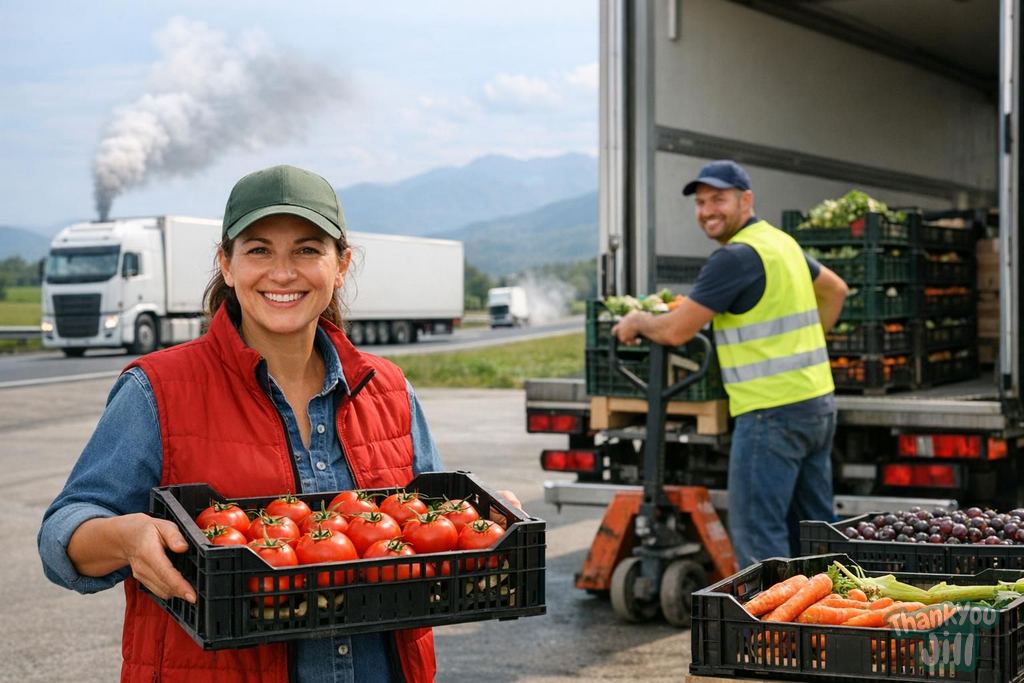
The concept of "food miles" became a cornerstone of the local food movement in the 2000s: the idea that food travels thousands of kilometers to reach our plate, generating enormous CO2 emissions. It's an intuitively sensible idea but numerically misleading when applied as the primary measure of food sustainability. Research has shown that transportation represents only 10-12% of a food item's total emissions on average. The production system (how the food is grown or raised) accounts for 70-80% of the carbon footprint.
The Transportation Chain: From Farm to Table
Food's journey from field to plate includes multiple transportation segments: transport from field to collection facility or initial processing (often short distances), transport to industrial processing/transformation facility, transport to wholesale distributor or retail chain distribution center, transport to retail point of sale, transport from store to consumer's home (often the most emission-intensive segment per kilometer per kilogram, since cars are used). Maritime shipping (container ships) is the most efficient by far per ton-kilometer: modern cargo ships emit approximately 10-15g CO2 per ton-km, compared to 60-150g for trucks and 600-900g for cargo aircraft. This is why a product shipped from Argentina to Europe by sea can have a lower transportation carbon footprint than a product trucked from Milan to Rome in a single day.
When Local Doesn't Save the Environment: Paradoxical Cases
A tomato grown in a gas-heated greenhouse in November in Trento emits more CO2 than a field-grown tomato from Sicily transported north in summer. Lettuce grown in a vertical farming facility with artificial lighting in a city emits 10-20 times more CO2 than food grown in open fields, despite being produced "locally." Spanish greenhouse strawberries in January have a lower carbon footprint than Italian heated-greenhouse strawberries in January. Napa Valley wine from California shipped to Italy by sea has a similar footprint to Tuscan wine trucked to Berlin. Seasonality (food grown in the right season, in open fields, without artificial heating) is far more important than geographic location for reducing carbon footprint.
When Local Really Matters: Valid Cases
Local sourcing makes environmental sense (not just economic and social sense) in these contexts: perishable products transported by air (certain exotic fruits, some out-of-season fresh vegetables): air transport has a carbon footprint 50-100 times higher than maritime shipping. If a product arrives by air from the other side of the world, even the short remaining distance contributes enormously. Reduced packaging: local food from short supply chains often has less packaging than mass retail distribution. Reduced waste: short supply chains often have fewer intermediaries and less time between harvest and consumption, resulting in less waste along the chain. Territorial impact: supporting local agriculture maintains agricultural landscapes, local biodiversity, rural economies—values that don't appear in carbon footprint calculations alone but are important for overall sustainability.
Zero-Kilometer Food: Beyond CO2
Buying local food (from farmers' markets, solidarity purchasing groups, community-supported agriculture, local farms) has benefits beyond reducing CO2 emissions: supporting local economies and small farmers, maintaining local varieties and agricultural biodiversity, supply chain traceability and transparency, direct consumer-producer relationships (essential for trust), superior freshness and nutritional quality (vitamin C content decreases significantly with time between harvest and consumption). These benefits justify choosing local even when the carbon footprint isn't necessarily lower.

Zero-kilometer food isn't the answer to everything, but it's more than a CO2 calculation. It's about relationships, trust, biodiversity, and local economy. A carrot from your trusted local farmer, grown in season, isn't just lower CO2: it's a different food system, more transparent, more resilient. It's worth supporting even when the emissions numbers aren't decisive.
How to Evaluate the Transportation Impact of the Food You Buy
The most important signal isn't the country of origin but the transportation method. Products almost certainly arriving by air (to avoid or minimize): fresh strawberries, blackberries, raspberries from African countries (Kenya, Morocco) from December to March, fresh green beans and other out-of-season vegetables from sub-Saharan Africa, certain tropical fruits out of season (fresh mango, lychee, rambutan). Products arriving by ship (relatively low transportation impact): dried goods and preserves from anywhere in the world, seasonal tropical fruit (bananas, pineapples, avocados), imported wines and oils. Applying seasonality to fresh produce choices naturally eliminates most air-transported products.
Build a Map of Local Producers Within 50 Kilometers
Platforms like Campagna Amica (Coldiretti), the Genuino Clandestino website, solidarity purchasing group networks (GAS), the AIAB website (Italian Organic Agriculture Association) for community-supported agriculture, and apps like Agriaffitto or Mercato a km0 allow you to find local producers, farmers' markets, and short supply chains in your area. Simply buying seasonal fruit and vegetables from a local producer reduces the carbon footprint of the fresh produce segment by 20-40% compared to mass retail with imported products.
The Waste Paradox: The Carbon Footprint of Discarded Food
Another aspect often overlooked in calculating transportation footprint: if you buy a local seasonal product and then throw it away, you've emitted zero CO2 for transportation but you've still burned all the CO2 produced to grow it. Wasted food contributes to 8% of global greenhouse gas emissions (more than commercial aviation). Reducing food waste has a far greater impact on food CO2 than choosing between local and imported for the vast majority of non-air-transported products.
Frequently Asked Questions
How much does transportation contribute to the total CO2 emissions of food?
Transportation represents only 10-12% of a food item's total CO2 emissions, while production accounts for 70-80%. Therefore, the distance food travels has less impact than the cultivation or farming method.
When is it worth choosing local food to reduce your carbon footprint?
Local food is more sustainable especially for perishable products transported by air, since air transport has a very high carbon footprint. Additionally, short supply chains reduce packaging and waste, improving overall environmental impact.
How can you tell if a food product has a high transportation impact?
The transportation method is the key factor: products transported by air, such as exotic fruits out of season or fresh vegetables from distant countries, have much higher impact than those transported by ship or truck over short distances.
What happens to CO2 emissions if you waste local seasonal food?
Even though local food has low transportation impact, food waste still results in high emissions, because CO2 was already consumed during production. Food waste contributes to 8% of global greenhouse gas emissions, exceeding commercial aviation.

Latest News




Comments
No comments yet. Be the first!
Leave a comment