


 Italiano
 Français
 Deutsch
 Español
 Português
 Svenska
 Suomi
Suomi
Eco-Friendly Educational Games
Ideas for environmentally conscious kids
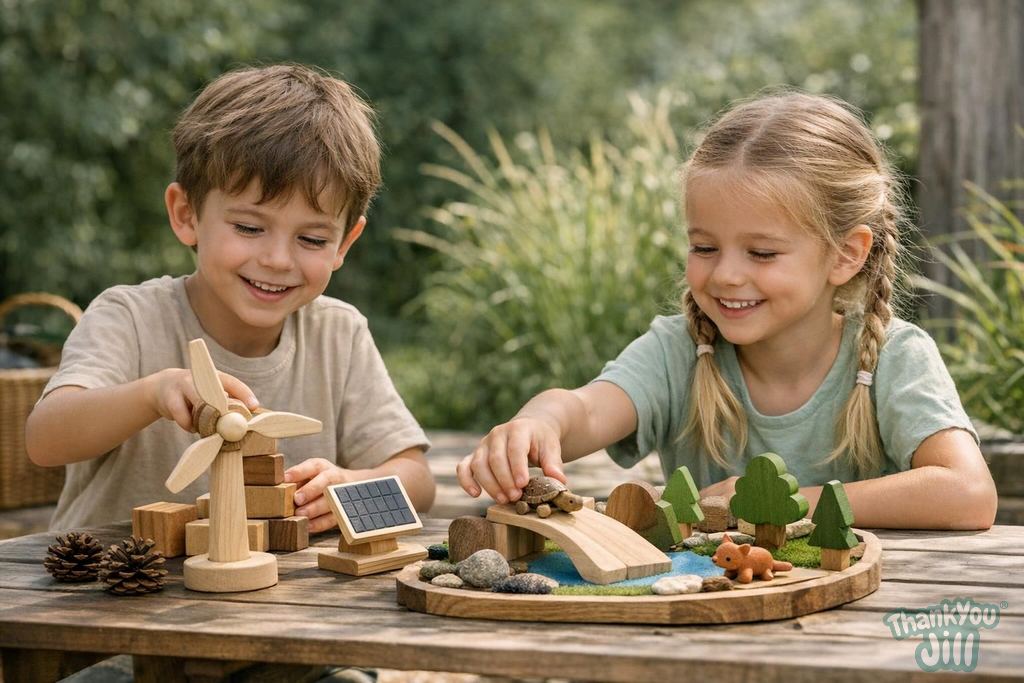
Play is children's primary learning tool: it's not the opposite of education, it's education's most effective form. Games with natural and environmental themes build in children a familiarity with the living world, systems thinking (understanding connections between things), and a sense of belonging to the ecosystem. The goal isn't to create mini-environmentalists, but curious children capable of thinking complexly about the interrelationships between their choices and the world around them.
Ecology-themed board games: the best for every age
Wingspan (ages 10+, 1-5 players): the bird-themed board game that became an international phenomenon. Players build habitats and attract birds with realistic, scientifically accurate characteristics. Perfect for families and nature enthusiasts. It's sparked genuine interest in ornithology among millions of players. European and Oceania expansions include species from around the world. Evolution (ages 12+, 2-6 players): strategy game about natural selection and species adaptation. Players develop evolutionary traits in their own species to survive in a shared ecosystem. Excellent for teaching evolutionary biology in concrete terms. Pandemic (ages 8+, 2-4 players): cooperative game where players must stop the spread of epidemics. Teaches systems thinking, cooperation, and the complexity of global systems. Not strictly environmental but fundamental for ecosystems thinking. Photosynthesis (ages 8+, 2-4 players): players plant trees that grow by seeking sunlight. Elegant mechanics that teach photosynthesis, competition for resources, and the forest life cycle. Visually stunning. CO2 Second Chance (ages 14+, 2-5 players): simulation of global energy transition. Players as energy companies must meet global energy demand without exceeding emission limits. Complex but highly effective for teenagers to understand the real challenges of decarbonization.
Outdoor and nature games: play that doesn't require a purchase
Free play in nature is the best eco-friendly educational game available, and it requires no purchases. Nature scavenger hunt: create a list of natural objects to find (an oak leaf, a feather, a round stone, a red berry, an insect). Children explore, observe, touch: they gain confidence with the natural world. Sensory memory: in a forest or park, blindfolded children must recognize natural objects by touch and smell. Shelter building: with branches, leaves, stones: creativity, practical physics, understanding of structures. Citizen science with iNaturalist: turn any nature outing into a scientific data collection session. Children photograph every living creature they find, upload it to the app, and wait excitedly for community identification. Create your neighborhood species list: how many different plant species are in the park near your home? How many birds can you spot in an hour? Positive competition and scientific curiosity develop naturally.
Science kits for kids: exploring nature with real tools
Digital microscope for children (€30-80): connected to a tablet or PC, it displays what's under the lens on video. Leaves, seeds, insects, pond water: invisible worlds become visible. Generates instant wonder and real scientific questions. Seed germination kit: growing from seed to plant. Bean seeds, peas, sunflowers, tomatoes: all germinate quickly and spectacularly. The child observes, measures, takes notes, cares for the plants. The simplest and most effective thing. Nets and trays for stream study: exploring life in aquatic ecosystems. Mayfly larvae, planarians, freshwater shrimp: the biodiversity of aquatic ecosystems is incredible and accessible in Italian streams. Junior astronomy kit (binoculars + star map): observing the moon and stars produces the same wonder as observing insects, on a cosmic scale. Compass and topographic map: learning to navigate in nature develops autonomy, confidence, and territory-reading skills. More educational than any GPS.

The best eco-friendly educational game is a free morning in a forest with permission to get your hands dirty. The second best is Wingspan, which turned millions of people into bird enthusiasts without them even realizing it. Environmental education that works is indistinguishable from pleasure: it's hidden within it.
Educational nature apps: the best for kids
iNaturalist Junior: simplified version of iNaturalist for children and school classes. Lets you photograph and identify species, create lists of your area. Free. Merlin Bird ID (Cornell Lab): identifies birds from photos or by their song. Intuitive interface, great for engaging children ages 7-8 and up in bird watching. Free. Plant Snap: identifies plants from photos. Simple and immediate, suitable from ages 6-7 and up with supervision. Freemium. Seek by iNaturalist: iNaturalist version with augmented reality that immediately identifies organisms captured by the camera. Doesn't upload observations online: suitable for younger children for privacy. Free. WWF Together (iOS): WWF app with augmented reality about endangered animals. Immersive and engaging for children from age 6. Free. Duolingo for Nature: doesn't exist yet as an app but as an approach: many citizen science apps have gamification elements (points, badges, leaderboards) that work with the same logic as Duolingo applied to nature discovery.
Building an insect hotel with kids: a practical project
An insect hotel is one of the most effective and simple practical nature education projects to do with children ages 8 and up. Materials: a hardwood log (oak, beech: moisture-resistant), or a recycled wooden box filled with various materials. Tools: drill with 3, 5, 7, 10 mm bits, marker. Procedure: drill the log or solid wood panels with holes of different sizes, at least 10-12 cm deep. Not through-holes: bees nest in closed cavities. Or fill the box with bamboo sections (5-10 mm diameter), hollow elderberry stems, pinecones, pine bark, rolled dried leaves: different materials attract different insects. Position your hotel in a sunny area (east-south facing), 1-2 meters high, sheltered from direct rain. Scientific observation: from March onward, observe which insects enter the holes, what they bring (yellow pollen, rolled leaves, leaves cut in circles). Document with iNaturalist the species that use your hotel.
Narrative books for children about nature and the environment
For children, narrative is often more powerful than non-fiction books for building emotional connection with the natural world. Stories that build empathy toward living things. Ages 4-7: "The Very Hungry Caterpillar" by Eric Carle (butterfly life cycle), "The Dream Tree" by Giusi Quarenghi (human-nature relationship), "Frog and Toad in Love" by Arnold Lobel (friendship and nature). Ages 8-12: "The Sea Wolf" by Jack London (wild nature), "My Tree" by Toon Tellegen (respect for nature), "The White Forest" by Sam Epstein (arctic ecosystems). Ages 12+: "Siddhartha" by Herman Hesse (relationship with nature and self), "Into the Wild" by Jon Krakauer (for teenagers: powerful and complex), "The Old Man and the Sea" by Ernest Hemingway (respect for nature and its rhythms). Narratives that place the protagonist in relationship with ecosystems (the sea, the forest, the mountain) produce identification and emotional connection deeper than any ecology manual.
Frequently Asked Questions
What are the benefits of ecology-themed board games like Wingspan and Evolution for children's learning?
Ecology-themed board games like Wingspan and Evolution teach children real scientific concepts, such as ornithology and evolutionary biology, through engaging game mechanics that stimulate systems thinking and understanding of environmental interactions.
How can free outdoor play contribute to children's environmental education?
Free play in nature, such as nature scavenger hunts or shelter building, promotes sensory exploration and scientific curiosity, helping children develop a direct and conscious relationship with the environment without needing tools or purchases.
When is it worthwhile to use citizen science apps like iNaturalist Junior for children's environmental education?
Citizen science apps like iNaturalist Junior are ideal for engaging children in species observation and identification activities during nature outings, stimulating scientific curiosity and active participation in data collection in a simple and interactive way.
How do you build an educational insect hotel and what benefits does it offer children?
Building an insect hotel with natural materials and holes of various sizes allows children to directly observe biodiversity and insect behavior, developing practical scientific skills and greater ecological awareness.
Latest News




Comments
No comments yet. Be the first!
Leave a comment