


 Italiano
 Français
 Deutsch
 Español
 Português
 Svenska
 Suomi
Suomi
Energy Communities
What They Are and How They Work
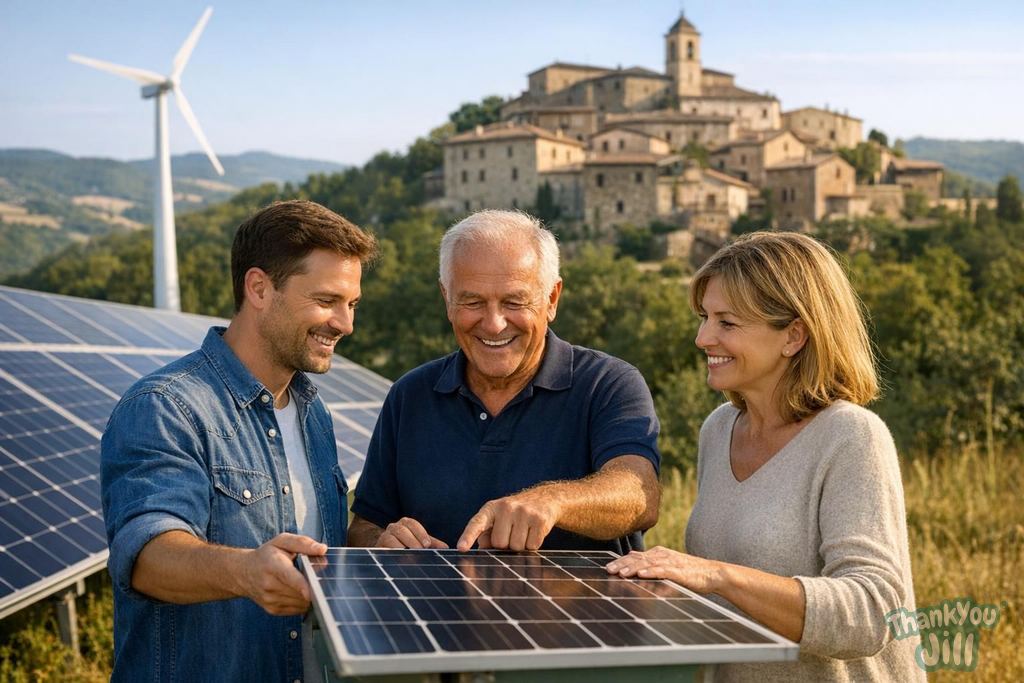
Renewable Energy Communities (RECs) represent the most significant innovation in Italy's energy landscape in recent years. Introduced in Italy through Legislative Decree 199/2021 (transposing the RED II Directive) and operationally regulated by Legislative Decree 23 of 2024, RECs allow groups of entities (families, businesses, public bodies, associations) to form a community to share electricity produced by local renewable installations, benefiting from specific public incentives that make the initiative economically highly advantageous.
How an energy community works: the mechanism
The principle is straightforward: one REC member has a photovoltaic installation (or wind, or other renewable) and produces energy. Another member of the same REC consumes energy from the grid at the same moment. When these two events occur simultaneously, "shared energy" is created: the energy the producer feeds into the grid coincides temporally with what the consumer draws. This shared energy is incentivized with an additional payment (the GSE's "incentive tariff") that adds to the normal economic benefits of the installation. REC members must be connected to the same MT/BT transformer cabinet (medium voltage/low voltage): in practice, they must be in the same neighborhood or residential area. Those who can participate in an REC include: individuals (families), SMEs, local authorities, third-sector entities, religious organizations. Large enterprises cannot participate in the "consumer" role within the REC, though they can as "producers" if production is separate. The power of REC renewable installations must not exceed 1 MW per single installation (updated to 5 MW for RECs in 5G areas by the 2024 budget law).
REC incentives: how much you earn
The incentive from the Ministerial Decree (DM REC) includes two components: incentive tariff on shared energy: recognized for 20 years on electricity actually shared among members. For installations under 200 kW: €110/MWh for photovoltaic, €100/MWh for wind, €107/MWh for hydroelectric. For installations 200-600 kW: reduced tariff. For installations 600 kW-1 MW: further reduction. The incentive tariff is added to the market value of energy: when shared energy is worth €0.10-0.12/kWh (€100-120/MWh) at market prices, energy producers in the REC receive €110+100-120 = approximately €210-230/MWh in total revenue for shared energy. Reimbursement of tariff components: consumer families in the REC receive an additional reimbursement on certain electricity tariff components (approximately €8-12/MWh) for shared energy consumed. This reduces bills even for those without an installation.
Who can start an REC and how
An REC can be started by any group of interested parties. The main steps are: identify participants: at least one producer (with a renewable installation) and at least one consumer, connected to the same MT/BT transformer cabinet. Verify the transformer cabinet: the transformer cabinet is indicated on your electricity bill or by contacting your local distributor (ENEL Distribuzione, A2A, Terna Rete Italia). Establish the REC's legal entity: the most common legal form is an unrecognized association (APS) or cooperative. Some RECs also use ETS Foundations or limited liability companies. Register with GSE: the Energy Services Manager handles REC registration and incentive recognition. The bureaucratic process takes several weeks. Obtain a connection quote (if the installation is new): from ENEL Distribuzione or another local distributor. Start sharing energy: the GSE automatically calculates shared energy based on production and consumption data communicated by the distributor.

The energy community is the democratic answer to the energy transition: not only those with a roof and money can benefit from photovoltaics. With an REC, even your neighbor renting on the fourth floor can participate in the neighborhood's renewable energy and reduce their bill. It's photovoltaics for everyone, not just villa owners with gardens.
Concrete examples of active RECs in Italy
In Italy, RECs are still relatively few (a few hundred in 2024) but growing rapidly following the final approval of the incentive decree. Significant examples: Gerbido REC (Turin): one of Italy's first experimental RECs. It involved a public housing condominium (ATCTO) with photovoltaic installations on roofs and families from lower floors as consumers. A model for inclusion of low-income families. Varese Municipality REC: the municipality installed photovoltaic systems on public buildings (schools, gyms) and established an REC with businesses and residents of the surrounding neighborhood. Cervia REC (Romagna): an initiative by Cervia Municipality with local families and businesses. It includes an agrivoltaic installation (photovoltaic on agricultural land with simultaneous agricultural production). How to find RECs in your area: the GSE website (gse.it) has a list of registered RECs and those in accreditation phase. Organizations like Italia Solare and Legambiente maintain updated maps of active RECs.
How to join an existing REC or start a new one
Joining an existing REC: search whether there's already an active REC in your area (GSE website, local associations, municipality). Contact the REC: they often seek new consumers to increase shared energy and spread fixed costs. Participation as a consumer requires no initial investment: you only pay membership fees (if the REC is an association). Starting a new one: the most useful support organizations are: Legambiente (offers practical guides and consultation services for RECs), Sustainable Development Foundation, RSE (Energy System Research), certified energy managers and energy consultants. Startup costs: establishing the legal entity (€500-2,000 in notary fees), GSE application (manageable internally or with a consultant: €1,000-3,000), any photovoltaic installation (if not already existing).
Agrivoltaics in RECs: the frontier of rural energy
Agrivoltaics (combining agricultural production and photovoltaics on the same land) is one of the most interesting applications for rural RECs. Photovoltaic panels are installed at sufficient height to allow cultivation beneath them (or between panel rows): some crops (vegetables, soft fruits, vineyards) benefit from partial panel shading during the hottest hours, reducing water requirements by 30-50%. The photovoltaic installation produces renewable energy that can be shared in the local REC. In Italy, Legislative Decree 199/2021 includes specific provisions for agrivoltaics, with dedicated incentives (Advanced agrivoltaics: technical specifications defined by the 2023 agrivoltaic decree). Italy's first commercial agrivoltaic installations are demonstrating the economic and agronomic feasibility of the system: one of the most promising developments for Italian renewable energy production compatible with agricultural land use.
Frequently Asked Questions
What are the requirements to participate in a Renewable Energy Community (REC)?
To participate in an REC, you must be connected to the same MT/BT transformer cabinet, be part of a group with at least one renewable energy producer and one consumer. Families, SMEs, public bodies, and third-sector entities can participate, but not large enterprises as consumers.
How are incentives calculated and what are they for shared energy in RECs?
Incentives include an incentive tariff for 20 years on shared energy, ranging from €110/MWh for photovoltaic installations under 200 kW to reduced tariffs for larger installations. It's added to the market value of energy and also includes reimbursements on tariff components for consumers.
How do you start a new Renewable Energy Community?
To start an REC, you must identify participants connected to the same transformer cabinet, establish a legal entity (e.g., association or cooperative), register with GSE, obtain a connection quote if necessary, and begin sharing energy. The bureaucratic process takes several weeks.
What are the benefits of agrivoltaics in rural Renewable Energy Communities?
Agrivoltaics combines agricultural and photovoltaic production on the same land, allowing crops beneath panels that reduce water requirements by up to 50%. It produces renewable energy shared in the REC, with dedicated incentives and compatibility with agricultural land use.
Latest News



Comments
No comments yet. Be the first!
Leave a comment