


 Italiano
 Français
 Deutsch
 Español
 Português
 Svenska
 Suomi
Suomi
Vertical Farming
The Future of Food in Cities
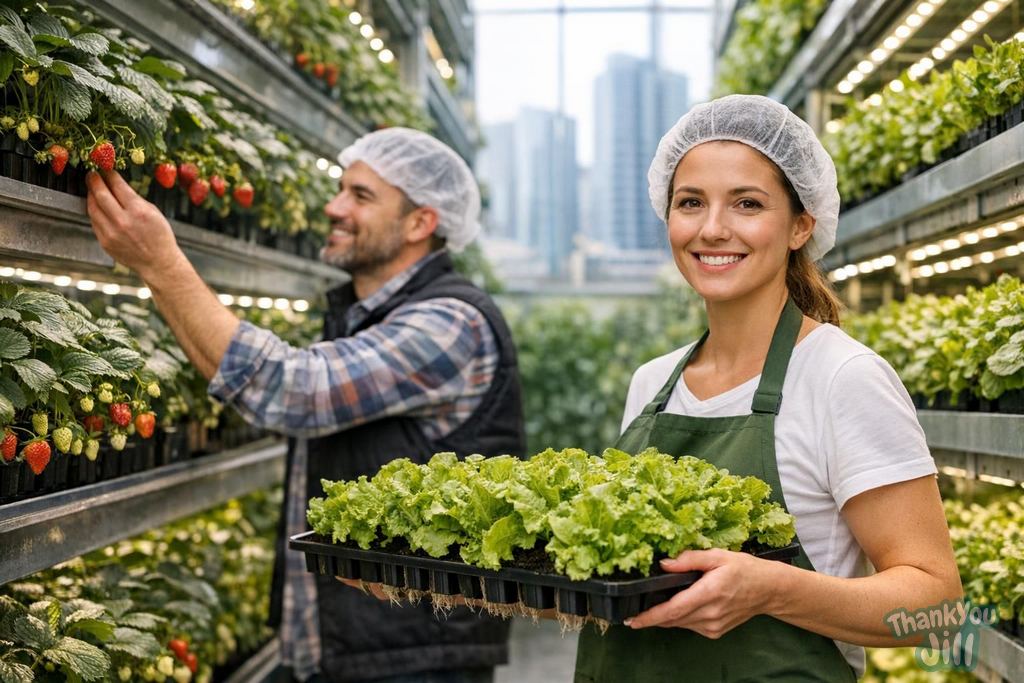
Vertical farming is the cultivation of plants in stacked layers in controlled indoor environments (warehouses, containers, dedicated buildings), with artificial LED lighting, hydroponic or aeroponic systems, and precise control of temperature, humidity, and CO2. The basic idea is to eliminate dependence on soil, climate, and season, producing fresh food close to consumers year-round with drastically reduced water consumption. The global vertical farming market was worth approximately $5.5 billion in 2022 and is projected to reach $35 billion by 2030. However, the sector experienced a significant crisis between 2022 and 2024, with major players failing (AeroFarms, AppHarvest, Bowery Farming), which tempered the most optimistic expectations.
How a vertical farm works technically
There are three main cultivation systems in vertical farms. Hydroponics: plant roots are immersed in nutrient-rich aqueous solution. The most widespread system in commercial vertical farms. Very high water efficiency: 90-95% of water is recovered and recirculated. Aeroponics: roots are suspended in air and periodically misted with nutrient solution. Even more water-efficient than hydroponics. Used by AeroFarms (now defunct) and others. Aquaponics: a combination of aquaculture (fish) and hydroponics—fish metabolic waste fertilizes plants, which in turn purify the water. LED lighting is the most critical technological component: it consumes 25-30% of the vertical farm's operating costs. Latest-generation full-spectrum LEDs (LG, Fluence, Signify) have reached efficiencies of 3-4 μmol/J: every joule of electrical energy produces 3-4 micromoles of photons useful for photosynthesis. Typical production of a vertical lettuce farm: 100-400 kg/m² annually (vs 4-6 kg/m² annually for open-field agriculture). A 20-100x productivity factor per unit of surface area.
Documented advantages of vertical farming
Water savings: 90-95% less than traditional irrigation (the largest savings item). In water-stressed regions (California, Spain, Middle East), this is a decisive advantage. Zero pesticides: the controlled, enclosed environment almost completely eliminates pest infestations. Products require no chemical treatments. Year-round production independent of climate: no droughts, no frosts, no hail. Constant and predictable productivity. Proximity to consumers (reduced food miles): vertical farms are installed in cities, reducing transportation and producing fresher food. Lettuce harvested in the morning is in supermarkets by afternoon. Superior quality control: every parameter (light, nutrients, temperature, CO2) is optimized for maximum growth and nutritional quality. Drastically reduced land use: 1 hectare of vertical farm (in height) is equivalent to 50-100 hectares of open field for suitable crops.
Real limitations and challenges
High energy consumption: LED lighting is the main constraint. Producing 1 kg of lettuce in vertical farming requires 10-30 kWh of electrical energy (vs practically zero for open field, which uses free sunlight). If energy comes from fossil sources, the carbon footprint of vertical farming can exceed traditional agriculture. With renewable energy (solar, wind), the balance improves dramatically. Still-high production costs: 1 kg of lettuce from vertical farming costs €3-8 in production costs vs €0.50-1 for field-grown lettuce. Economies of scale and increasing LED efficiency are closing the gap, but cost parity with field crops hasn't been reached for most products yet. Crop limitations: vertical farms work well for leafy crops (lettuce, arugula, spinach, herbs, microgreens), strawberries, and some small berries. They don't work economically for cereals (wheat, corn, rice), deep-rooted crops (potatoes, carrots), legumes, or fruit (too much energy to maintain trees). This severely limits vertical farming's contribution to global food security: cereals account for 50% of global calories.

Vertical farming won't replace traditional agriculture—it complements it. Lettuce, herbs, microgreens produced at zero kilometers in cities year-round: that's its real niche. Wheat and corn will stay in the field. But that pesticide-free lettuce grown in the neighborhood warehouse, harvested this morning: that's already the future of fresh urban food.
Vertical farms in Italy: current state
In Italy, the vertical farming sector is growing with some interesting players. Planet Farms (Cavenago di Brianza, Milan): one of Europe's largest vertical farms. Produces approximately 900 tons of lettuce annually. Supplies supermarkets like Esselunga. Has received investments from Eataly and Caviro. Agricola Moderna (Milan): produces microgreens and lettuce for fine dining and supermarkets in northern Italy. Zero Farms (Bologna): vertical farm integrated into a traditional agricultural cooperative. Iberfruit (Palermo): experimentation with vertical farming for strawberry production in Sicily. Italy's major retail chains (Esselunga, Coop, Carrefour, Conad) are testing or distributing vertical farming products, signaling growing consumer interest in local products, pesticide-free and with low water footprint.
The photovoltaic and vertical farming combination: the energy future
The main limitation of vertical farming (high energy consumption) is solved by coupling it with renewable energy sources. The most promising solutions: agrivoltaics + hydroponics: photovoltaic panels that generate energy to power the vertical farm's lights. In the Netherlands, some farms calculate they can power their LED lights with energy from a photovoltaic system whose surface area is about 30% of the farm's. Heat recovery: modern LEDs produce heat as a byproduct. Thermal recovery systems use this heat for farm conditioning in winter, reducing energy requirements. CO2 from industrial sources: vertical farms can use CO2 from nearby industrial processes to enrich the farm's atmosphere (plants grow faster with elevated CO2): an example of circular industrial symbiosis.
How to buy vertical farming products in Italy
Vertical farming products are recognized in stores by: labels indicating "grown in controlled environment," "hydroponic," "pesticide-free," "zero kilometers" in northern Italy retail chains, exceptional freshness (they haven't traveled from Spain or the Netherlands), superior refrigerator shelf life (vertical farm lettuce lasts 7-10 days vs 3-4 days for conventional field products). Where to find them: Esselunga (Planet Farms), Eataly (Planet Farms and small local producers), Naturasì (organic producers integrated with controlled techniques), Amazon Fresh (in some cities). The current price premium compared to traditional lettuce is 20-50%: the market predicts this difference will shrink as production scale increases.
Frequently Asked Questions
What are the main advantages of vertical farming compared to traditional agriculture?
Vertical farming reduces water consumption by up to 95%, eliminates pesticide use, allows constant year-round production independent of climate, and reduces transportation thanks to proximity to consumers, guaranteeing fresh, high-quality products.
How does energy consumption impact vertical farming efficiency?
LED lighting accounts for 25-30% of operating costs and requires 10-30 kWh per kg of lettuce, making energy consumption high. If energy comes from fossil sources, the carbon footprint can exceed traditional agriculture, while with renewable energy the balance improves significantly.
Which crops are suitable for vertical farming and what are its limitations?
Vertical farming is ideal for leafy crops like lettuce, herbs, microgreens, and strawberries. It's not economically advantageous for cereals, deep-rooted crops, legumes, or fruit, limiting its contribution to global food security.
How can vertical farming integrate with renewable energy to improve sustainability?
Integration with photovoltaic systems allows LED lights to be powered by clean energy, reducing environmental impact. Additionally, heat recovery from LEDs and use of CO2 from industrial sources improve energy efficiency and plant growth.


Latest News




Comments
No comments yet. Be the first!
Leave a comment