


 Italiano
 Français
 Deutsch
 Español
 Português
 Svenska
 Suomi
Suomi
Accessible Urban Mobility
The Current State in Italy
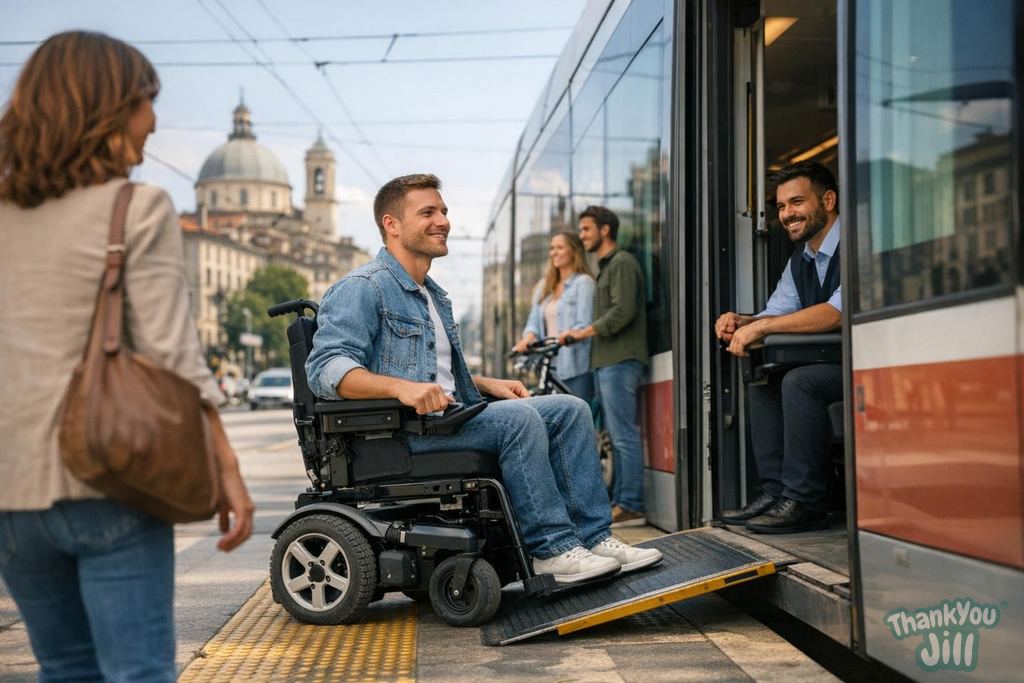
Mobility is the foundation of everything: employment, social relationships, access to healthcare, cultural participation. For people with motor, visual, or cognitive disabilities, urban mobility represents the primary barrier to social inclusion. In Italy, the regulatory framework on accessibility is relatively advanced (Law 13/1989, DM 236/1989, 2006 Guidelines on the Plan for Eliminating Architectural Barriers - PEBA), but implementation has historically been patchy, with enormous territorial differences between North and South, between major cities and small municipalities, between new infrastructure and established historic heritage.
Public Transport: The Bright and Dark Sides of Italian Accessibility
Metro and trains: metro stations built after 2000 are generally accessible (elevators, tactile pathways, audio information). But many historic stations are not. Milan metro: approximately 60-65% of stations are wheelchair accessible. Rome metro: fewer than 40% of stations have functioning elevators. Elevator maintenance is the main problem: often out of service for weeks. RFI (Italian Railway Network) has an "Accessible" program with interventions at 600+ stations, with several dozen completed each year. The "Sala Blu" assistance service (bookable 24 hours in advance) allows people with disabilities to request assistance for boarding and disembarking trains. Buses: nearly all new buses have low-floor platforms with wheelchair ramps. Bus stops are the critical issue: many lack accessible raised sidewalks at the ramp exits. The Accessible Mobility line in many cities has specific characteristics: Turin (GTT) and Milan (ATM) are the cities with the best public transport accessibility. In Southern Italy, the situation is generally more critical. Taxis and private hire vehicles: adapted taxis for wheelchairs are available in all major cities but often insufficient in number with very long wait times. The Uber Assist service (accessible vehicles on request) is available in some Italian cities. The cost of adapted taxis is often higher than standard taxis without compensatory incentives.
The Disability Code and the Delegation Act: Regulatory Change Underway
Delegation Act No. 227/2021 (approved in December 2021) launched the most significant reform of Italy's disability support system in decades. Core principles: shift from the medical approach (disability as a personal deficit) to the biopsychosocial approach of the ICF Classification (WHO's International Classification of Functioning, Disability and Health), multidimensional assessment of the person (not just medical diagnosis, but analysis of participation and environmental barriers), individualized life project (personalized based on the person's aspirations and needs, not just deficits), simplified access to benefits (reduced bureaucracy and "double assessments"). For urban mobility: the Plan for Eliminating Architectural Barriers (PEBA) becomes mandatory for all municipalities (not just optional as it is now) and must be monitored and updated periodically. The PNRR allocates significant resources to accessibility of public spaces, school buildings, and public offices (Mission 5, Component 2: inclusion and cohesion).
Apps and Digital Technologies for Accessible Mobility
Digital technologies are improving autonomous mobility for people with disabilities. Accessible maps: Google Maps indicates wheelchair accessibility for many stations and routes ("Accessibility" function in navigation options). Accuracy is still limited for pedestrian routes. Wheelmap.org: participatory map (crowd-sourcing) of accessibility of public places (restaurants, shops, museums, restrooms). Based on OpenStreetMap. In Italy it's still not well updated but grows with citizen participation. Local accessibility apps: many cities have developed dedicated apps. Florence: "Firenze Accessibile" app with maps of architectural barriers. Turin: "TO Be Accessible" app. Rome: "Roma Accessibile" app (partially updated). Voice navigation applications for the blind: Blindsquare (iOS): navigation with geolocation and voice notifications about pedestrian crossings and accessible POIs. Ariadne GPS (iOS and Android): voice navigation specific for people with visual disabilities. Online booking of assistance services: Trenitalia and Italo allow online booking of station assistance service (Sala Blu) with 24 hours' notice. Eliminates the need to call by phone. Requesting accessible taxis: official taxi apps (iTaxi, Grab) allow you to specify the need for an accessible vehicle when booking.

Being in a wheelchair in Milan is not the same as being in a wheelchair in Catania. And in both cities, it's not the same as being in a wheelchair in Amsterdam. Italy has the right laws but implementation is dramatically patchy. The PNRR and the Disability Delegation Act are the biggest opportunities for change in the last 30 years. The pressure from disability associations and citizens with disabilities is essential so that opportunity isn't lost.
How to Report Architectural Barriers: Channels and Tools
Reporting architectural barriers is the first step toward eliminating them. Who can report: anyone. You don't need to be personally disabled. Where to report: Your municipality of residence (Technical Office or Accessibility Office, if it exists). Reports can be made online through the municipality's portal (civic reporting form) or via email or certified mail to the competent office. Civic reporting apps: many municipalities have civic reporting apps (Municipia, SegnalaCI, E015): they allow you to photograph the barrier, geolocate it, and send it directly to the competent office. Trade associations: FISH (Italian Federation for Overcoming Disability), FAND (Federation of National Associations of People with Disabilities), ANFFAS, Angsa. They have legal offices that support the most relevant reports. Wheelmap.org: for barriers in public places, reporting on Wheelmap increases visibility for all platform users. Media pressure: in case of chronic and unresolved barriers, disability associations have media pressure channels that have in several cases accelerated resolution.
Examples of Good Practices in Urban Accessibility in Italy
Some Italian cities stand out for their commitment to urban accessibility. Trento: a city with one of the most comprehensive and implemented PEBAs in Italy. The Autonomous Province of Trento has systematically funded the removal of architectural barriers in public buildings and urban spaces. Turin: entirely accessible metro (all stations have functioning elevators), systematic tactile pathways, low-floor buses across the entire network. Bologna: revitalization of the historic center with universal accessibility criteria. Trieste: widespread accessibility project for tourism that mapped the entire historic center for accessibility. Matera (European Capital of Culture 2019): the municipality implemented an accessibility plan for the Sassi (one of the most "difficult" historic centers due to terrain morphology) as part of the European Capital of Culture program. An example of how even complex historic centers can become more accessible with investment and political will.
Accessible Tourism as a Driver of Change
Accessible tourism is one of the main economic drivers for improving urban accessibility. The "accessible tourism market" (people with disabilities + companions + elderly with reduced mobility) is worth approximately 80-100 billion euros annually in Europe (ENAT data, European Network for Accessible Tourism). Cities that invest in accessibility for tourism improve accessibility for all residents: an elevator in a tourist station also serves the wheelchair-using citizen. Most accessible Italian destinations for tourism: Turin, Bologna, Rome (modern center), Florence (some areas), some coastal locations with accessible beaches (Blue Flag Accessible Beaches). Accessible tourism platforms: Tourisme et Handicaps (French, excellent for France and used as a model), AccessibleGo.com, Tourism For All (UK), DisabiliTOUR (Italian). Four and five-star hotels generally have accessible rooms but with highly variable quality: it's always better to verify directly before booking the specific accessibility features (bathroom dimensions, shower type, bed height, distance between furnishings).
Frequently Asked Questions
What are the main challenges with accessibility in Italian metro stations?
Stations built after 2000 are generally accessible, but many historic stations are not. Elevator maintenance is a frequent problem, with many out of service for weeks, limiting wheelchair access especially in major cities like Rome and Milan.
How does Delegation Act No. 227/2021 affect accessible urban mobility?
The Delegation Act introduces a biopsychosocial approach to disability, makes the Plan for Eliminating Architectural Barriers (PEBA) mandatory for all municipalities, and provides for periodic monitoring, simplifying access to benefits and allocating significant resources through the PNRR to improve urban accessibility.
What apps and digital technologies can help with accessible mobility?
Apps like Google Maps with Accessibility function, Wheelmap.org, and local apps such as 'Firenze Accessibile' or 'TO Be Accessible' provide maps and information about architectural barriers. Additionally, voice navigation apps like Blindsquare and Ariadne GPS support people with visual disabilities, while Trenitalia and Italo allow online booking of assistance.
How can you effectively report architectural barriers in cities?
Anyone can report architectural barriers through their municipality of residence, using online forms, email, or civic reporting apps like Municipia or SegnalaCI. Disability associations offer legal and media support for significant reports, while platforms like Wheelmap increase the visibility of reports.

Latest News




Comments
No comments yet. Be the first!
Leave a comment