


 Italiano
 Français
 Deutsch
 Español
 Português
 Svenska
 Suomi
Suomi
Defensive Alliances
When Plants Call on Insect Allies
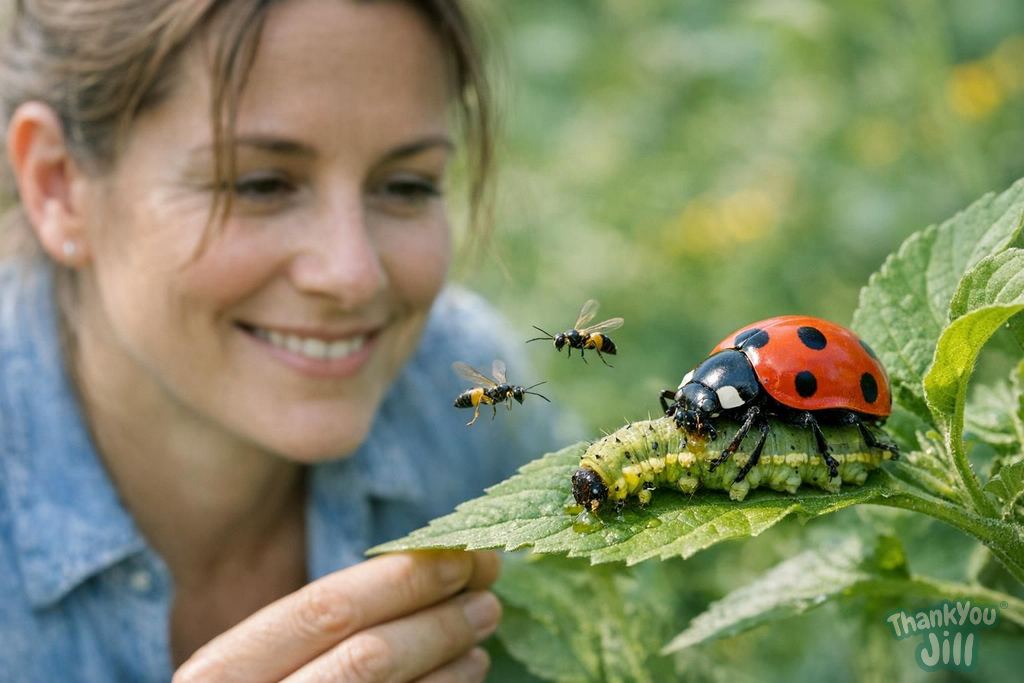
The defensive alliance between plants and predatory insects or parasitoids is one of the most sophisticated and fascinating indirect defense systems in the plant world. Rather than investing exclusively in direct defenses (toxins, spines, reinforced cell walls), some plants have evolved the ability to "call" the enemies of their enemies: an indirect bio-defense strategy mediated by precise chemical signals.
The tritrophic plant-herbivore-parasitoid system
The most studied tritrophic system (three interacting trophic levels) involves corn plants (or cotton or tomato) attacked by Lepidoptera (caterpillars) and parasitoid wasps that parasitize those caterpillars. Here's how the corn's "call for reinforcements" works: a larva of Spodoptera exigua (a noctuid Lepidopteran) begins eating corn leaves. The plant detects the mechanical damage (through mechanosensitive receptors) and the oral secretions of the larva (which contain specific elicitors like volicitin, a lipid compound in the saliva of herbivorous insects that specifically activates plant defense responses). These signals activate the synthesis of a specific bouquet of HIPV (Herbivore-Induced Plant Volatiles): a mix of sesquiterpenes (β-caryophyllene, bergamotene, farnesene), monoterpenes (linalool), and other compounds. Female Cotesia marginiventris (a parasitoid wasp microhymenopteran) recognize this bouquet as a "host signal": it indicates the presence of Spodoptera larvae on which to lay eggs. The wasp finds the larvae on the corn leaves and lays eggs on the caterpillar's body. The wasp larvae develop inside the caterpillar larva, feeding on it and killing it at the end of their development. The corn has reduced the number of caterpillars through an intermediary: the wasp. The demonstrative experiment (Turlings and Tumlinson, 1992): corn in two pots, one infested with Spodoptera, one uninfested but receiving the VOCs from the first through the air. Cotesia wasps introduced: they oriented decisively toward the infested corn (due to direct HIPV) and toward the uninfested corn that had received the VOCs (due to priming: it produced more HIPV upon subsequent stimulation). An elegant proof of the tritrophic system.
The specificity of the HIPV bouquet: the plant recognizes the herbivore
One of the most surprising aspects of the plant's "calling" system is its specificity: the VOC bouquet emitted changes based on the herbivore species attacking it, and parasitoids prefer the bouquet of their specific host. How the plant distinguishes herbivores: different herbivores produce oral secretions with different chemical compositions (different elicitors). Spodoptera exigua produces volicitin (17-hydroxy linoleic acid: a compound specific to this caterpillar). Helicoverpa zea produces other compounds. An aphid sucks sap without mechanical damage, producing different signals. The plant "reads" these elicitors and modifies the HIPV bouquet accordingly. How the parasitoid distinguishes its host: each parasitoid species has co-evolved with one or a few specific hosts and has learned to recognize the specific HIPV bouquet of its host. Cotesia glomerata (cabbage parasitoid) preferentially recognizes the bouquet of cabbage infested with Pieris brassicae (its preferred host). Cardiochiles nigriceps preferentially recognizes the bouquet of tobacco infested with Heliothis virescens (its host). Parasitoids learn: conditioning experiments show that parasitoids can learn to associate new bouquets with successful host-finding. If a parasitoid repeatedly finds its host associated with a particular bouquet, its preference for that bouquet increases. An associative learning system in insects that supports the efficiency of the plant's "calling" strategy.
Predatory mites and grapevines: a well-documented system
A particularly well-studied and practically applied tritrophic system is that of grapevines (Vitis vinifera) attacked by herbivorous mites Tetranychus urticae (red spider mite) and Panonychus ulmi, and predatory mites Phytoseiidae (especially Phytoseiulus persimilis, Neoseiulus californicus, Typhlodromus pyri). How it works in grapevines: leaves of grapevines infested with Tetranychus emit a bouquet of VOCs (mainly linalool, β-ocimene, DMNT: 4,8-dimethyl-1,3,7-nonatriene) that attracts predatory Phytoseiidae. The predatory mites follow the VOC gradient to the infested leaves, where they find and eat the herbivorous mites. The uninfested but nearby grapevine produces a different bouquet: after exposure to VOCs from the infested grapevine (priming), it produces more HIPV upon first infestation, accelerating the arrival of predators. Application in organic viticulture: biological control of phytophagous mites in viticulture through the introduction or promotion of predatory Phytoseiidae mites is an established practice in organic and integrated viticulture in Italy. Understanding the tritrophic system has allowed for its optimization: maintaining grass cover under the vines (refuge for predators), reducing pesticides that kill Phytoseiidae (particularly organophosphates and pyrethroids), and possibly releasing laboratory-reared Phytoseiidae in vineyards with high infestation. In Tuscany and Piedmont, 70-80% of organic vineyards use mite biological control as their primary management strategy.

The plant is not passive in the face of attack: it calls its own soldiers. And the soldiers arrive. This indirect defense system, co-evolved over millions of years, is far more sophisticated than any pesticide: it is specific to the herbivore, does not kill beneficial insects, and self-regulates. The challenge of future agriculture is to understand how to harness it instead of destroying it with indiscriminate chemical treatments.
Nectar-bearing flowers as refuge for parasitoids: the "bug banks" project
To fully exploit plant-insect defensive alliances, plants must not only emit the right VOCs at the right time: they must also provide resources to maintain populations of parasitoids and predators in the field when there are no herbivores. The solution: flower strips at field margins. Adult parasitoids feed on nectar and pollen (adults of Cotesia, Aphidius, Trichogramma feed on flowers: this is the energy needed for host-seeking and egg-laying). Fields without flowers → parasitoids that migrate elsewhere → no resident population when herbivores arrive. Flower strips at field margins → resident parasitoids → rapid response to herbivore arrival. The most effective flowering species for parasitoids: Phacelia tanacetifolia (phacelia): blue flowers very attractive to Braconidae and Ichneumonidae, flowers quickly (6-8 weeks from sowing). Buckwheat: white flowers with abundant nectar, attractive to many parasitoid species. Dill and fennel: umbellifers with flat, accessible flowers. Borage: rich nectar, abundant pollen. In Italy, the "Biocontrol in Buffer Strips" project (CREA and Regional authorities) has documented significant reductions in aphids and mites in cereals and vegetables with flower strips at field margins, without increasing pesticide use. The European Union's "Living Labs" project tests these combinations in real agricultural contexts in 10 European countries.
Classical biological control: importing natural alliances
Classical biological control is the deliberate introduction of non-native parasitoids or predators to control an introduced pest. It is based on the same principle as the natural tritrophic system: the natural enemy of the pest in its country of origin is imported and released in the new area. Examples of success: Aphelinus mali against the woolly apple aphid (Eriosoma lanigerum): introduced to Europe in the 1920s. Excellent control. Encarsia formosa against the whitefly (Trialeurodes vaporariorum): the most used in Italian greenhouses for vegetable crops (tomato, pepper, cucumber). Sold in sachets of pupae to be released in the greenhouse. Trichogramma spp. against Lepidopteran eggs: parasitoids of eggs of lepidopterans of various genera (Helicoverpa, Ostrinia). Used in corn and tomato. The case of the mealybug (Planococcus citri) in Sicily: the parasitoid wasp Leptomastix dactylopii (introduced in the 1970s from Brazil) is now the main biological control agent of mealybug in Sicilian citrus groves, with excellent results in farms that reduce pesticide use. Biological control in Italy: the biological control sector in Italy is worth approximately 180 million euros (2023) and grows by 15% annually. The main producing companies (Biobest, Koppert, ICB Pharma) supply parasitoids, predators, and entomopathogenic nematodes for greenhouses and open-field crops. The use of biological control is particularly advanced in greenhouses in Southern Italy (Sicily, Calabria, Campania) for vegetables exported to Northern Europe where markets require pesticide residues close to zero.
Frequently Asked Questions
How does the tritrophic plant-herbivore-parasitoid system work in plant defense?
The tritrophic system involves plants that emit chemical signals (HIPV) when attacked by herbivores, attracting specific parasitoids or predators that attack the herbivores, thus reducing plant damage in a natural and targeted way.
What is the role of flower strips in maintaining populations of beneficial insects in organic farming?
Flower strips at field margins provide nectar and pollen essential for adult parasitoids, maintaining resident populations of beneficial insects that can respond rapidly to the arrival of herbivores, improving the effectiveness of biological control.
How do plants distinguish between different herbivores to emit specific chemical signals?
Plants recognize different herbivores through their oral secretions, which contain specific chemical elicitors. These elicitors activate the production of unique VOC bouquets that attract parasitoids specialized in attacking that specific herbivore.
When is it worthwhile to use classical biological control with introduced parasitoid insects?
Classical biological control is worthwhile when an invasive pest has no local natural enemies. By importing parasitoids or predators specific to the pest from its country of origin, effective and sustainable control can be achieved, as in the case of certain crops and greenhouses.

Latest News




Comments
No comments yet. Be the first!
Leave a comment