


 Italiano
 Français
 Deutsch
 Español
 Português
 Svenska
 Suomi
Suomi
Forest Soil
The ecosystem beneath your feet
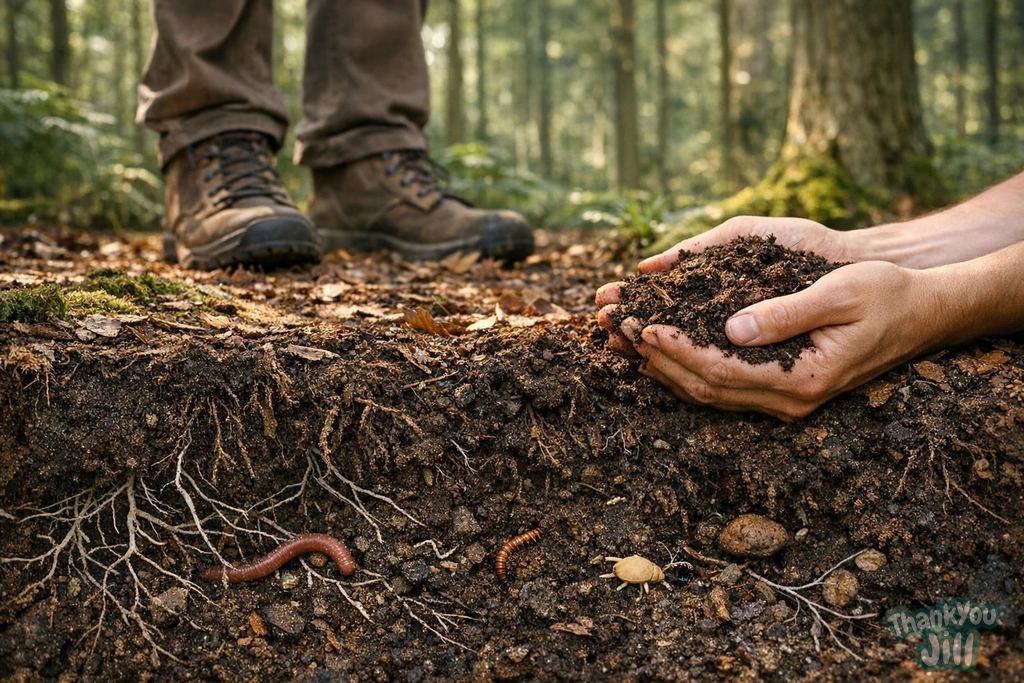
If the ocean is the great unknown of the biosphere in terms of volume, forest soil is the great unknown in terms of biodiversity. It's estimated that over 25% of all species on Earth live in soil. In a European meadow, you'll find more species in a square meter of soil than in a square meter of tropical rainforest. Soil is not inert: it's alive, dynamic, and fundamental to the functioning of every terrestrial ecosystem.
Forest soil formation: a millennia-long process
Forest soil forms slowly (one centimeter of productive soil requires tens to hundreds of years of pedogenic processes) through a combination of physical, chemical, and biological processes. Pedogenesis: the parent rock (geological substrate) is physically broken down by freeze-thaw cycles, root pressure, and abrasion, and chemically altered by acidic water (carbonic acid, organic acids from litter). The result is mineral soil. Adding the organic component: litter (fallen leaves, branches, fruits, animal droppings) is decomposed by decomposers, producing humus. Humus mixed with the mineral component forms living soil. Soil depth: in lowland forests (Po Valley, Po river valleys): 50-100 cm of productive soil, rich in humus. In alpine forests: 20-50 cm of soil, more acidic, with a powerful organic horizon. In Mediterranean forests on calcareous rock: shallow soil (10-30 cm: Mediterranean red earth), but rich in carbonates. In tropical forests on laterite (oxisols): deep soil (1-3 m) but poor in nutrients (nutrients are in the biomass, not in the soil). The soil profile: forest soil has vertical horizons with different characteristics: O horizon (organic: fresh litter + partially decomposed humus), A horizon (mineral + humus: the agronomically most fertile soil), B horizon (mineral with clay and oxide accumulation), C horizon (altered parent rock). Litter is a crucial layer: it intercepts heavy rain (prevents soil compaction), is the main site for decomposition and nutrient recycling, and hosts enormous mesofauna biodiversity.
The nutrient cycle in forest soil
The nutrient cycle in forest soil is a process tightly integrated between plants, decomposers, and the microbial community. The forest nitrogen cycle: fallen tree leaves contain organic N (in proteins). Decomposer fungi and bacteria mineralize organic N into ammonium (NH4+) and nitrate (NO3-). Roots and mycorrhizae absorb mineralized N and reincorporate it into plants. N losses through leaching (washing into deep soil) are minimal in a healthy forest: forest soil "retains" N. The forest phosphorus cycle: phosphorus is the most limiting nutrient in mature forests (nitrogen is replaced by nitrogen-fixing bacteria; phosphorus is not). Mycorrhizae are fundamental: without mycorrhizae, phosphorus in forest soil is poorly available. Mycorrhizal fungi produce phosphomonoesterase that mineralizes organic phosphorus and makes it available. The carbon cycle: litter (organic carbon) is decomposed by fungi and bacteria, releasing CO2 (heterotrophic respiration) and producing stable humus. Humus is a long-term carbon reservoir (decades to centuries of stability). Competition between fungi and bacteria: in temperate forests, decomposition is dominated by fungi (which produce more stable humus: moder humus) in acidic conifer forests, and by bacteria and earthworms (which produce mull humus: richer and more favorable for soil fauna) in calcareous broadleaf forests. This difference influences soil fertility and soil fauna biodiversity.
Earthworms: the engineers of forest soil
Earthworms are the single most important organisms for the physical structure and fertility of forest soil in temperate zones. Italian species: in Italy, the most important earthworm species for forest soil are Lumbricus terrestris (the common earthworm, the largest: up to 30 cm long), Aporrectodea caliginosa (the grey earthworm: the most abundant in lowland forests), Allolobophora chlorotica (the green earthworm: common in humid forests). Earthworm functions: ingestion and soil mixing: a single L. terrestris ingests each year an amount of soil equal to its own weight 50-100 times. The ingested soil is mixed, disaggregated, enriched with bacteria and digestive secretions, and produced as casts (droppings) with structure and composition very different from the ingested soil. Casts are rich in mineralized nutrients, bacteria, and glomalin (produced in part by fungi associated with the earthworm's intestinal canal). Burrows: earthworms dig vertical (up to 2 m deep in the case of L. terrestris) and horizontal burrows. The burrows plow the soil without destroying it, increase porosity (= better water infiltration, better aeration for roots), and provide preferential pathways for plant roots. Destruction of soil fauna: pesticides (especially insecticides), deep plowing, and soil compaction drastically reduce earthworm populations. In Italian arable lands treated with pesticides, earthworm density is often 10-20 times lower than in nearby forests. The loss of earthworms significantly reduces soil fertility.

Every time you walk in a forest, you step on a living ecosystem with billions of organisms per square meter. That soft, dark soil is the result of centuries of work by earthworms, fungi, and bacteria that have transformed fallen leaves into fertile humus. One centimeter of that soil takes 100 years to form. Deep plowing destroys it in minutes. Treating soil as an inert substrate is the main mistake of modern agriculture.
Forest soil degradation: the main threats
Forest soil is threatened by various factors, some natural and many of anthropogenic origin. Excessive trampling: excessive tourist traffic or the circulation of heavy machinery (excavators, forest tractors) in forests compacts the soil, reducing porosity, infiltration, and mesofauna biodiversity. Protected forests with regulated access (especially for off-road vehicles) maintain significantly less compacted soils. Litter removal: in some rural areas of Italy (especially historically), litter was collected as bedding for animals or as fuel. Systematic litter removal eliminates the main source of organic matter input to the soil, progressively impoverishing humus. Repeated fires: high-intensity fires can sterilize the surface soil (killing soil biota), reduce humus through combustion, and increase surface erosion (without vegetation cover and without stable humic aggregates). Nitrogen deposition from the atmosphere: acid precipitation and reactive nitrogen deposition (NOx, NH3) from vehicles and intensive agriculture are acidifying European forest soils and altering nutrient cycles. Excess nitrogen favors nitrophilic species (nettle, elderberry) at the expense of oligotrophic understory species (orchids, heaths, bilberry). Wild boar impact: wild boar populations (Sus scrofa) rapidly increasing in Italian forests (due to the reduction of natural predators and abandonment of rural areas) produce intense rooting activity that disturbs litter, exposes soil to erosion, and reduces understory herbaceous cover.
How forest soil protects against erosion and flooding
The structure of forest soil is Italy's main natural defense against hydrogeological hazards: landslides, floods, and subsidence. Italian data: Italy has one of the highest percentages of territory at hydrogeological risk in Europe: 94% of Italian municipalities have areas at risk of landslides or flooding (source: ISPRA 2022). Costs: 4-6 billion euros per year in damages from hydrogeological hazards. The role of forest soil: one hectare of forest with forest soil in good condition can infiltrate up to 200-400 mm of rain in just a few hours without surface runoff. The same hectare with bare soil (degraded, plowed, compacted) generates surface runoff even with moderate rainfall. The mechanism: macropores in forest soil (produced by earthworms, roots, fungi) allow water to infiltrate rapidly. Humus acts like a sponge: it absorbs water and releases it slowly. Tree roots physically anchor the soil, reducing surface landslides. Deforestation and hazards: historical studies show a significant correlation between 20th-century deforestation (clearing for agriculture, charcoal, and war) and increased flooding in Italy. Post-war reforestation (1950-1980: over 1 million hectares reforested by the State Forestry Corps) reduced hydrogeological risk in many areas of the peninsula. But many reforestations from that period were monocultures of conifers (black pine, larch) that now need conversion toward mixed forests that are more resilient and more effective for soil protection.
Frequently asked questions
What is the role of earthworms in forest soil fertility?
Earthworms improve soil fertility by ingesting and mixing the soil, producing nutrient-rich droppings, and creating burrows that increase porosity and aeration, promoting root growth and soil biodiversity.
How does litter removal affect forest soil health?
Litter removal eliminates the main source of organic matter that transforms into humus, progressively impoverishing the soil, reducing fertility, and compromising the cycle of nutrients essential for plants.
How does forest soil help prevent landslides and flooding?
Forest soil, thanks to macropores created by earthworms, roots, and fungi, allows rapid absorption of rainwater, while humus acts as a sponge, reducing surface runoff and stabilizing the ground against erosion and hydrogeological hazards.
What are the main anthropogenic threats that degrade forest soil?
Threats include excessive trampling that compacts soil, litter removal, pesticide use that reduces soil fauna, high-intensity fires, and excess nitrogen deposition that alters nutrient cycles and biodiversity.


Latest News




Comments
No comments yet. Be the first!
Leave a comment