


 Italiano
 Français
 Deutsch
 Español
 Português
 Svenska
 Suomi
Suomi
The Spotted Salamander
Creature of the damp forest: life, poison, and its bond with decaying logs
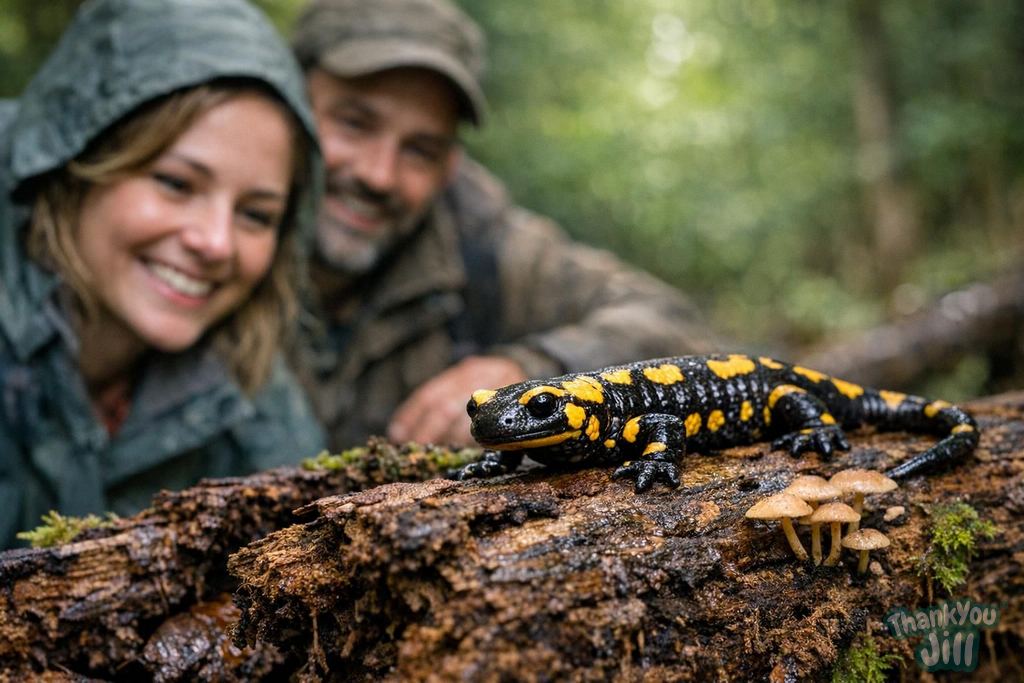
It's raining at night in a beech forest in the Apennines. The air smells of wet earth and mushrooms. Then you see something moving on the path: brilliant black and yellow, slow, almost indifferent to your presence. The spotted salamander. One of the most beautiful and least known animals in Italian wildlife — and one of the most closely tied to humid forest ecosystems.
What is the spotted salamander
The spotted salamander (Salamandra salamandra) is a caudate amphibian (persistent tail) — the same family as newts. It can reach 20-23 cm in length. Its coat is unmistakable: glossy black with irregular yellow patches (sometimes almost orange in alpine populations) arranged in a way that's always unique — no two salamanders have the same markings, like human fingerprints. The coloration is aposematic: it warns predators that the animal is toxic. The salamander's skin secretes through specialized glands on its back and neck a mixture of toxic alkaloids (samandarin, samandaridine) that cause muscle cramps, convulsions, and at high doses can be lethal to small mammals and birds. For humans they are strongly irritating to mucous membranes (eyes, mouth) but rarely dangerous. Don't touch your eyes or mouth after handling a salamander — it's best to wash your hands.
Life in the humid forest: the bond with decaying logs
The spotted salamander is an exclusive inhabitant of humid forest environments — broadleaf woods (beech, oak, hornbeam, chestnut) at medium to high altitude (300-1,800 m) with abundant damp leaf litter, decaying logs, and springs or streams. It cannot tolerate dryness: its permeable skin loses water rapidly and requires constant moisture for survival. Decaying logs are fundamental to its ecology: it uses them as daytime shelter (hiding under loose bark, in damp cavities of decomposing wood), as hibernation sites (it enters buried logs in autumn), and as hunting grounds (in summer it finds larvae, earthworms, and slugs in the humus around decomposing logs). A forest without dead wood is a forest without salamanders — and conversely, the presence of salamanders indicates a forest with abundant damp organic substrate and good forest microclimate. It is an excellent bioindicator of the ecological quality of the forest.
An almost exclusively nocturnal life and an almost exclusively rain-dependent emergence
The spotted salamander is an almost exclusively nocturnal animal. By day it remains hidden; it emerges after sunset to hunt. But the most fascinating characteristic of its activity patterns is its dependence on rain: in dry conditions, even at night, it stays hidden. It actively emerges only when the temperature is mild (8-18°C) and the soil is wet from rain. On rainy summer or autumn nights, it can be visible in abundance on forest paths — a silent procession of black and yellow forms crossing the mud illuminated by your flashlight. This behavior is called rain emergence and is common to many amphibians in the temperate zone.
Reproduction: ovoviviparous and without aquatic stages in the adult stage
Unlike frogs and newts, the spotted salamander does not lay eggs in water. It is ovoviviparous (or viviparous in the alpine subspecies, S. s. salamandra var. alpina): the female carries embryos inside her body for 8-12 months, until the larvae have reached a stage advanced enough to survive in water. The larvae (10-40 per birth depending on the subspecies) are then deposited in clear, cold streams or springs where they develop for 3-6 months before metamorphosis. The alpine subspecies (S. s. salamandra var. alpina) is completely viviparous: it gives birth directly to small salamanders already metamorphosed, without the aquatic larval stage — an extreme adaptation for survival in mountain environments with few available water bodies.

The salamander emerges only when it rains. It doesn't struggle against its environment: it moves when conditions are perfect for it and hides when they're not. It's a wisdom that its species has refined over 160 million years. We call it slowness. They call it survival.
How to encounter the spotted salamander without disturbing it
- Search on rainy nights in September-October: rainy evenings of late summer and autumn in beech and chestnut forests are the best time to observe the spotted salamander. With a headlamp, walk slowly on the paths of the humid forest. In the right places (forests above 500 m with streams and abundant leaf litter), you can encounter 10-20 salamanders in a single hour-long outing.
- Don't collect them with bare hands: the salamander's skin toxins irritate mucous membranes. Observe it without touching it. If you want to move it off the path (to prevent it from being stepped on), use nitrile gloves or pick up leaves to move it without direct contact.
- Don't use UV lamps: flashlights with UV (ultraviolet) light used for scorpion hunting are harmful to amphibians — UV light damages permeable skin. Use only white or red lights for observing nocturnal amphibians.
- Protection of the humid forest: the salamander is an excellent indicator of the health of the humid forest. If you find it in abundance, the forest still has enough damp leaf litter, decaying logs, and cool microclimate — all characteristics that should be protected. Report its presence to local naturalist associations or on iNaturalist.
- With children — the lesson of colored poison: show children a photograph of the salamander and ask: why is it so colorful? Explain aposematism — color as a danger signal. Then play a game: find other colorful animals that use aposematism (ladybug, wasp, tropical poison dart frog, pufferfish). Create together a "catalog of animals with the red warning label" — animals that use color to say "don't eat me".
- Preserve decaying logs in the forest: whenever you can, defend dead wood in forests. Fallen and decomposing logs that many would want to remove for "tidiness" are the primary habitat not only for the salamander but for dozens of vertebrate species and hundreds of invertebrates. A forest with abundant dead wood is a forest alive in the most complete sense of the term.
The spotted salamander is one of the most beautiful animals in Italy, and one of the least known. It emerges only at night, only when it rains, only in humid and well-preserved forests. It doesn't ask for much: only that we leave the fallen logs standing, that we don't dry out the streams, that we don't cut the forest down to the last meter. An animal so ancient and so beautiful deserves that we leave it its corner of wet forest.
Frequently Asked Questions
What is the role of decaying logs in the life of the spotted salamander?
Decaying logs are fundamental to the spotted salamander as daytime shelter, hibernation sites, and hunting grounds. They provide moisture and protection, hosting insects and larvae on which it feeds, and indicate a healthy and humid forest ecosystem.
How can you tell if a spotted salamander is toxic and what precautions should you take?
The spotted salamander is toxic thanks to skin secretions of alkaloids that irritate mucous membranes and can cause cramps. It's important not to touch your eyes or mouth after handling it and to wash your hands. It's best to avoid direct contact or use gloves.
When and under what conditions is it most likely to observe the spotted salamander in nature?
The spotted salamander emerges almost exclusively at night and only during rain, with temperatures between 8 and 18°C. Rainy nights of late summer and autumn in humid broadleaf forests are the best time to observe it.
What are the differences in reproduction of the spotted salamander compared to other amphibians?
The spotted salamander is ovoviviparous or viviparous (alpine subspecies), carrying embryos internally for months. The larvae are then deposited in water to develop, or are born already metamorphosed in the alpine subspecies, avoiding the aquatic larval stage typical of other amphibians.
Latest News


Comments
No comments yet. Be the first!
Leave a comment