


 Italiano
 Français
 Deutsch
 Español
 Português
 Svenska
 Suomi
Suomi
Bioluminescence in the Forest
Glowing fungi and magical insects: the light of nocturnal life
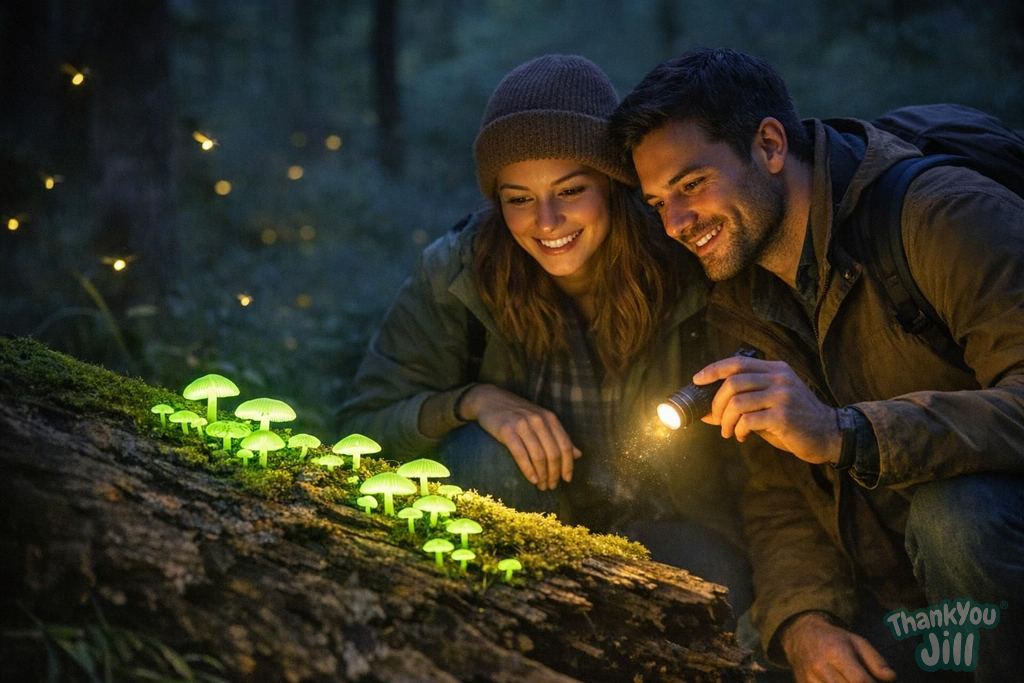
Imagine walking through a forest at night and seeing the ground glow. Not from a flashlight, not from the moon — a diffuse, blue-green, almost spectral light rising from a rotting log on the forest floor. You're not dreaming. You're witnessing bioluminescence — one of nature's oldest and most mysterious biological phenomena.
What is bioluminescence and how does it work
Bioluminescence is the production and emission of light by a living organism through a chemical reaction. The fundamental mechanism is nearly universal: an enzyme called luciferase catalyzes the oxidation of a substrate called luciferin in the presence of oxygen, producing an excited compound that releases energy in the form of visible light photons. The reaction produces no heat (it's "cold" bioluminescence), is nearly 100% efficient at converting chemical energy into light (by comparison, a traditional lightbulb converts only 5-10% to light, the rest becomes heat), and works even at temperatures near freezing. Bioluminescence has evolved independently at least 40-50 times across different branches of the evolutionary tree — in marine organisms (plankton, deep-sea fish, mollusks), insects (fireflies, click beetles), fungi, worms, and a few other terrestrial groups. Its function varies: attracting prey, communicating with members of the same species (fireflies), deterring predators, or simply as a byproduct of metabolism (as in bioluminescent fungi).
Bioluminescent fungi in Italy: wood that glows
Several bioluminescent fungal species live in Italy, though the phenomenon is not common and requires specific conditions to observe. The most well-known species is Mycena chlorophos — found in Europe, though intense bioluminescence is more characteristic of tropical species. More easily observable in Italy is the phenomenon of mycelial bioluminescence in decaying wood: beech, oak, and chestnut wood colonized by certain decomposer fungi (particularly Panellus stipticus and some Omphalotus species) emits a faint blue-green light on dark nights. The olive fungus (Omphalotus olearius), common in Italy on olive, oak, and chestnut stumps, has gills that emit extremely faint light in complete darkness. Armillaria (honey fungus), one of the most common fungi in Italian forests, has a bioluminescent mycelium that colonizes dead wood — on particularly dark and humid nights, the roots and colonized trunks glow with an eerie, faint light. To see it, you need: absolute darkness (no moon, no artificial light), high humidity, actively decomposing colonized wood, and at least 20-30 minutes for your eyes to adapt to darkness.
Fireflies: bioluminescence in insects
Fireflies (Lampyris noctiluca and Luciola italica in Italy) are the forest's most famous and most visible bioluminescent organisms. Males fly while producing flashes of yellow-green light (at 550-570 nm) with a species-specific flashing rhythm: each species has its own signal code, allowing females to recognize males of their own species. Females (of Lampyris) are wingless and remain on grass, flashing in response to males. The light organ is located on the ventral side of the last abdominal segments: it's a highly vascularized tissue rich in luciferin, luciferase, and myoglobin that supplies oxygen to the reaction. Nervous control of the flashing is precise to the millisecond. Fireflies are in steep decline across Europe (estimated: -75% in 30 years) due to loss of wet habitats (meadows, hedgerows, damp forest edges), light pollution (which interferes with flashing signals), and insecticide use. In Italy, they can still be seen in damp hillside meadows and at the edges of deciduous forests from June to July.
Glowing worms: an almost unknown phenomenon
Some species of springtails (microscopic soil arthropods) and millipedes emit faint bioluminescence when disturbed. The phenomenon is extremely difficult to observe due to the organisms' small size, but it's documented in forest soils rich in decomposing organic matter. Much more visible, in some areas of the Alps and humid Apennines, are the bioluminescent larvae of click beetles (Elateridae), small beetles whose larvae live in soil and decaying wood, emitting yellow-green light probably used as a deterrent against nocturnal predators.
Observing bioluminescence: a practical guide
To increase your chances of observing fungal bioluminescence in Italian forests: look for decaying beech or oak wood with obvious fungal colonization (fallen logs with visible white mycelium between bark and wood). The best season is September-October, after periods of heavy rain. Go into the forest on a new moon night (complete darkness). Keep your eyes covered or closed for 30 minutes before starting observation — the time needed for your retinal rods to fully adapt to darkness. Then approach the decaying wood you identified during the day and observe patiently. The light is extremely faint — like the glow of an old analog alarm clock — and requires fully dark-adapted eyes.

There's a rotting log in a beech forest in the Apennines that glows in the darkness of a moonless night. It doesn't know it's beautiful. It's simply decomposing, with mycelium at work, and that chemical reaction releases light as a byproduct. The purest beauty is that which doesn't know it is beautiful.
How to observe fireflies and bioluminescence: a practical guide for families
- When and where to look for fireflies: firefly season in Italy runs from late May to July, peaking in June in hilly areas. Look for damp meadows at forest edges, tall hedgerows, canal and stream banks with thick vegetation — not rarely mowed meadows or cultivated fields. Fireflies appear 20-30 minutes after sunset and fly for 1-2 hours.
- Reduce light pollution during observation: turn off flashlights, move away from street lights, let your eyes adjust. Male fireflies fly in a characteristic way — soft curves through the air, with regular, rhythmic flashes. Females on the grass flash in response. If you're lucky, you'll see the exchange of signals between male and female.
- Photograph fireflies: to photograph firefly flights use "bulb" mode or a 15-30 second timer on a fixed tripod, with open aperture (f/2.8 or f/4) and medium-high ISO (800-1600). The result is trails of green light in the forest darkness — one of the most accessible and beautiful nature photographs possible with any camera.
- With children — the firefly code: explain to children that each firefly species has its own "Morse code" of flashes. With a small flashlight, imitating the male's flashing rhythm (flash every 5-6 seconds for Luciola italica), sometimes females will respond. It's an experience of direct biological communication that no child forgets.
- Protecting fireflies in your garden: keep at least one area of unmowed grass, don't use insecticides during June-July, turn off outdoor garden lights on peak nights (in June) — light pollution is the factor that most disrupts firefly mating signals and reduces reproductive success.
- Glowing wood in the forest: if you want to try seeing fungal bioluminescence, plan a nighttime outing in a beech forest in the Apennines in October, after a week of rain. Identify fallen logs with obvious white mycelium during the day. Return at night in total darkness, wait 30 minutes with eyes closed, then observe. The probability isn't high, but when you see it, it's an experience that stays with you forever.
Bioluminescence is one of those phenomena that reminds us that life is far stranger and more beautiful than it seems in sunlight. A glowing log, a firefly speaking in flashes of light, a larva warning predators with its luminous body — every time you see it, for a moment you understand that you're inside something far greater and older than yourself.
Frequently asked questions
What conditions are necessary to observe fungal bioluminescence in forests?
To see fungal bioluminescence you need absolute darkness (moonless night with no artificial light), high humidity, decaying wood colonized by active fungi, and at least 20-30 minutes for your eyes to adapt to darkness. The emitted light is very faint and requires patience.
How does the chemical reaction underlying bioluminescence work?
Bioluminescence is based on the enzyme luciferase, which catalyzes the oxidation of luciferin in the presence of oxygen, producing visible light without heat. This reaction is nearly 100% efficient at converting chemical energy into light, unlike traditional lightbulbs.
How to recognize and observe fireflies during summer season?
Fireflies are found in damp meadows and forest edges from late May to July. Males fly while emitting regular flashes of yellow-green light, while females respond by flashing from the ground. It's important to reduce light pollution and let your eyes adapt to darkness for better observation.
What is the evolutionary role of bioluminescence in insects and fungi?
In insects like fireflies, bioluminescence serves to communicate and attract mates with coded light signals. In fungi, it can be a byproduct of metabolism or serve as a deterrent to predators, with different functions depending on the species and environment.
Latest News



Comments
No comments yet. Be the first!
Leave a comment