


 Italiano
 Français
 Deutsch
 Español
 Português
 Svenska
 Suomi
Suomi
Deforestation Through History
From the Ancient Mediterranean to Modern Forests: Three Thousand Years of Loss
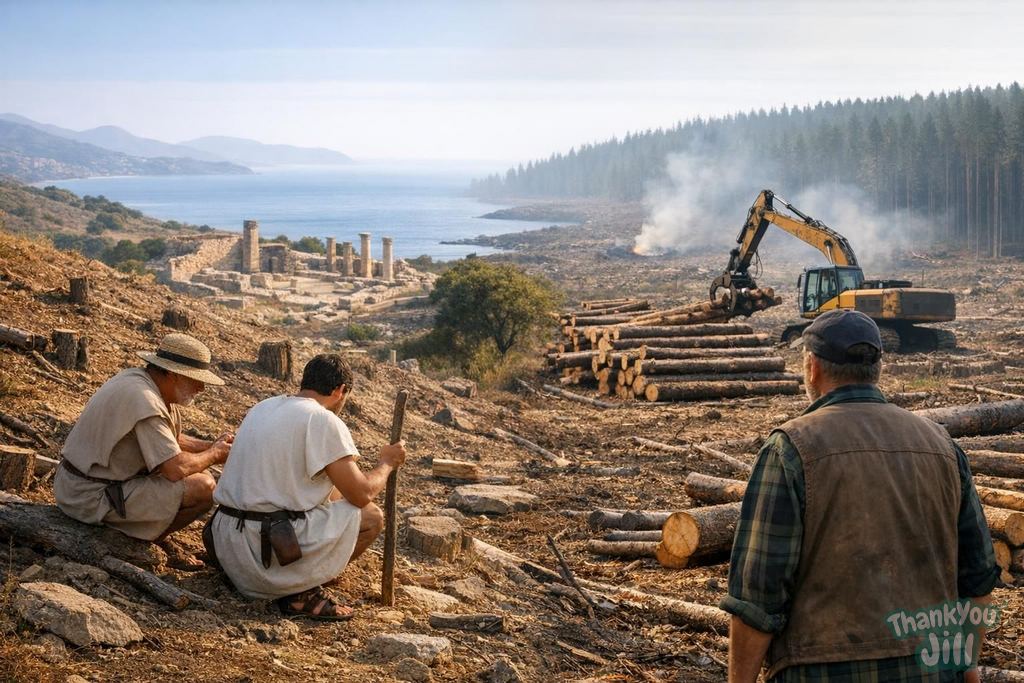
Plato, in the Critias, described the Attica of his time — the Attic peninsula around Athens in the fourth century B.C. — as an arid, rocky land where once there had been rich forests and fertile soil. The mountains were wooded, and the plains were full of fertile earth... Now only the skeleton of the diseased territory remains, like the body of a wasted man. This is probably the first documented description of deforestation and soil degradation in Western history. And Plato was right: the ancient Mediterranean was far more forested than it is today.
The Mediterranean Before Civilization: A Sea of Forests
Before 3000 B.C., the entire Mediterranean basin was covered by a dense band of forest vegetation. Lebanon had its cedars, Greece had its beeches and oaks, the Italian peninsula was almost entirely wooded, and North Africa — now largely desert — had forests of cedars and oaks where sand now reigns. Pollen analysis of lake and marine sediments documents this original vegetation cover with great precision. Deforestation began with Neolithic agriculture (10,000–8,000 B.C.) and accelerated progressively with urbanization, shipbuilding, and intensive agriculture under the great Bronze Age civilizations. By Homer's time (eighth century B.C.), large areas of Greece were already deforested. By Caesar's time (first century B.C.), the Italian peninsula had already lost much of its lowland and hill forests.
Rome and the Clearing of Italy
The expansion of Republican and Imperial Rome was accompanied by massive deforestation of the Italian peninsula. The main causes were agricultural expansion (the Romanization of Italy meant transforming vast forested areas into ager romanus — cultivated land), the construction of villas, roads, aqueducts, and cities (the demand for building timber was enormous), the production of charcoal for metallurgy and heating, shipbuilding (already discussed), and lime production (each lime kiln required enormous quantities of wood). The central and southern Apennines, Sicily, Sardinia, and Calabria were the hardest hit. Strabo, Theophrastus, and other ancient writers document this process indirectly through their geographical descriptions, which show territories already heavily deforested compared to earlier sources.
Medieval and Modern Deforestation
The process continued in the Middle Ages, with agricultural expansion in the eleventh to thirteenth centuries — the European medieval "Great Clearing" — which destroyed much of the remaining European forest to create new farmland. In Italy, the Roman countryside, the Po Valley plains, and the Tuscan hills lost almost all their forest cover between the tenth and thirteenth centuries. The process accelerated further in the nineteenth century with industrialization. In the 1860s–1880s, the newly formed Italian nation imported from France the concepts of reforestation and forest hydrogeology — the science showing the link between mountain deforestation and downstream flooding. Italy's first forestry laws (Royal Decree 3267/1923, the fascist "Forest Code") imposed reforestation requirements precisely to counter the hydrogeological damage of historical deforestation.
The Good News: Italy's Spontaneous Reforestation
One of Italy's most positive environmental transformations in the twentieth century was nearly invisible: the abandonment of mountain farmland, which triggered spontaneous forest recovery across millions of hectares of abandoned agricultural land. Since the end of World War II, Italy's forest area has increased by roughly 40–50% — from 5.8 million hectares in 1946 to over 11 million hectares today. This spontaneous reforestation has lower ecological quality than prehistoric primary forests (less species diversity, simpler structure), but it still represents an extraordinary reversal of historical trends, unique in Europe.

The Mediterranean was covered in forests, and we cleared them to build civilization. Then we understood our mistake, and the forests came back — not as they were, but they came back. The story of deforestation is also a story of possible recovery. Not everything that breaks stays broken forever.
How to Understand Your Area's Forest History
- Compare historical maps: Historical topographic maps from the Italian Military Geographic Institute (IGM) from the late 1800s show the vegetation cover of that era. By comparing those maps with current satellite imagery, you can clearly see where forests have increased (spontaneous reforestation of abandoned farmland) and where they've decreased (urbanization, infrastructure). Historical IGM maps are available online for free.
- Read the stones: erosion as a clue: Badlands — the characteristic clay erosion formations of the Tuscan, Marche, and Calabrian hills — are largely the result of historical deforestation. A forested area doesn't produce badlands: tree roots hold the soil in place. Badlands are the geological signature of past forest abandonment. Recognizing them in your area is a way of reading your territory's environmental history.
- Study local dendrochronology: Dendrochronological dating of the oldest trees in local forests helps you understand when an area was recolonized by forest. A 150-year-old beech in an area that was pasture in the 1800s tells the story of twentieth-century spontaneous reforestation. Many Italian universities with forestry departments offer local dendrochronological data.
- With children — before and after: Show children a historical photograph (from a vintage postcard or local archives) of a landscape in your area, then a current photograph of the same place. Often you'll see forest that has returned where there were once bare fields or pastures. Visual comparison makes the concept of landscape change over time immediately understandable.
- Participate in a reforestation project: Various Italian organizations (Legambiente, WWF, LAV, local groups) organize planting days in degraded areas or fire-affected zones. Participating with your family is a concrete act in Italy's long forest recovery process.
Mediterranean deforestation is not irreversible. Forests have returned where we stopped cutting them — slowly, spontaneously, but they've returned. The process takes centuries, not decades. But every tree planted today is an investment in a future forest that someone — fifty years from now, a hundred years from now — will walk through just as we walk today through the beech forests of the Apennines. It's the longest promise we can make.
Frequently Asked Questions
What were the main causes of deforestation in the ancient Mediterranean?
Deforestation in the ancient Mediterranean was caused mainly by Neolithic agriculture, urban expansion, shipbuilding, and charcoal production, which led to the progressive loss of original forests to make room for farmland, cities, and infrastructure.
How can you understand a territory's forest history today?
To understand a territory's forest history, you can compare historical maps with current satellite imagery, study soil erosion like badlands, analyze dendrochronological data from the oldest trees, and observe visual changes through historical and current photographs.
When is it worthwhile to promote spontaneous reforestation over artificial reforestation?
Spontaneous reforestation is worthwhile when agricultural or mountain areas are abandoned, allowing vegetation to recover naturally at reduced cost, even though biodiversity is lower than in primary forests, still representing important environmental recovery.
How long does forest recovery take after historical deforestation?
Forest recovery after historical deforestation takes centuries, not decades. Regrowth is slow and spontaneous, but every tree planted today is an investment in a future forest that will be appreciated by generations to come.
Latest News



Comments
No comments yet. Be the first!
Leave a comment