


 Italiano
 Français
 Deutsch
 Español
 Português
 Svenska
 Suomi
Suomi
Planting a Tree
The right time, the right place, and the correct method to make it last
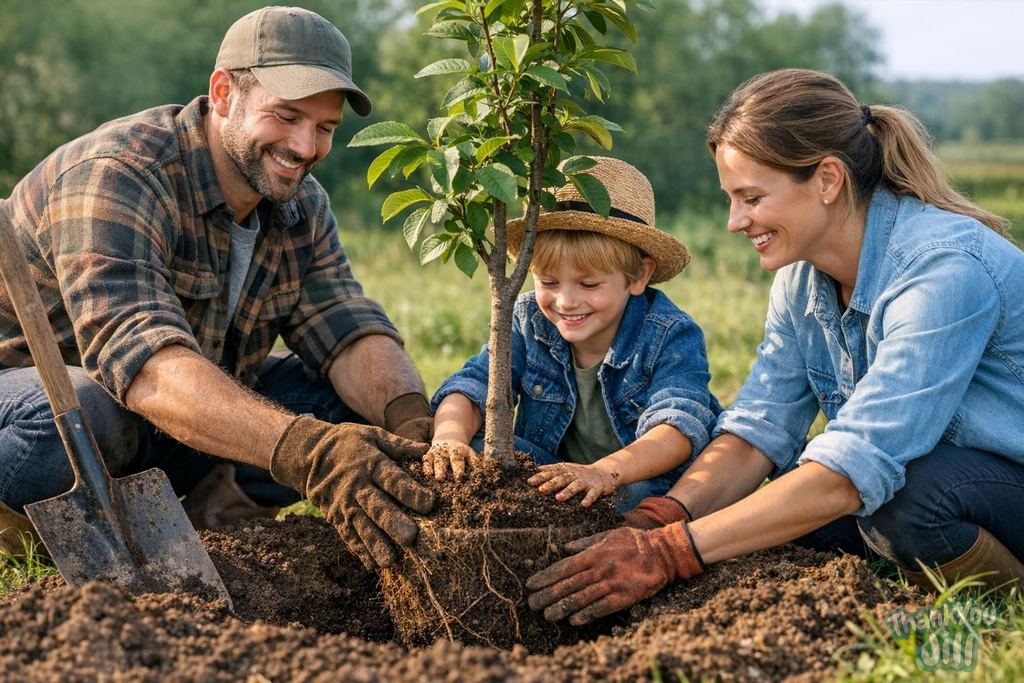
Planting a tree is one of the most optimistic acts a human being can perform. A seed that will become a magnificent specimen in 30 years — when perhaps you won't be around to see it. Yet it's worth doing. It's worth doing well. Because a poorly planted tree dies within three years, and that optimistic gesture becomes a waste. So: how do you plant a tree the right way?
When to plant: timing is essential
The best time to plant a tree is during the dormant season, when the tree has no leaves and its metabolism is at a minimum. In Italy, this corresponds to the months of November through March for deciduous broadleaf trees (oaks, beeches, cherry trees, lindens, maples). Transplanting during this period causes minimal stress: the tree doesn't need to support leaf transpiration, and the cut roots have time to callus over before the active growing season begins. For evergreens (holm oak, olive, Mediterranean shrubs), the ideal period is September-October or March-April — before summer drought sets in or before severe winter frosts. Absolutely avoid planting in the height of summer (heat and drought stress) or during severe frosts (cut roots freeze easily). The traditional gardener's rule: plant when the leaves have fallen and haven't yet sprouted. For container-grown trees (with root ball), the window is wider — you can plant almost year-round if you ensure adequate watering.
How to choose the right species for the right place
Choosing the species is the most important decision. A tree planted in the wrong species for that location will suffer, grow poorly, become diseased, and likely die within a few years. Before choosing, consider: Local climate: minimum winter temperature (each species has its frost resistance threshold), summer rainfall, humidity. Exposure: sunny, shaded, windy, sheltered. Soil: pH (acidic or alkaline), drainage (clay that waterloggs or sandy that drains too quickly), depth. Available space: how much space does the trunk and canopy need as an adult? A mature holm oak takes up 10 meters of diameter; a century-old oak 20 meters. Don't plant large species under power lines, near foundations, or under gutters. Desired function: summer shade (choose deciduous broadleaves), windbreak (evergreen conifers), fruit (fruit trees), flowering (cherry trees, lindens), wildlife attraction (rowan, hawthorn). Choose native species from your region when possible: they adapt better, support more local wildlife, and require less maintenance.
Preparing the planting hole: the most critical step
The hole is the foundation of success. A hole that's too small forces the roots into confined space — the tree grows slowly and poorly. The correct hole should be 2-3 times wider than the root ball or soil mass of the purchased plant, and as deep as the root ball — no deeper (the tree shouldn't be planted too deep: the collar must remain at soil level or slightly above). Prepare the hole: dig with a spade, loosen the walls with a garden fork (promotes root penetration), remove any large stones. If the soil is very clayey, add coarse sand and mature compost to improve drainage. If it's very sandy, add compost and clay to improve water retention. Mix the excavated soil with 20-30% mature compost — this mixture will be used to backfill after planting.
The transplanting moment
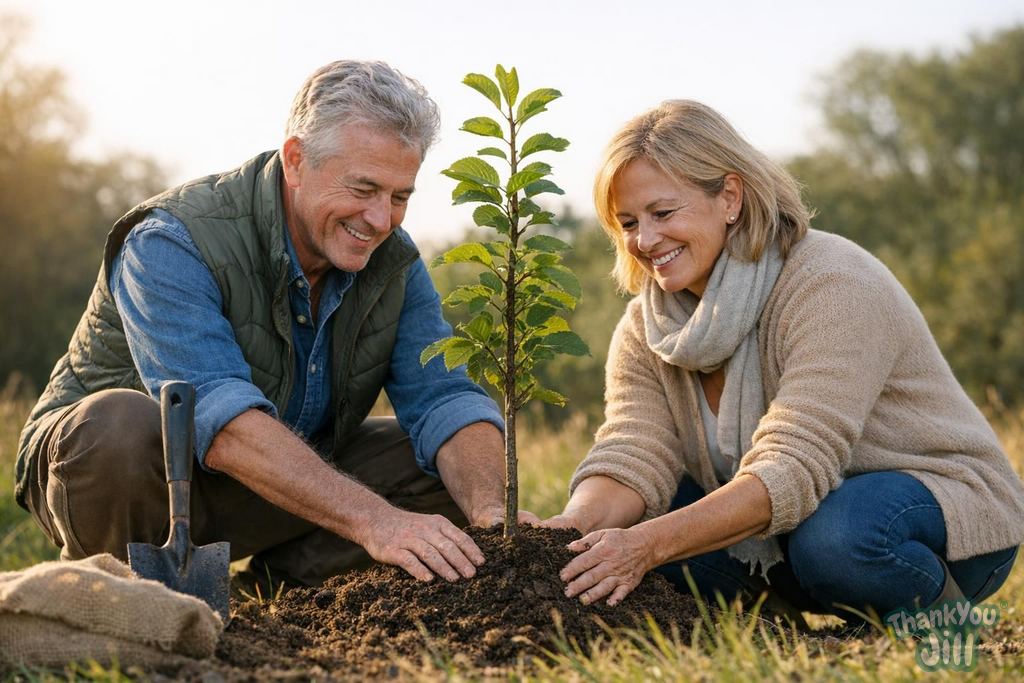
Bring the plant close to the hole. If it's bare-root (purchased dormant without a soil ball), remove any broken or rotted roots with a clean cut. Don't leave the roots exposed to air longer than necessary — keep them wrapped in a damp cloth until transplanting. Place the plant in the hole, holding it vertically. Check that the collar (the transition zone between trunk and roots) is at soil level or 2-3 cm above — not below. Fill the hole with the soil and compost mixture, firming progressively to eliminate air pockets. Create an irrigation basin: a ridge of soil around the diameter of the hole to retain irrigation water. Water abundantly immediately after transplanting (20-30 liters).

Planting a tree well is an act of love for the future. Not your future — that of someone who will come after you. If you do it right, your tree will grow for decades after you've forgotten you planted it. If you do it wrong, it will die before you notice. It's worth doing with care.
Care in the first three years: the critical period
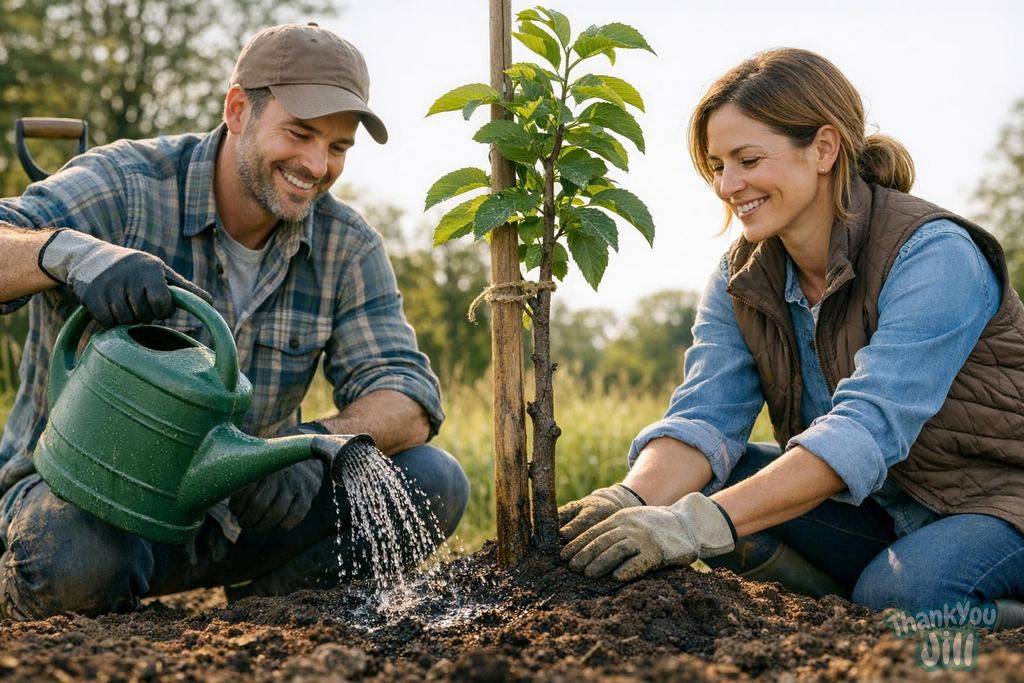
- Watering in the first year: this is the most important care. A newly planted tree doesn't yet have the deep roots that allow it to survive without watering. During dry months (May-September), water every 7-10 days with 20-30 liters of water at a time — better abundant and infrequent than sparse and frequent. Stop watering in autumn when rains resume.
- Mulching: cover the soil around the trunk with a layer of 8-10 cm of shredded bark, compost, or straw, in a circle the diameter of the canopy. Mulching reduces evaporation, keeps the soil cool, prevents competing weeds from growing, and gradually improves soil structure. It shouldn't touch the trunk (leave 10 cm of distance).
- Staking: for trees with trunks taller than 1.5 meters, install a stake (wooden or bamboo pole 2 meters long) next to the trunk, securing it with elastic ties (not wire that cuts into bark). The stake protects the tree from wind before the root system is established. Remove it after 2-3 years when the roots can support the tree on their own.
- Don't fertilize in the first year: contrary to intuition, excessive fertilizing in the first year stresses the tree. Wait until the second year for any compost or slow-release fertilizer applications.
- With children — the planting ceremony: turn planting a tree into a memorable event for children. Dig the hole together, insert the plant together, water together. Give the tree a name. Photograph it on planting day and then every year. In 10 years, the child will have a photo album of how "their tree" grew. It's one of the most lasting educational gifts you can give.
Every correctly planted tree is an investment that compounds for decades. A holm oak planted today will return shade, oxygen, habitat for animals, absorbed CO2 for the next 200 years. In terms of return on investment, nothing is comparable. It costs just a few euros, a few hours of work, and three years of watering. The rest it does itself.
Frequently Asked Questions
What is the best time to plant a bare-root tree and why?
The best time is during the dormant season, when the tree has no leaves and its metabolism is at a minimum, typically between November and March for deciduous broadleaf trees. This reduces stress and allows the roots to callus over before active growth begins.
How do you choose the most suitable tree species based on climate and soil?
Evaluate the minimum winter temperature, summer rainfall, humidity, sun exposure, and soil type (pH, drainage, depth). Choose native species for better adaptability and lower maintenance needs, avoiding species that are too large for the available space.
How much does hole preparation impact the survival of a planted tree?
The hole should be 2-3 times wider than the root ball and the same depth to avoid root constriction. Preparing the soil with compost and soil amendments promotes drainage and water retention, significantly increasing the chances of healthy growth.
How do you manage watering and care in the first three years after planting?
Water abundantly every 7-10 days during dry months with 20-30 liters of water, use mulch to maintain moisture, and protect the tree with a stake if it's taller than 1.5 meters. Avoid fertilizing in the first year to avoid stressing the plant.
Latest News


Comments
No comments yet. Be the first!
Leave a comment